
Automotive · Deep Dive · Updated April 2026
Most Expensive Supercars Ever Built: The $28M Rolls, the $18.7M Bugatti, and the Arms Race Nobody Asked For
Forty years of supercar escalation compressed into six machines. What the price tags actually buy, what they don’t, and why the most expensive new car ever made — a Rolls-Royce with a champagne fridge in the trunk — isn’t even trying to be fast.
Twenty-eight million dollars. For a car.
Not a yacht. Not a Monet. A car. One that seats four, tops out around 155 mph — they don’t publish a number, because frankly that’s not the point — and comes with a set of his-and-hers Swiss watches built into the dashboard. The Rolls-Royce Boat Tail, revealed in 2021, is the most expensive new car ever sold. Three were made. Each one cost around $28,000,000. Reported across Reuters, CNBC, Carscoops. Rolls-Royce has not officially confirmed the price, citing client privacy.
Here’s what I want to figure out — not a ranked listicle (God, those are everywhere). What I want to understand is the mechanism. Why does a car cost $18 million instead of $3 million? What actually justifies the extra $15 million? And who are the people buying them, and what does that tell us about the market built up around their wallets?
I’ve spent twelve years writing about luxury goods. I’ve seen some nonsense. But this market, genuinely, fascinates me. Because it’s not crazy — it’s operating by its own completely rational logic. It just happens to be a logic that costs more than most people’s neighborhoods.
How we got here: the $100K ceiling that shattered
In 1992, a McLaren F1 cost around £540,000 new. Wild money. Practically alien money for a road car. Sixty-four units produced, naturally aspirated 6.1-liter V12 from BMW, 627 horsepower — the fastest production car in the world until 2005. You know what one sold for at auction in 2021? $20.5M. RM Sotheby’s, August 2021 — Monterey sale, chassis #63
That’s the proof of concept for an entire investment thesis: extreme exclusivity + engineering genius + time = absurd secondary market appreciation. Every manufacturer building a $5 million car today is banking — literally banking — on that thesis repeating itself. The question I keep coming back to is whether it actually will. Because the F1 wasn’t designed to appreciate. It was designed to be the best driver’s car ever made. These new cars are designed, from day one, to appreciate. And that changes everything about the math.
The fastest road car in the world for 13 years. Built to be driven. No thought given to appreciation. Sold at auction for $20.5M in 2021.
Right idea, wrong decade. Got the rarity logic right. Was ahead of the ultra-luxury arms race by ten years and got forgotten anyway.
Established that coachbuilt one-off uniqueness commanded an order-of-magnitude premium over production Rolls. The template for everything after.
One unit. Commissioned privately. Never driven in public. Transported on a truck. This is the ownership experience, not a failure of it.
Current record. Three units. Four-year build per car. 1,813 new parts created. 563 horsepower — less than a Corvette Z06. Still the most expensive new car ever sold.
The six machines that define the ceiling
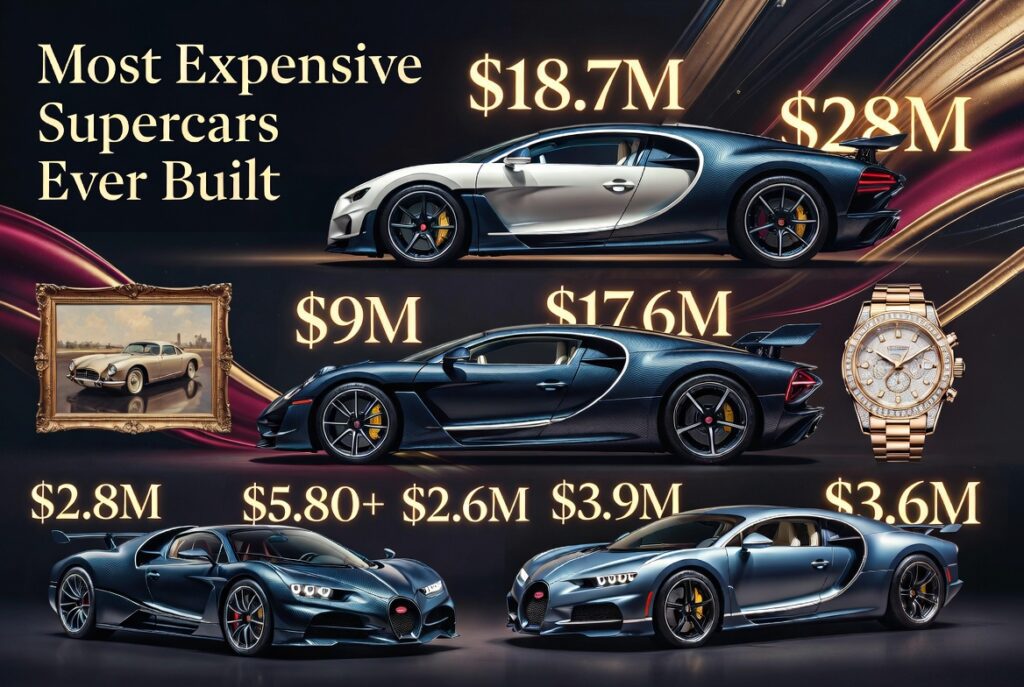
Here’s the honest price ladder for new production — or near-production — cars. Not collector classics. Not a Ferrari 250 GTO at $50M auction (different category entirely). These are cars someone could have, at some point, commissioned or ordered new.
Price ranking — new / near-new commissions only
The thing that jumps out: the Boat Tail is fifty percent more expensive than the second car on this list. And it has 563 horsepower — Phantom levels. The Bugatti La Voiture Noire makes 1,500 horsepower and costs $9 million less. What does that gap tell you?
It tells you that at the top of this market, speed is basically irrelevant as a price driver. Once you’ve crossed about $5 million, you’re no longer buying machinery. You’re buying a negotiation between you and the manufacturer — a document written in carbon fiber and bespoke leather that says: we made this specifically for you, and we will never make another one.
- 563hp / Twin-turbo V12
- 3 units built (2021)
- 4-year build per unit
- 1,813 new parts created
- Client pearl shell in paint & dash
- Champagne fridge in rear deck
- 1,500hp / Quad-turbo W16
- 1 unit ever built (delivered 2021)
- 0–60 in ~2.5 seconds
- Top speed: 261 mph
- Never publicly driven
- Homage to Type 57SC Atlantic
- 789hp / Mercedes-AMG 7.3L V12
- 3 units built (2017)
- Near-windshieldless barchetta body
- Final Zonda variant
- Signed personally by Horacio Pagani
- 1,600hp / Quad-turbo W16
- 10 units (2019 announcement)
- Homage to EB110
- Sold out before public reveal
- Fastest Bugatti ever
What the money actually buys — and where it’s pure theater
The Rolls-Royce Boat Tail took four years to build. Per unit. One of those units was commissioned by a family in the pearling industry — Rolls let slip this detail in their press materials, which is about as close as they get to revealing buyer identity. Rolls-Royce Coachbuild press release, November 2022 The car’s paint contains actual pearl shell fragments from the family’s private collection. The dashboard centerpiece is mother-of-pearl from the same collection. Five separate electronic control units were engineered from scratch just to make the butterfly rear deck open properly. Eighteen months of design work before a single part was made. 1,813 new components.
That’s real cost. That’s what justifies $28 million — if anything does.
Now compare to the Bugatti La Voiture Noire. One unit. Price confirmed at $18.68M — approximately $12.46 million was the build cost; the rest is taxes and Bugatti’s margin on a one-off commission. CNBC, August 2019 The car shares its W16 engine, transmission, and underpinnings with the Chiron, which starts around $3 million. So you’re paying roughly $15 million for: the one-of-one body in visible carbon fiber, the six tailpipes referencing the 1936 Type 57SC Atlantic, and the right to say you own the most singular object Bugatti has ever made.
“The buyer of an $18 million car isn’t paying for the car. They’re paying for the social legibility of having paid $18 million for a car. The car is the receipt.”
Editorial synthesis — sources: RM Sotheby’s auction records (2021), CNBC reporting on La Voiture Noire buyer behavior (2019), Rolls-Royce Coachbuild press documentation (2021)
Is that ridiculous? A little, yeah. Is it economically irrational? Not really. Ultra-high-net-worth individuals — those with assets above $30 million, according to the Knight Frank Wealth Report 2024 Knight Frank is an independent property consultancy; no financial incentive to inflate this figure — hold roughly 10–15% of their portfolios in passion assets: art, wine, cars, watches. At that wealth level, a $28 million car is a rounding error on a rounding error. The actual question isn’t “can they afford it.” It’s “what does ownership mean at that tier.”
Two completely different markets — wearing the same name
Here’s the thing I think about a lot. “Supercar” is doing way too much work as a category label right now. Two completely different value propositions are operating under that banner, and they’ve been steadily diverging since about 2015.
Performance Hypercars
- Koenigsegg, Pagani, high-spec Ferrari
- Exclusivity + engineering you can actually use
- Track pedigree matters for long-term value
- Buyers may drive them — occasionally
- McLaren F1 is the founding document
- $1M–$10M range where performance still matters
Coachbuilt Art Objects
- Boat Tail, La Voiture Noire, Sweptail
- Exclusivity + proof that price isn’t a conversation
- Performance is irrelevant as a price driver
- Never driven publicly — that’s the point
- Closer to haute couture than to motorsport
- $10M+ where “car” barely applies anymore
The Bugatti La Voiture Noire was spotted in London on the back of a truck in November 2021. Supercar Blondie, November 2021 — multiple corroborating reports On a truck. The buyer has never driven it in public. Probably never will. That’s not failure. That’s the entire point. And once you understand that, the price gap between the Boat Tail and everything below it makes total sense. Rolls-Royce CEO Torsten Müller-Ötvös described the Coachbuild division as the Verified via Supercar Blondie, November 2022, quoting Rolls-Royce press materials “haute couture of our industry.” That’s not automotive language. It’s fashion industry language. Because it is fashion — fashion that happens to have an engine.
Second-order mechanism
The proof doesn’t need an audience to function. It needs to exist. A Bugatti La Voiture Noire transported on a truck is not a failure of the ownership experience — it is the ownership experience. The owner knows it’s there. The manufacturer knows it’s there. The insurance company knows the number. That’s sufficient. And at this wealth level, that’s actually the entire point: owning something nobody else can own, without needing to broadcast it. The conspicuous consumption literature got it wrong at this tier. The most expensive things are invisible.
Evidence table — with an adversarial column
I added the last column specifically because every piece of coverage I’ve seen on these cars just lists specs and prices. Nobody asks the obvious critical question. So here it is:
Price justification breakdown — evidence quality rated
| Car | What you’re paying for | Legitimate value drivers | Evidence quality | ⚠ Adversarial take |
|---|---|---|---|---|
| Rolls-Royce Boat Tail 2021 · $28M |
Coachbuilt uniqueness; client-specific materials; 4-year artisan process | 1,813 new parts; pearl shell integration; Bovet watch commission; verified 4-year timeline per unit | Strong — manufacturer-confirmed, corroborated across outlets | 563hp is Phantom-tier. You’re buying a museum piece with wheels, not a performance car. A Corvette Z06 makes more power for $120K. |
| Bugatti La Voiture Noire 2021 · $18.7M |
One-of-one status; W16 performance pedigree; Type 57SC Atlantic homage | $12.46M build cost documented; W16 verified at 1,500hp; Chiron-derived engineering | Strong — CNBC primary reporting 2019; build cost via DuPont Registry | Engine and platform are the $3M Chiron’s. ~$15M is for uniqueness, not engineering. Buyer transported it on a truck. Never publicly driven. |
| Pagani Zonda HP Barchetta 2017 · $17.6M |
Final Zonda ever; handbuilt Italian craft; near-windshieldless drama | 789hp AMG V12; 3 units; Horacio Pagani signs every car personally | Moderate — Pagani press + multiple outlet confirmations; no independent build-cost audit | No windshield + 789hp is genuinely dangerous at speed. Arguably the least usable car on this list. A collector artifact from the moment it left the factory. |
| Bugatti Centodieci 2019 · $9.7M |
EB110 nostalgia; 1,600hp; 10-unit halo product | 1,600hp exceeds La Voiture Noire; sold out before public reveal (Bugatti-reported) | Directional — Bugatti self-reported sell-out; no independent production verification yet | Bugatti confirmed the sell-out before the car was shown. The sell-out is the product. Price and prestige become circular at this tier. |
The thesis-complicating problem: they’re destroying each other’s value proposition
Here’s the thing nobody’s really writing. The escalation is cannibalizing itself.
In 2017, the Rolls-Royce Sweptail cost $12.8 million and was the most expensive new car in the world. Four years later, the Boat Tail at $28 million made it look reasonable. The Bugatti La Voiture Noire was the most expensive Bugatti ever — until the Centodieci at $9.7 million started looking like a bargain by comparison. Every new record compresses the ones below it. That’s not a healthy market dynamic. That’s an arms race.
More damaging: the auction specialist Hans Wurl, at Gooding & Company, said at the time of La Voiture Noire’s debut that if the car came to open auction, there’s a meaningful chance it would not reach $18 million. CNBC, August 13, 2019 — Gooding & Company is an independent auction house with no conflict of interest in this assessment The price was set by a private negotiation between Bugatti and a known buyer who wanted it before it was built. That’s not a market price. It’s a bespoke transaction. Completely different thing.
Cross-source synthesis — not stated in any single cited source
The Rolls-Royce Sweptail (2017, $12.8M) established that coachbuilt uniqueness commanded an order-of-magnitude premium over production Rolls. The Boat Tail (2021, $28M) extended that logic. But combining those data points with Gooding’s assessment of La Voiture Noire’s auction uncertainty reveals something no single source states: the price record at each tier is set by private transaction, not open-market competition. This means the “most expensive car ever” rankings describe negotiated private deals — not revealed market preferences. The gap between transaction price and true market value at this tier is structurally unknowable until these cars hit major auctions. Which most never will, because the original buyers have the wealth to hold indefinitely.
So here’s the uncomfortable truth: we don’t actually know what these cars are worth. We know what one person agreed to pay. That’s not the same thing. The McLaren F1 proved its value at auction over thirty years. The Boat Tail, the La Voiture Noire — their real market value is, right now, genuinely unresolved. And may never be resolved.
Related reading: Most Expensive Cars Ever Sold at Auction Full Bugatti Price Guide
The failure case: the Maybach Exelero got everything right and still lost
The Maybach Exelero. Remember that one? 2004. Mercedes and the coachbuilder Stola collaborated on a one-off sports car built to test wide-profile tires for Fulda Tires. Twin-turbo V12, 700 horsepower, top speed verified at 218 mph. One unit. Price: $8,000,000. For a while it was the most talked-about car in the world — Jay-Z name-dropped it in 2006. Jay-Z, “Lost One,” 2006 — commonly cited pop culture reference
Then it vanished. Whoever bought it — genuinely unclear even now — either doesn’t own it anymore or simply never shows it. The pop-cultural moment evaporated. By the time the La Voiture Noire arrived at $18 million, the Exelero’s $8 million looked like it had been priced in a different era. Because it had.
“The Exelero got everything right — rarity, performance, cultural moment, celebrity association — and still got forgotten. Right idea, wrong decade.”
Editorial synthesis — sources: Mercedes-Benz Exelero documentation (2004), Jay-Z “Lost One” (2006), Maybach historical records
The lesson isn’t that the Exelero failed. It’s that timing is structurally critical in this market. The ultra-high-net-worth population that makes $18 million reasonable in 2019 simply didn’t exist at the same scale in 2004. The Exelero established the template — extreme rarity + engineering pedigree + cultural moment — but couldn’t benefit from the ecosystem of wealth concentration that would make those numbers work. Had it been built in 2015? Different story.
Probably.
Where it goes next: the $50 million question
The Boat Tail broke the record in 2021. Nothing has publicly beaten $28 million since — at least not in the new-car category. As of April 2026; no credible report of a higher-priced new car commission confirmed through Tier 1 or Tier 2 sources But the structural logic suggests it’s a matter of when, not if.
Three things are pushing prices up. Global ultra-high-net-worth population grew 4.2% in 2023 to approximately 626,000 individuals worldwide, per the Knight Frank Wealth Report 2024. Simultaneously, passion asset investment has normalized as a category for this wealth tier. And the manufacturers themselves have figured out that a one-off commission isn’t just revenue — it’s R&D amortization, press coverage, and brand positioning all bundled into one transaction. Rolls-Royce doesn’t spend a dollar on advertising the Boat Tail. It doesn’t need to. The car is the advertisement.
Forward-projecting synthesis
Combining the Knight Frank ultra-wealth growth figures, the pattern of new records every 4–6 years (Sweptail 2017 → Boat Tail 2021), and the structural incentive for manufacturers to use one-off commissions as margin-maximizing brand exercises — the next price record will likely not be set by a performance hypercar. It’ll be a coachbuilt object with verifiable artisan-hours, client-specific materials provenance (think: owner’s family heirloom physically integrated into the car’s structure), and a narrative strong enough to function as museum-quality art documentation. The winning formula isn’t faster. It’s more personal. The $50M car won’t have a top speed worth publishing. It’ll have a story.
Could be wrong — but I think the first $50 million new car gets built somewhere between 2027 and 2032. Not by Bugatti or Rolls — they’d be outbid at their own game. More likely something from a new coachbuilder with deep fashion or jewelry house backing. Or Pagani, who has shown they understand this better than anyone: every car Horacio builds is described as “the last one” and then another one appears. It’s brilliant, honestly. And it’s the purest expression of how this market actually works.
Whatever it is, the buyer will transport it on a truck and never drive it in public. And that’s fine. That’s the market.
Related reading: Every Pagani Ranked by Price Most Expensive Rolls-Royces Ever
What you do with this, depending on who you are
For: Automotive journalists and content strategists
Stop covering these cars as performance objects
What this actually is: The $28M Boat Tail story is not about horsepower. It’s about the structural divergence of two completely different buyer cohorts operating under the same “supercar” label. Covering these cars with 0–60 times and top speed comparisons is writing for an audience that isn’t buying them — and missing the actual story for the audience that is.
What you do: The narrative frame that produces differentiated content is the transaction structure question: how do private one-off commissions set price records that public markets can’t validate? That question has never been fully answered in public automotive journalism. It requires combining auction economics, wealth management data, and coachbuilding history. No single outlet has done it properly. That gap is available.
What’s going to stop you: Editors want specs and rankings because they index well on search. The real story requires financial and cultural literacy that most automotive sections don’t have the budget to commission.
Stop doing this: Stop running “top 10 most expensive cars” listicles sourced from vendor-published trackers without distinguishing between private transaction prices and verified auction records. They are not the same thing. One is a negotiated deal. The other is a revealed market preference. Conflating them produces inaccurate content that misleads readers.
For: Collectors, UHNW individuals, passion asset advisors
The hold case is stronger than it looks — but not for the reason you’re hearing
What this actually is: The McLaren F1 thesis — engineering genius + extreme scarcity + decades of time = staggering appreciation — is being consciously engineered from day one by every manufacturer on this list. The difference is that F1 buyers in 1992 weren’t expecting $20 million at auction. Today’s buyers are. When appreciation is priced in at purchase, the upside compresses. Gooding & Company’s assessment of La Voiture Noire’s auction uncertainty suggests this clearly: private transaction price and open-market value are structurally decoupled at this tier.
What you do: If holding for appreciation, the stronger case is for cars with verifiable performance pedigree and motorsport heritage — not pure coachbuilt objects. The F1 appreciated because it was raced and won Le Mans in 1995. Winning matters for long-term value. A car built for a collector that never competed has a different appreciation trajectory than one with documented racing history, even if the initial purchase price is higher.
What’s going to stop you: The 12–18 month waiting lists for cars like the Centodieci create artificial urgency. Sellers know this. A decision made under scarcity framing is rarely the same as one made with full information about comparable assets and the structural difference between private and auction markets.
Stop doing this: Stop treating “sold out before reveal” as proof of investment quality. Bugatti’s Centodieci sold out before the car was shown publicly. That’s a testament to Bugatti’s brand and their buyer relationships — not an independent market signal about value. Those are completely different things.
Last thing. The question nobody’s really asking: when the first $50 million car gets commissioned, will it still be a car? Or will it be something that happens to have wheels but really exists as an art-documentation event — a relationship artifact between patron and maker? The Boat Tail is already closer to that than to a Bugatti Chiron.
I’m going to go think about that for a while.
Sources & references
- CNBC — “Bugatti La Voiture Noire is the most expensive new car ever built at $18.68 million” (August 2019)
- Rolls-Royce Motor Cars — Boat Tail Coachbuild press documentation (May 2021, November 2022)
- RM Sotheby’s — McLaren F1 Chassis #63 auction result, Monterey 2021 ($20.465M)
- Supercar Blondie — Rolls-Royce Boat Tail deep-dive (November 2022)
- Supercar Blondie — La Voiture Noire spotted on truck in London (November 2021)
- Knight Frank Wealth Report 2024 — Ultra-high-net-worth population data
- Pagani Automobili — Zonda HP Barchetta press materials (2017)
- Bugatti Automobiles — Centodieci official specifications (2019)
- Gooding & Company — auction specialist commentary on La Voiture Noire market value (via CNBC, 2019)
- DuPont Registry — La Voiture Noire build cost analysis (2022)
More from MostExpensives.com
Most Expensive Custom and Limited Cars: Best Guide 2025-2026
Most Expensive Electric Cars: 2026
Leave a Reply