

Most Expensive Restaurants in the World 2026
Twelve people sit in a sealed capsule while the walls become the ocean floor. One person sits at a hinoki counter while a chef places a single piece of otoro down without a word. Both cost ~$950. Booking the wrong one is the most expensive mistake in fine dining.
There Are Two Types. Confusing Them Costs $950.
The world’s most expensive restaurants split cleanly into two categories — and I mean cleanly, in a way that almost nobody writing about fine dining bothers to say out loud.
Theatrical experience restaurants — Sublimotion, Alchemist — sell a multi-sensory event that happens to involve food. The price buys a memory. A narrative. Something you’ll describe to someone else in story form for years.
Culinary craft restaurants — Masa, Guy Savoy, Kikunoi Honten — sell the highest expression of a cooking tradition performed by a living master. The price buys access to a ceiling. Ingredients, technique, and human expertise that simply don’t exist at lower price points.
Both are legitimate. Neither is overpriced for what it actually is. The problem? Diners routinely book the theatrical experience when they want great food, or book the craft restaurant when they want an event. At $950 per person, that’s a very expensive misread.
“Booking the wrong category for your disposition is the primary reason people leave these meals feeling the price wasn’t justified.”
— The only question you need to answer before committing a deposit- To describe what happened, not just what you ate
- Projection, scent systems, VR — the full spectacle
- A story for the next decade
- To be challenged, unsettled, provoked by food
- The finest expression of a culinary tradition
- Ingredients you cannot access any other way
- To eat, not perform
- Mastery — austere, focused, unrepeatable
- Sublimotion, Ibiza (~$1,640 incl. wine)
- Alchemist, Copenhagen (~$790–$2,340)
- Masa Hinoki Counter, NYC ($950)
- Guy Savoy, Paris (~$810)
- Kikunoi Honten, Kyoto ($220–$670)
- Sushi Kanesaka London (~$530)
Why These Prices Are Structurally Real
The jump from $300 (a serious three-Michelin-star tasting menu) to $950 — or $2,340 — isn’t just “better ingredients.” It’s a completely different economic model. And understanding that model is what separates a decision from a shock.
Aragawa uses Sanda-gyu — Tajima cattle from Hyogo Prefecture whose sirloin alone runs ¥55,000–¥99,000 per portion before a single appetizer or glass of wine. That’s not a restaurant marking up wagyu three times. That’s a restaurant serving a luxury good at restaurant margins. Different business entirely.
Alchemist converted a Copenhagen shipyard into a multi-room experience space. That capital investment amortizes over roughly 12 guests per service. When you sit down at Alchemist, you’re not paying for food — you’re paying your fraction of a performance venue’s operating costs, plus a two-Michelin-star kitchen.
The implication is direct. Theatrical restaurants spend on production infrastructure and staffing ratios. Craft restaurants spend on sourcing and human expertise at the preparation stage. Which spend produces an evening you’ll value is the only question.
Price range: From ~$425 (Per Se, New York) to ~$2,340 (Alchemist Sommelier Table, Copenhagen) before wine, which typically adds 30–50%.
Planning horizon: 2–6 months. Some restaurants use monthly batch releases, not rolling availability.
Most common regret: Booking a theatrical experience when you wanted a great dinner, or vice versa. This article tells you which is which.
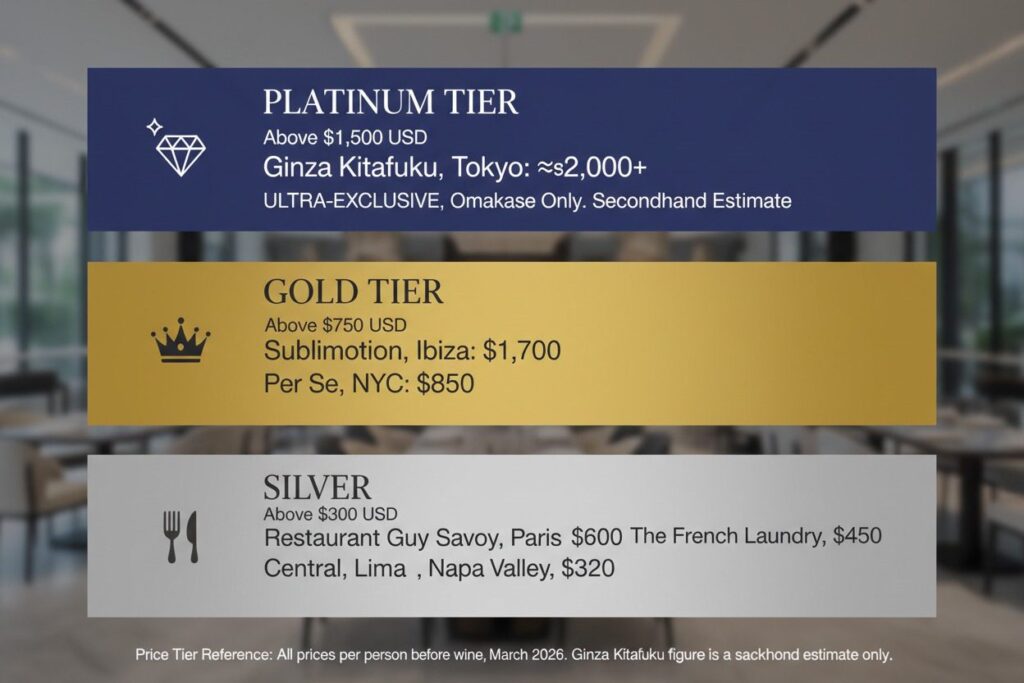
Every Tier, Every Restaurant — March 2026
These prices were verified from official reservation channels or primary journalism sources as of March 2026. At this tier, prices change without announcement. Confirm at the official booking channel before committing any deposit.
At this level, booking availability — not budget — is the primary constraint. A couple’s total with wine regularly exceeds $5,000.
- → Alchemist Sommelier Table (Copenhagen) — ~$2,340 / DKK 16,600
- → Ginza Kitafuku (Tokyo, winter crab) — ~$2,000 (¥300,000)* secondhand estimate only
- → Sublimotion (Ibiza) — ~$1,640 / €1,500 — wine & champagne included
- → Caviar Russe Grand Tasting (New York) — $975 — Dom Pérignon included
- → Masa Hinoki Counter (New York) — $950 — gratuity included
The world’s most celebrated three-Michelin-star rooms and highest-tier omakase counters. Total with wine is typically $800–$1,800 for two.
- → Guy Savoy (Paris) — ~$810 / €740
- → Sushi Kanesaka London — ~$530 / £420
- → Aragawa (Tokyo) — $670+ / ¥100,000+
- → Kikunoi Honten top tier (Kyoto) — $670 / ¥100,000
- → Masa Table Seating (New York) — $750
- → Masa Lunch Omakase — $495
- → Ikoyi (London) — ~$480 / £380
- → Per Se (New York) — $425
- → Crissier gastronomic/game menus (Switzerland) — ~$275–$295 / CHF 410–440
High-achievement fine dining at the entry edge. Planning still required. Craft exceptional.
- → Core by Clare Smyth (London) — ~$335 / £265
- → Sketch Lecture Room (London) — ~$285 / £225
- → Crissier discovery menu (Switzerland) — ~$160–$210 / CHF 240–315 — remarkable value
- → Kikunoi entry dinner (Kyoto) — ~$220 / ¥33,000
| Restaurant | Location | Price/Person | Beverages | Stars |
|---|---|---|---|---|
| Alchemist (Sommelier Table) | Copenhagen | ~$2,340 | Extra | ⭑⭑ + Green |
| Ginza Kitafuku (winter crab) | Tokyo | ~$2,000* | Unknown | — |
| Sublimotion | Ibiza | ~$1,640 | Included | ⭑⭑ |
| Caviar Russe Grand Tasting | New York | $975 | Dom P. incl. | ⭑ |
| Masa (Hinoki Counter) | New York | $950 | Extra, grat. incl. | ⭑⭑ |
| Alchemist (Experience) | Copenhagen | ~$790 | Extra | ⭑⭑ |
| Masa (Table Seating) | New York | $750 | Extra, grat. incl. | ⭑⭑ |
| Guy Savoy | Paris | ~$810 | Extra | ⭑⭑⭑ |
| Aragawa | Tokyo | $670+ | Extra | No stars |
| Kikunoi Honten (top tier) | Kyoto | $670 | Extra | ⭑⭑⭑ |
| Sushi Kanesaka London | London | ~$530 | Extra | ⭑⭑ |
| Masa (Lunch Omakase) | New York | $495 | Extra, grat. incl. | ⭑⭑ |
| Ikoyi | London | ~$480 | Extra | ⭑⭑ |
| Per Se | New York | $425 | Extra, grat. incl. | ⭑⭑⭑ |
| Core by Clare Smyth | London | ~$335 | Extra | ⭑⭑⭑ |
| Sketch Lecture Room | London | ~$285 | Extra | ⭑⭑⭑ |
| Crissier (gastronomic) | Switzerland | ~$275–$295 | Extra, service incl. | ⭑⭑⭑ |
| Kikunoi Honten (entry) | Kyoto | $220 | Extra | ⭑⭑⭑ |
| Crissier (discovery) | Switzerland | ~$160–$210 | Extra, service incl. | ⭑⭑⭑ |
| Ultraviolet | Shanghai | Closed | — | — |
What the Price Actually Buys
Honest assessments. No PR language. Where relevant first-hand accounts exist and conflict with the official narrative, I include them.
Opened in 2014 — predates Alchemist’s theatrical model by half a decade. Chef Paco Roncero’s two-Michelin-star kitchen operates inside a sealed white capsule where every surface is a projection screen. Guests move through the ocean floor, outer space, abstract compositions. VR headsets deploy mid-meal. Scent systems activate per course.
The wine and champagne are included in the €1,500 — which makes the total-cost comparison to ostensibly cheaper restaurants more favorable than the headline suggests. A couple at Guy Savoy with wine pairing will approach a similar total bill.
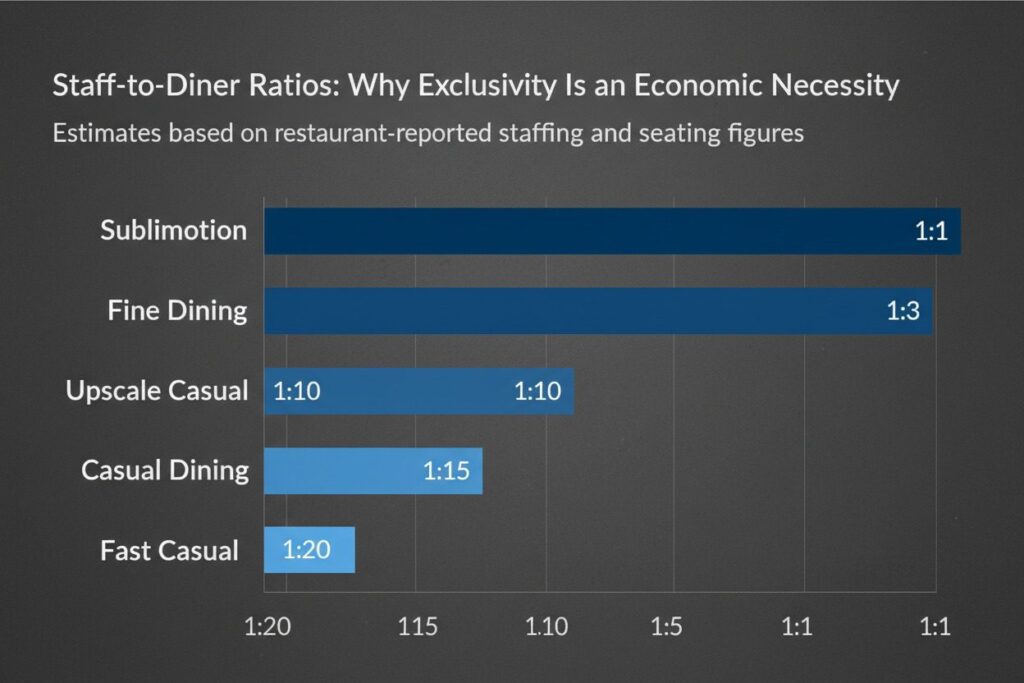
Here’s the thing about the staff ratio. Sublimotion runs ~25 professionals for 12 guests. That’s not a luxury flex — it’s technically required. Projection technicians, scent-system operators, VR calibrators, and performance coordinators don’t appear on the restaurant floor. They make the room work.
Book: sublimotionibiza.com — April or May for summer season. Full payment typically required at reservation.
These are two completely separate products. Not the same evening at different price points. The Experience (~$790 / DKK 5,600) is a multi-room dinner. The Sommelier Table (~$2,340 / DKK 16,600) is a separately bookable format built around dedicated sommelier wine curation throughout. Beverages are extra on both. Both carry a DKK 3,000 deposit and a non-refundable 2.5% service fee at booking.
Chef Rasmus Munk uses food to address social, environmental, and ethical themes. Some courses produce deliberate discomfort. Past iterations have processed factory farming, ocean plastic, and mental health through dishes designed to provoke something beyond flavor. This is not a comfortable evening. Munk makes no apology for that.
Book: alchemist.dk or Tock — batch releases only. Sommelier Table: 3–6 months from release. Experience: 2–4 months.
The $260,000 hinoki wood counter isn’t décor. Its natural cedar-scented oils are a literal sensory component — the counter is part of the meal. All three formats include gratuity. No printed menu on any format. The meal ends when the chef decides it ends.
Masa was downgraded from three to two Michelin stars in the 2025 Guide USA. That matters. Read recent first-hand accounts — not profiles written during the three-star era. The price has not followed the stars down. That’s worth sitting with before committing $950.
Book: exploretock.com/masa — Hinoki Counter: 2–3 months. Lunch more accessible.
One Michelin star. $975 per person. That’s more than most three-star restaurants in New York — and the gap tells you something. Caviar’s wholesale cost per gram already exceeds most restaurant entrées. This isn’t kitchen ambition outrunning critical recognition; it’s a singular ingredient event, and the economics reflect that.
Eleven courses: a five-variety spoon tasting at the bar (Gold Osetra, Classic Osetra, Sevruga, Siberian, Pacific) paired with Dom Pérignon 2012, then six courses each incorporating caviar — including a final cannelle with buttermilk, crème anglaise, and roe at dessert. Nine consecutive Michelin stars. This place is consistent.
Book: OpenTable — generally 1–3 weeks ahead. No same-day bookings.
No menu shown — before or during the meal. Chef Jeremy Chan fuses micro-seasonal British produce with sub-Saharan West African spices. The plantain is cut to precisely 13.5 centimeters. That detail matters: it tells you the kitchen’s obsession is craft, not marketing.
Aged turbot with egusi miso. Smoked jollof rice. Suya with creamed peas. Spice complexity that is simply unavailable at any comparable price point in London. The room at The Strand is terracotta and burnished brass, open kitchen visible.
There’s a recurring criticism worth naming directly. A November 2025 TripAdvisor reviewer with 52,644 contributions described “a severe room and joyless service fond of the term ‘umami.'” That matches a pattern. The cooking gets consistent praise. The atmosphere and service tone divide opinion. At £380, know which you’re booking for.
Book: ikoyilondon.com — NOT OpenTable. Releases 1st of each month at 12:00 pm GMT. Up to two months ahead.
Gordon Ramsay’s mentor. The Monnaie de Paris — the French Mint — on the Quai de Conti overlooking the Seine. Classical French haute cuisine at its most ceremonial and assured. The artichoke soup with black truffle and truffled mushroom brioche has been on the menu for decades and remains the primary reason people book. That’s not a criticism. That’s the point.
Chef Savoy is typically present. Prices are not published on the official website — the €740 figure for “Colours, Textures & Flavours” is confirmed by Pursuitist, March 2026. Confirm pricing at booking.
Two documented caveats worth knowing before committing €740. Paris food writer Meg Zimbeck of Paris by Mouth publicly stopped recommending Guy Savoy following a reservation dispute — a documented operational risk signal. Critic Alexander Lobrano has described the cooking as “impeccably prepared and rather polite.” At this price, polished predictability is a risk worth knowing about in advance.
Book: guysavoy.com/en or +33 1 43 80 40 61 — typically 3–4 weeks ahead. Jacket required for men.
The longest unbroken three-star run in the United States — continuously since the 2006 inaugural New York guide. At $425 with gratuity included, the lowest published price among New York’s three-star restaurants. Shares a floor with Masa at 10 Columbus Circle. Floor-to-ceiling windows facing Central Park.
Two nine-course menus daily — Chef’s Tasting and Tasting of Vegetables. The honest assessment: technically impeccable, emotionally flat. A November 2025 diner reported being asked if it was their first visit despite multiple prior reservations under the same name. At a restaurant charging $425, that’s a service failure that shouldn’t happen.
Book: exploretock.com/perse — 2–4 weeks ahead. Among the most accessible restaurants at this tier.
How to Actually Get a Seat
Every restaurant on this list has a specific booking channel. Using the wrong one — or assuming availability works the way it does at normal restaurants — wastes weeks. Some of these places you genuinely cannot book through a third-party platform.
Experience: 2–4 months
Lunch: more accessible
Alchemist: DKK 3,000 deposit; non-refundable 2.5% service fee at booking.
Sublimotion: Full payment typically required at reservation.
Per Se: $425 deposit applied in full to the bill.
Most restaurants at this tier enforce 48–72 hour cancellation windows. Some are non-refundable regardless of notice. Read the terms before paying, not after.
On concierge services: American Express Centurion, Quintessentially, and Ten Lifestyle Group sometimes access inventory not on public platforms — most relevantly for Alchemist and Masa. For Japanese restaurants without English-language booking systems, a Tokyo-based concierge or English-language platform (Pocket Concierge, Tableall) is usually the only viable option for non-Japanese speakers.
Most Expensive Restaurants by City
Is It Worth the Price?
These restaurants are not expensive the way a luxury hotel suite is expensive — the same product at a higher quality. They’re expensive the way a front-row concert ticket is expensive. The price buys a specific event whose value depends entirely on whether you wanted that specific event.
The theatrical case — Sublimotion, Alchemist. The correct question isn’t “could I have eaten better for less?” It’s “could I have had a more memorable evening for the same money?” Past diners consistently describe these meals in narrative terms — what happened, what surprised, what unsettled. If that output is what you’re buying, these restaurants regularly deliver it. If the output you want is dinner, they don’t.
The culinary craft case — Masa, Guy Savoy, Sushi Kanesaka, Kikunoi. These justify price through access to the ceiling of a tradition. Masa at the counter is not expensive relative to flying to Tokyo and eating at its peers. Guy Savoy’s artichoke soup is not expensive relative to recreating its ingredients privately. The value proposition is access to craft at its limit — set by individuals, not institutions.
The honest case against both. At $800–$2,340 per person before wine, the opportunity cost is real. The same money buys 3–5 nights at a luxury European hotel, a business-class transatlantic flight, or a week of outstanding meals across a city. If variety matters more than ceiling experiences, distributed spending delivers better value per dollar of pleasure. That’s not a criticism of these restaurants. It’s just how diminishing returns work at the top of any market.
For theater: Sublimotion (warmer, summer-only, wine included) or Alchemist (challenging, year-round).
For culinary craft — Japanese: Masa Hinoki Counter or Sushi Kanesaka London.
For culinary craft — French: Guy Savoy. Kaiseki: Kikunoi Honten.
For adventurous, spice-forward cuisine: Ikoyi London at £380.
Best value in tier: Masa Lunch Omakase ($495) and Per Se ($425) — same building, same New York trip, gratuity included on both. Combined cost per person lower than one dinner at Alchemist.
“For a first experience at this tier, start at Masa Lunch and Per Se. Decide what you actually want to spend $2,000 on.”
— The only advice that survives every dining budget conversation intactFrequently Asked Questions
- Alchemist Official
- Masa on Tock
- Sublimotion Official
- Per Se on Tock
- Caviar Russe on OpenTable
- Guy Savoy Official
- Ikoyi Official
- Michelin Guide
- World’s 50 Best
- Ultraviolet Closure (Wikipedia)
- Pocket Concierge
- Tableall
- Paris by Mouth
- Crissier Official
- Relais & Châteaux
- 45 Park Lane (Sushi Kanesaka)
- Core by Clare Smyth
- Sketch London
- Pursuitist (Guy Savoy pricing)
- Best Discovery (Aragawa data)