
Last updated: October 19, 2026, after the market close. Next refresh: SpaceX reports Q3 results on October 20 after the close. The “What to watch” section and the data file at the bottom are scheduled for an update the same evening.
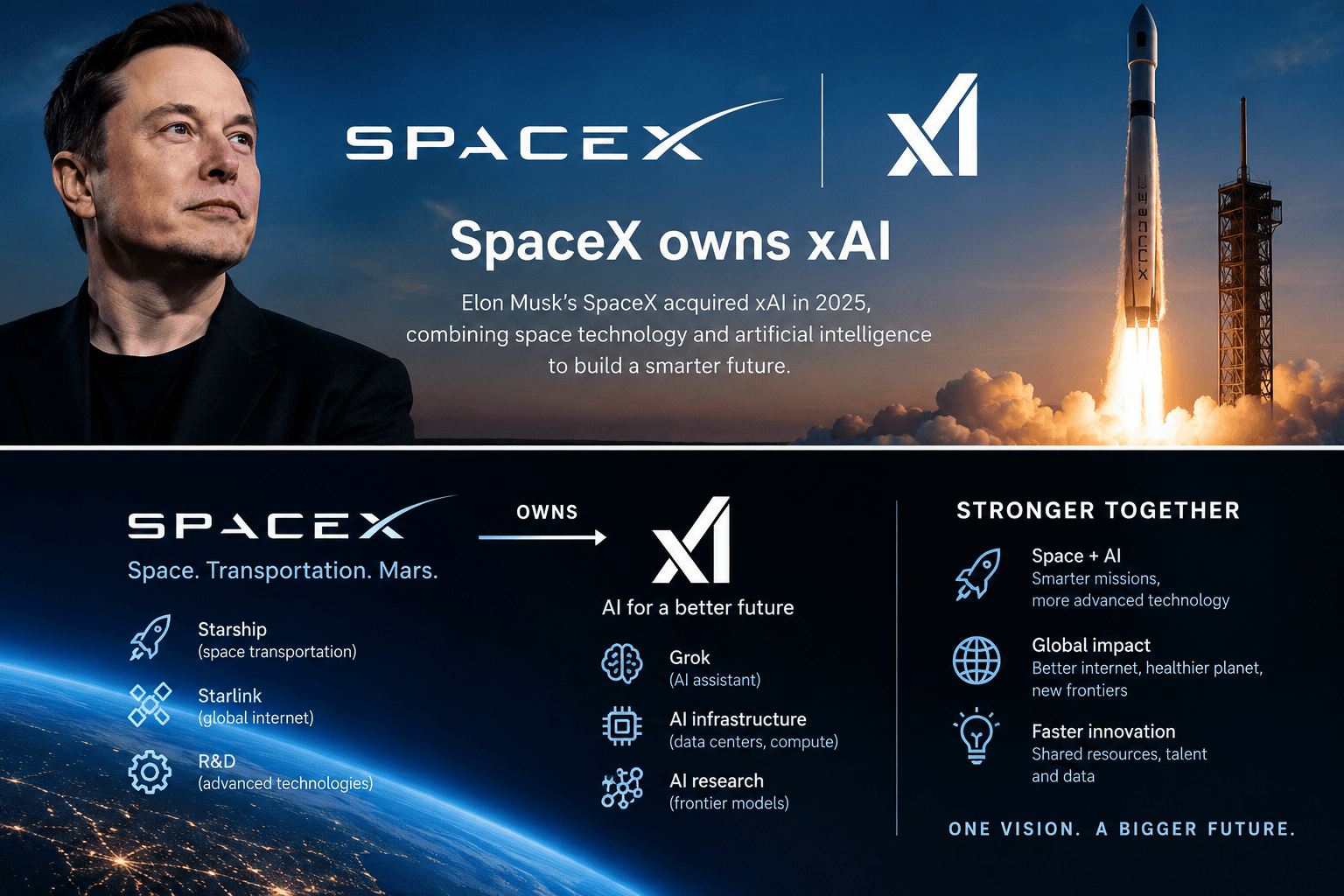
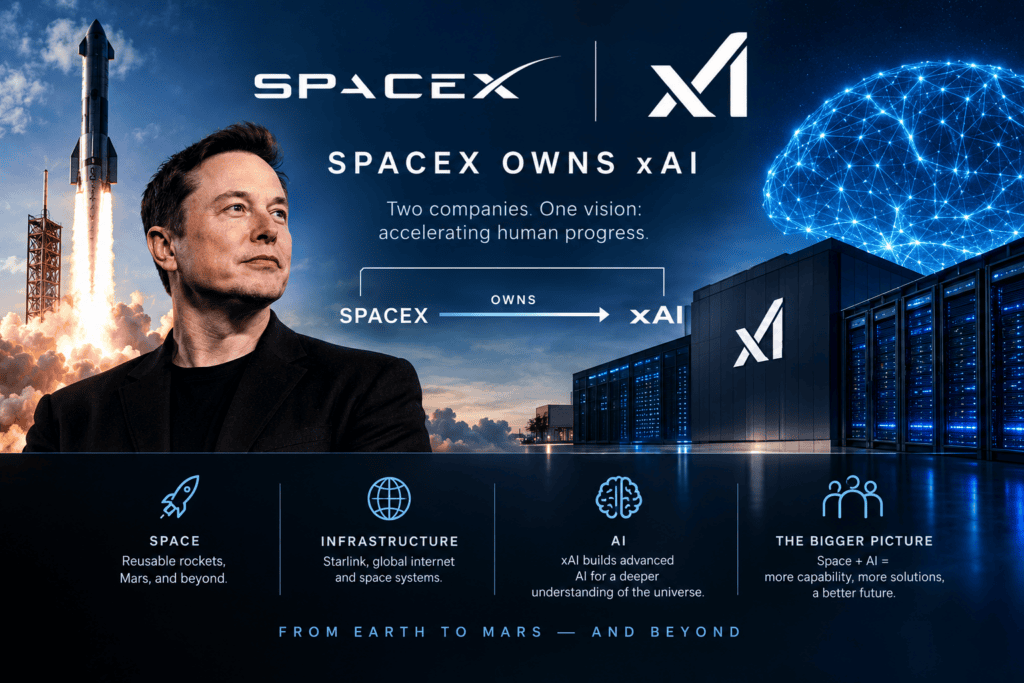
SpaceX acquired xAI, the maker of Grok, in an all-stock deal announced on February 2, 2026. Reuters reported that it valued xAI at about $250 billion. That is a negotiated valuation between two companies controlled by the same person, not a check written to an outside seller, and it is the first thing to understand before comparing it with any other deal.
This guide rebuilds the transaction from SpaceX’s own filings: the Form S-1 (May 20), the Q2 earnings release, and the Form 10-Q for the quarter ended June 30. Where a figure comes only from press reporting, the text says so. A dagger (†) marks arithmetic we did ourselves from cited figures; it is not a company statement.
The key numbers
| Number | What it is | Basis |
|---|---|---|
| $250B | xAI’s valuation in the deal, paid in SpaceX stock | Reuters, citing a person familiar |
| 0.1433 | SpaceX shares per xAI share, before the split; about 0.7165 after the 5-for-1 split† | Reuters; 10-Q (split) |
| $75.46 | Per-share cash option offered to some xAI executives; implies a $526.59 SpaceX share price† | Reuters |
| $12.7B vs. $3.2B | AI segment capex vs. revenue, FY2025 (4.0׆) | Form S-1 |
| $15.8B vs. $2.6B | AI segment capex vs. revenue, Q2 2026 (6.2׆) | Q2 earnings release |
| $147.96 | SPCX close on October 19, 2026, vs. the $135 IPO price | StockAnalysis; 10-Q |
The short answer
SpaceX’s 10-Q defines the “xAI Merger Date” as February 2, 2026, the day xAI became a wholly owned subsidiary. Reuters put SpaceX at about $1 trillion and xAI at about $250 billion, or $1.25 trillion combined, and reported that the deal passed Vodafone–Mannesmann as the largest M&A transaction on record, based on LSEG data. That ranking holds in nominal dollars on LSEG’s basis. It does not hold on every dataset or after inflation, as the record section below shows.
Eight months later, SpaceX is public (Nasdaq: SPCX), its AI segment has started renting out compute but still spends far more than it earns, and the AI unit has been renamed twice.
What were the deal terms?
Reuters reported the main terms on February 2, citing people familiar with the deal. SpaceX has not published a term sheet, so the valuations below rest on that reporting rather than on a filed document.
| Term | Detail | Basis |
|---|---|---|
| Effective date | February 2, 2026 | SpaceX 10-Q, Note 1 |
| Form of payment | All stock, through a share exchange | Reuters; 10-Q |
| SpaceX valuation | About $1 trillion (last valued at about $800B in an insider share sale) | Reuters |
| xAI valuation | About $250 billion (last valued at about $230B) | Reuters, citing the Wall Street Journal |
| Combined value | About $1.25 trillion | Reuters |
| Exchange ratio | 0.1433 SpaceX shares per xAI share (pre-split) | Reuters |
| Cash option | $75.46 per xAI share, for some executives | Reuters |
| Reference share price | About $527 (Reuters); $75.46 ÷ 0.1433 = $526.59† | Reuters; our arithmetic |
| Stock split since | Five-for-one, May 2026 | 10-Q, Note 1 |
The numbers hang together: the cash option equals the stock exchange at the implied reference price, which is a useful check that the reported ratio and cash figure describe the same deal.
One dating detail: the $230 billion xAI valuation is tied to a $20 billion funding round announced January 6, 2026. Reuters, citing the Wall Street Journal, dates that valuation to November. Either way, the $250 billion mark was roughly a 9% step-up†.
What did xAI shareholders actually get?
Each xAI share converted into 0.1433 SpaceX shares before the split, or about 0.7165 after it. At the deal’s reference price, that equals $75.46. The table shows what that stake has been worth at later prices.
| Date | SPCX price | Value per xAI share† | vs. $75.46 |
|---|---|---|---|
| Deal reference (split-adjusted) | $105.32 | $75.46 | n/a |
| IPO price, June 11 | $135.00 | $96.73 | +28% |
| Aug 5 close | $108.27 | $77.58 | +3% |
| Oct 16 close | $146.03 | $104.63 | +39% |
| Oct 19 close | $147.96 | $106.01 | +40% |
Before taxes and subject to lock-ups. In early August, the cushion over the cash option shrank to about 3%. The same exchange ratio diluted SpaceX’s existing holders: if the combined company was worth $1.25 trillion and SpaceX was $1 trillion of it, they kept 80% of the whole, a 20% dilution†.
Is it really the biggest deal ever?
On the dataset Reuters used, yes. Reuters, citing LSEG, said the deal passed Vodafone’s takeover of Mannesmann, a record that had stood for more than 25 years. Dealroom’s 2026 list also ranks it first by deal value. Three things complicate the headline.
The older deal has several sizes. Sources value Vodafone–Mannesmann anywhere from about $180 billion to $203 billion, depending on whether net debt is counted.
| Source | Vodafone–Mannesmann figure | Note |
|---|---|---|
| LSEG, via Reuters | $203B | Basis of the record claim |
| Dealroom (2026 list) | $202.8B | Includes Mannesmann’s net debt |
| CityIndex | $183B | Transaction value |
| Smartroom (citing Goldman Sachs) | About $180B | All-share, at completion |
On LSEG’s basis, the margin is about $47 billion†; on the lower figures, it is $67 to $70 billion†.
Inflation changes the ranking. Dealroom’s earlier inflation-adjusted estimate put Vodafone–Mannesmann near $389 billion and AOL–Time Warner near $340 billion. Both exceed $250 billion. The “largest ever” claim is true in nominal dollars, not in purchasing power.
Datasets disagree on what counts. An earlier Dealroom list shows $278 billion for 2017’s Shenhua–China Guodian combination of two state-owned groups. Reuters’ claim rests on LSEG’s dataset, and we could not see LSEG’s inclusion rules, so we cannot say how such mergers are treated there.
And it is a valuation, not a payment. No cash changed hands for the headline amount, so what the “price” is worth moves with SpaceX’s stock. As far as we could confirm, no larger deal was announced in 2026, but we did not have a full year-to-date league table from LSEG or Dealogic.
Why did SpaceX want xAI?
The stated reason is compute in orbit. SpaceX’s prospectus argues that AI demand is outrunning power available on the ground, and that satellites in Sun-synchronous orbit could supply it. It says orbital AI compute could begin deploying “as early as 2028” and ties that to Starship. The same document warns that these initiatives rely on unproven technology and may never become commercially viable, so 2028 is a goal, not a commitment. Starship Flight 13 in July deployed 20 production V3 Starlink satellites, according to the Q2 release.
The financing reason is the burn. Reporting at the time put xAI’s cash burn near $1 billion a month. It had announced a $20 billion round on January 6 with investors including Nvidia, Cisco and Fidelity. Tesla disclosed a $2 billion investment in that round, which converted into an indirect stake in the combined company. Folding xAI into a company with a profitable Starlink business gave it a larger balance sheet to borrow against and a route to public markets.
The IPO story is interpretation. Analysts read the merger as a way to give the coming IPO a bigger growth narrative. That is commentary, not disclosure. What the filing confirms is how much of the pitch depends on AI: SpaceX’s S-1 estimates a $28.5 trillion total addressable market, of which $26.5 trillion is AI.
What does “common control” mean for the $250 billion?
The headline figure did not create $250 billion of new assets on SpaceX’s balance sheet. The 10-Q’s Note 1 labels both the xAI merger and the earlier X merger (March 28, 2025, when xAI acquired X) as “Common Control Mergers,” each effected through a share exchange. SpaceX’s S-1 recast its historical financial statements as if the businesses had always been combined.
Our reading of general accounting practice, not a statement from the filing, is that a common-control acquirer normally carries the acquired assets at existing book values rather than the deal price. The balance sheet is consistent with that: at June 30 the 10-Q shows $11.1 billion of goodwill in the AI segment and $65.7 billion of total property, plant and equipment for the entire company. Neither is close to $250 billion.
Two consequences follow. SpaceX’s 2025 results include xAI’s losses even for months before the legal merger. And impairment testing is an open question: SOC Investment Group told the SEC that a June 3 amended filing did not discuss impairment of xAI assets despite co-founder departures and Musk’s statement that xAI was being rebuilt (as reported by Bloomberg Law). That is the group’s claim, not an SEC finding.
How was the deal structured, and what happened to xAI’s debt?
Reuters reported on February 5 that the transaction used a common two-step merger process. According to that report, it avoided a change-of-control trigger on xAI’s debt, gave shareholders a tax advantage, and left xAI’s past liabilities inside the subsidiary. TaxProf Blog, reasoning from Nevada filings, concluded the mechanics were most likely a reverse triangular merger followed by a sideways merger into a new LLC, and flagged that as an inference because the private terms were not public.
The 10-Q shows what happened to the debt next, and it is not what the “no refinancing” framing might suggest. In March 2026, SpaceX took out a $20 billion unsecured bridge loan and used it to repay X’s two term loans, xAI’s two term loans, and xAI’s 12.5% senior secured notes, which together carried about $17.5 billion of principal at the end of 2025†. In June, it repaid the bridge with a $25 billion investment-grade bond sale, in five tranches at rates between 5.35% and 6.65%. The first half of 2026 includes a $1.5 billion loss on debt extinguishment and $1.15 billion of extinguishment premiums paid, per the cash flow statement.
The 10-Q does not say whether the merger structure avoided a forced repayment. It does show the old debt was retired within five months anyway, at a cost, and replaced with cheaper paper.
What do the filings show about the AI segment?
Starlink pays for the rest of the company. The AI segment, which holds xAI, Grok, and X, spends several times what it earns.
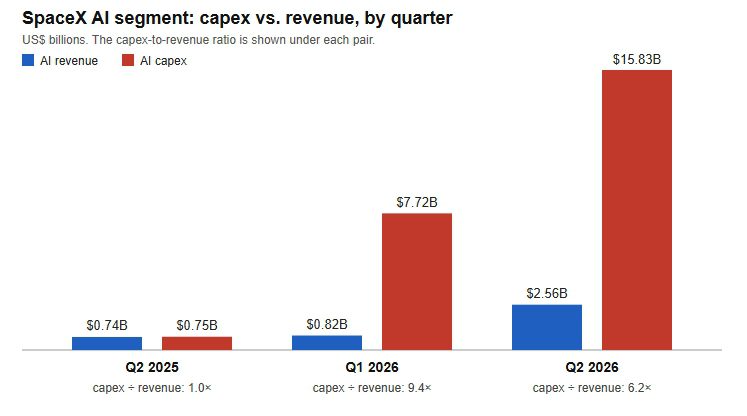
| AI segment, US$ millions | FY2025 | Q1 2026 | Q2 2026 |
|---|---|---|---|
| Revenue | 3,201 | 818 | 2,561 |
| Operating income (loss) | (6,355) | (2,469) | (1,257) |
| Segment adjusted EBITDA | n/a here | (609) | 1,146 |
| Capex | 12,727 | 7,723 | 15,828 |
| Capex ÷ revenue† | 4.0× | 9.4× | 6.2× |
FY2025 figures are from the Form S-1; Q1 and Q2 figures are from the Q2 earnings release. Because of the common-control recast, the 2025 figures describe xAI, X, and Grok as if they had always been inside SpaceX.
The whole company in Q2 2026
| US$ millions | Revenue | Operating income (loss) | Segment adj. EBITDA | Capex |
|---|---|---|---|---|
| Space | 962 | (542) | (205) | 1,174 |
| Connectivity (Starlink) | 4,291 | 1,656 | 2,597 | 1,367 |
| AI | 2,561 | (1,257) | 1,146 | 15,828 |
| Total | 7,814 | (143) | 3,538 | 18,369 |
Total revenue rose 92% from a year earlier, and the net loss was $541 million, $467 million narrower than a year before. Connectivity was the only segment with an operating profit; it ended the quarter with 12.0 million Starlink subscribers, double a year earlier, although monthly revenue per subscriber fell to $66 from $85.
What the AI numbers do and don’t say
The revenue growth is real, and it is compute rental. AI revenue was 3.5 times its year-earlier level†. AI solutions and infrastructure revenue, which includes the new cloud-services contracts, reached $2,194 million against $311 million a year earlier, while advertising fell 14%† to $367 million. The company said new cloud agreements added $1.6 billion of incremental infrastructure revenue in the quarter.
The positive adjusted EBITDA is an add-back. The $1.1 billion segment figure excludes $1,885 million of depreciation and amortization, equal to 74% of AI revenue†, and $516 million of share-based compensation. On the GAAP measure, the segment still lost $1.3 billion, though that was about half the Q1 loss.
Capex is still the story. AI took $15.8 billion of the quarter’s $18.4 billion of capex, or 86%†. Across the first half, capex of $28.5 billion was about eight times operating cash flow of $3.5 billion†. The gap was funded by the IPO, which raised $85.7 billion net, and the $25 billion bond sale. SpaceX ended June with $100 billion of cash and marketable securities and a $47.5 billion backlog, 56% of which it expects to recognize within a year.
The customers behind the jump
The S-1 names Anthropic PBC as a cloud customer: $1.25 billion a month through May 2029, with a reduced fee while capacity ramped in May and June. Google signed a separate agreement on June 5 worth $920 million a month, according to Verdict, which reports the money starting in October. As an illustration only, $1.25 billion a month annualizes to about $15 billion, roughly 4.7 times the segment’s 2025 revenue†.
Treat those figures as revenue at risk of change, not locked-in backlog. The S-1 says Anthropic’s agreements can be terminated by either side on 90 days’ notice, and Musk said on X in May that the Colossus lease was for 180 days with a mutual 90-day cancellation right afterward (Reuters). The Q2 release’s own definition of “contracted sales,” the $14.1 billion figure it cites, covers only the non-cancellable, enforceable period of each contract.
The 10-Q also shows concentration. An unnamed AI-segment customer, labeled “Customer B,” was 19.5% of Q2 revenue, about $1.5 billion†. The filing does not name it.
What happened after the deal?
| Date | Event | Source |
|---|---|---|
| Mar 28, 2025 | xAI acquires X | 10-Q |
| Jan 6, 2026 | xAI announces a $20B funding round | CNBC headline, via Seedtable |
| Feb 2, 2026 | SpaceX acquires xAI | 10-Q; Reuters |
| May 2026 | Five-for-one stock split; Anthropic agreements signed | 10-Q; S-1 |
| May 20 | S-1 filed | SEC |
| Jun 5 | Google Cloud agreement signed | Verdict |
| Jun 11–12 | IPO priced at $135; trading starts on Nasdaq | 10-Q; Q2 release |
| Jun 15 | IPO closes: 638.9M shares, $85.7B net proceeds | Q2 release |
| Jun 26 | $25B inaugural bond sale closes | Q2 release |
| Aug 4 | First earnings report as a public company | Q2 release |
| Aug 2026 | Cursor deal ($60B) reported closed | Press reports |
| Oct 4 | Musk announces SpaceXAI will become SpaceXSI (“SpaceX Super Intelligence”); the unit had been renamed SpaceXAI over the summer | Teslarati |
| Oct 12 | “The X Subscription” bundles Grok, Cursor and X Premium | Teslarati |
How has the stock done, and what is the lock-up ladder?
SpaceX priced its IPO at $135 on June 11 and began trading on June 12. The shares closed the first day around $161, up about 19%, per Wikipedia. The 52-week range on StockAnalysis runs from $104.83 to $225.64, with the high set in the week after the IPO.
| Date | SPCX | Context |
|---|---|---|
| Jun 11 | $135.00 | IPO price |
| Jun 12 | About $161 | First-day close |
| Aug 4 | $125.33 | Close before Q2 results (StartupHub) |
| Aug 5 | $108.27 | Close after results, down 13.6% (StartupHub) |
| Oct 6 | $176.42 | Recent high (TradingKey) |
| Oct 16 | $146.03 | Close, down 1.74% on the day |
| Oct 19 | $147.96 | Close |
The October 19 close is about 34% below the 52-week high and about 10% above the IPO price†.
The lock-up does not end on one date. According to the prospectus as summarized by The Financial Sciences Company and Motley Fool, the release ladder for the standard 180-day group looks like this:
| Date | Up to (shares) | Status |
|---|---|---|
| Aug 6 | About 911.5 million | Released (earnings-linked) |
| Aug 20, Sep 9, Sep 24, Oct 9 | About 319–328 million each | Released |
| Oct 22 (expected) | About 1.3 billion (28% of the pool) | Second full trading day after Q3 results |
| Oct 24 (first trade Oct 26) | 328.4 million | Scheduled |
| Dec 8 | About 797.6 million | Final 180-day release |
| Jun 12, 2027 | About 6.4 billion (Musk) | 366-day lock-up |
Other holders are on longer, phased schedules into 2027. Verify every date against the “Shares Eligible for Future Sale” section of the prospectus before relying on it. Eligibility is not selling: on September 24, total trading volume was roughly 73 million shares, against 328.4 million eligible, per Motley Fool. We have no data on how much insiders actually sold.
Is the valuation justified?
The skeptics and supporters are reading the same filings and weighting them differently.
The bear case. Morningstar’s Nicolas Owens put fair value near $780 billion when the IPO was targeting about $1.8 trillion (Yahoo Finance). On the October 19 close and the share count on the 10-Q cover (13.18 billion Class A and B shares at July 28), SpaceX is worth about $1.95 trillion†, roughly 62 times annualized Q2 revenue†. SOC Investment Group’s letter raised the impairment disclosure question above. And SpaceX is a “controlled company” under Nasdaq rules per its S-1; Class B shares were about 42% of shares outstanding at July 28†.
The bull case. Starlink is profitable and growing, the AI loss has narrowed from the first quarter, and a long list of banks rate the stock a Buy. Price targets run from $173 (Susquehanna, Hold) to $300 (Morgan Stanley, Buy), per Google Finance and TipRanks. Wall Street’s Q3 revenue estimate of $12.89 billion would be about 65% above Q2†.
What to watch next
SpaceX reports Q3 results on Tuesday, October 20, after the market close. The date was set unusually late and came as a surprise to analysts, per Yahoo Finance. Consensus is $12.89 billion of revenue and $0.14 of earnings per share, per TipRanks. The test is whether AI revenue is catching up with AI spending.
| Check this | Q2 2026 baseline |
|---|---|
| AI revenue | $2,561M |
| AI capex | $15,828M (6.2× revenue†) |
| AI segment adjusted EBITDA | $1,146M |
| AI operating loss | $(1,257)M |
| Contracted sales in the quarter | $14.1B |
| Compute capacity | 1.4 GW |
| Cash and marketable securities | About $100B |
| Largest AI-segment customer share of revenue | 19.5% |
Then the supply: about 1.3 billion shares become eligible on October 22, followed by another 328.4 million for trading on October 26, with the final standard release on December 8. On the operating side, the S-1 lists Starship payload delivery in the second half of 2026 and orbital AI satellites “as early as 2028” as expectations, next to its own warning that they may slip or fail.
FAQ
When did SpaceX acquire xAI?
SpaceX announced the acquisition on February 2, 2026. Its 10-Q defines the xAI merger as effective that day.
How much did SpaceX pay for xAI?
There was no cash headline price. It was an all-stock deal valuing xAI at about $250 billion, per Reuters, citing a person familiar with the terms. Some executives could take $75.46 per xAI share in cash.
What was the exchange ratio?
0.1433 SpaceX shares per xAI share before the split. After the May 2026 five-for-one split, that is about 0.7165 shares.
Is SpaceX–xAI the biggest merger ever?
In nominal dollars on LSEG’s data, per Reuters, yes. After inflation, Vodafone–Mannesmann was larger by Dealroom’s earlier estimate, and other datasets rank state-owned mergers differently.
Is xAI profitable?
No. The S-1 shows a 2025 AI segment operating loss of $6.4 billion on $3.2 billion of revenue. In Q2 2026, the segment’s operating loss narrowed to $1.3 billion on $2.6 billion of revenue.
Can I still buy xAI stock?
No. xAI has never been listed on its own. Exposure comes through SpaceX, which has traded on Nasdaq as SPCX since June 12, 2026.
What is xAI called now?
The AI unit was renamed SpaceXAI over the summer, and Musk announced on October 4 that it would become SpaceXSI. Grok and X sit inside the AI segment.
Did Tesla get anything from the merger?
Tesla disclosed a $2 billion investment in xAI’s January round, which converted into an indirect stake in the combined company. Tesla was not part of the merger.
Data you can cite
Free to reuse with a link back to this page. Figures are US$ millions. FY2025 and Q1 2026 come from the Form S-1; Q2 2026 comes from the Q2 earnings release and Form 10-Q. Segment rows sum to the consolidated rows in every period; consolidated capex is the sum of the three segments (editorial arithmetic).
period,segment,revenue,operating_income,capex
FY2025,Space,4086,-657,3832
FY2025,Connectivity,11387,4423,4178
FY2025,AI,3201,-6355,12727
FY2025,Consolidated,18674,-2589,20737
Q1 2026,Space,619,-662,1052
Q1 2026,Connectivity,3257,1188,1332
Q1 2026,AI,818,-2469,7723
Q1 2026,Consolidated,4694,-1943,10107
Q2 2026,Space,962,-542,1174
Q2 2026,Connectivity,4291,1656,1367
Q2 2026,AI,2561,-1257,15828
Q2 2026,Consolidated,7814,-143,18369
Suggested citation: “SpaceX–xAI Acquisition: The $250 Billion Deal, Explained From the Filings,” mostexpensives.com, October 19, 2026, https://www.mostexpensives.com/spacex-acquires-xai/. Primary sources: Space Exploration Technologies Corp., Form S-1 (filed May 20, 2026), Q2 2026 earnings release and Form 10-Q (quarter ended June 30, 2026).
How we built this page
Sources are ranked in this order: SpaceX’s SEC filings and earnings release; Reuters and other wire reporting; named analysts and data providers; everything else. Deal terms that exist only in press reports are labeled as such. Arithmetic marked † was done by the mostexpensives.com editorial team from the cited figures. Share prices are closing prices from the sources named in the tables; confirm live quotes before making financial decisions. Nothing here is investment advice.
Update log
- October 19, 2026: Rebuilt the Q2 section from the Q2 release and Form 10-Q instead of press summaries. Corrected AI revenue growth to 3.5× a year earlier (the earlier draft said “nearly tripled”). Rebuilt the lock-up section from the prospectus schedule. Added the debt-refinancing facts, the Customer B disclosure, and the Vodafone–Mannesmann valuation range. Replaced two unattributed price rows with sourced figures.
Sources
Primary (SEC filings)
- SpaceX Form 10-Q, quarter ended June 30, 2026
- SpaceX Q2 2026 earnings release
- SpaceX Form S-1 and other filings, SEC EDGAR
Reuters (syndicated)
- Deal announcement and record claim
- Exchange ratio and cash option
- Musk on the Anthropic lease term
Market data and analysis
- StockAnalysis: SPCX quote and 52-week range
- TradingKey: October 16 close and recent high
- TipRanks: Q3 consensus
- Yahoo Finance: Q3 date and lock-up commentary
- Google Finance: SPCX analyst ratings
- The Financial Sciences Company: lock-up calendar
- Motley Fool: lock-up releases
- Verdict: Google cloud agreement
- Teslarati: SpaceXSI rename and subscription bundle
- Wikipedia: Initial public offering of SpaceX
Historical deal sizes