
Collector Markets · Updated June 2026
The Most
Expensive
Classic Cars
Ever Sold
From a $48 million Ferrari that nobody thought could be topped — to the $143 million sale that rewrote everything. A complete record of the cars that redefined what an automobile is worth.
The bidding on May 5, 2022, started at €50 million. That figure alone — before a single counterbid — was already higher than any car had ever sold for at public auction. By the time the room fell silent inside the Mercedes-Benz Museum in Stuttgart, the number on the board was €135 million. $143 million. For one car.
Nobody on the invite list that morning expected a car to become one of the ten most valuable objects ever sold at auction in any category — alongside Da Vinci paintings and Warhol silkscreens. But that’s what a 1955 Mercedes-Benz 300 SLR Uhlenhaut Coupé did. In fifteen minutes. And it still holds the record today.
Below is the complete, updated record of the most expensive classic cars ever sold — public auction results only, with verified prices including buyer’s premiums, sourced from RM Sotheby’s, Bonhams, Mecum, and specialist data from Classic Car Auctions. Private sales, where the prices are unverified rumors, are noted where relevant but kept separate. This list is about what actually happened, on the record, in front of witnesses.
Three Ingredients Every Car on This List Shares
You could spend years trying to explain what makes one old car worth $143 million and another worth $14,300. The honest answer involves three things, and virtually every car on this list has all three in some concentration.
Documented racing history with named drivers. Not just “raced in period” — specifically: which chassis number, which race, which driver, what result. Phil Hill at the 1962 Targa Florio. Juan Manuel Fangio at the 1955 Buenos Aires Grand Prix. Jochen Rindt winning Le Mans. The paper trail matters more than the trophy.
Scarcity with no plausible future supply. Ferrari built 36 GTOs. Mercedes built two Uhlenhaut Coupés. Jaguar built 16 D-Types. These numbers cannot increase. More wealth entering the collector car market each decade chases the same fixed pool of objects.
Originality — or the right kind of history. A GTO with matching numbers and its original engine is worth dramatically more than one that’s been restored or raced hard and rebuilt. “The most authentic example” is the phrase auction catalogues use. What they mean is: nothing was replaced unnecessarily, and what was replaced can be accounted for.
One more factor the auction houses won’t say directly: rivalry. When two serious collectors both want the same car on the same day, records fall. The $143 million Mercedes result wasn’t just about the car’s value. It was about one person being willing to pay whatever it took.
The $143M Mercedes 300 SLR sale places the car in the top 10 most valuable objects ever auctioned in any category worldwide — above most Old Masters paintings and alongside Leonardo da Vinci’s Salvator Mundi in terms of magnitude. The previous auction record for a car had been $48.4 million. The Stuttgart sale didn’t inch the record forward — it tripled it.
The Most Expensive Classic Cars Ever Sold
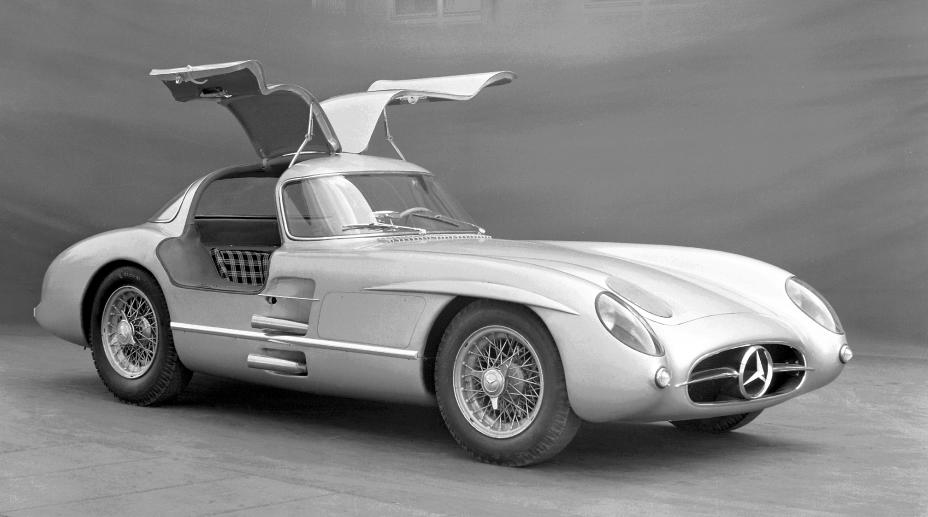
1955 Mercedes-Benz 300 SLR Uhlenhaut Coupé
RM Sotheby’s · Stuttgart, Germany · May 5, 2022
There are only two of them. One sold. One stayed at the Mercedes-Benz Museum. Those are the only two facts you need to understand why this happened.
The 300 SLR was never meant to be a road car. Rudolf Uhlenhaut, the chief engineer whose name the car carries, built it as a coupe version of the W 196 S racing chassis — the same platform that won the 1955 World Sportscar Championship. He drove it to work occasionally, reportedly at speeds that alarmed his colleagues on the Autobahn. It was capable of 180 mph. In 1955. On street tyres.
Mercedes had no intention of ever selling it. The car spent decades as a museum exhibit, shown to journalists and collectors as the untouchable crown jewel of the Stuttgart collection. What changed in 2022 was that British dealer and advisor Simon Kidston reportedly lobbied Mercedes’ board for 18 months to allow a sale, and eventually persuaded them — with the condition that the winning bidder agree to keep the car available for public display on special occasions.
The auction was invitation-only. Attendees were screened for “alignment with corporate values.” Bidding opened at €50 million — already above the previous world record. The hammer fell at €135 million, approximately $143 million including fees. The proceeds went to the Mercedes-Benz Fund, supporting science scholarships.
Nobody knows the buyer’s identity. Kidston placed the winning bid on their behalf.
The margin by which this car leads the list is extraordinary. The second-most-expensive car sold at auction — a 1954 Mercedes-Benz W196R racing car — achieved $54 million in 2025. The 300 SLR outsold it by nearly $90 million.
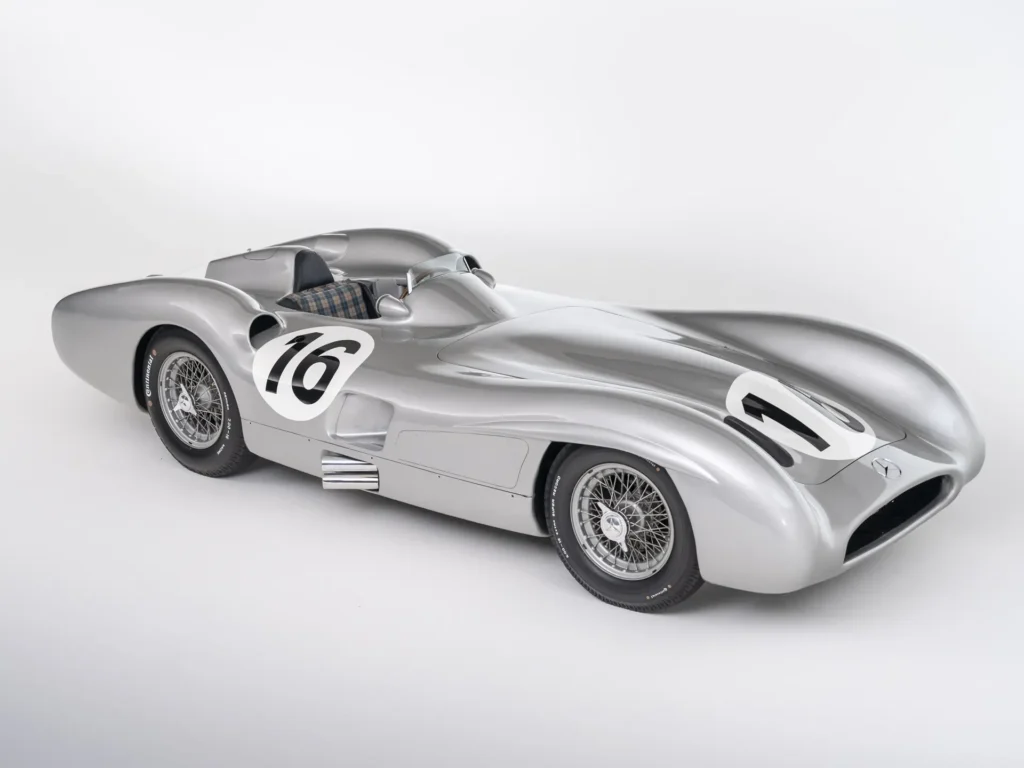
1954 Mercedes-Benz W196R Stromlinienwagen
RM Sotheby’s · Mercedes-Benz Museum, Stuttgart · February 1, 2025
One of only four surviving streamlined-body Formula 1 cars from the W 196 R programme — the one that dominated the 1954 and 1955 World Championship seasons with Fangio at the wheel. This specific chassis had competed in the 1955 Buenos Aires and Monza Grands Prix, with both Fangio and a young Stirling Moss behind the wheel.
It had sat at the Indianapolis Motor Speedway Museum since 1965, donated as a piece of American motorsport heritage. When it came up for sale in Stuttgart, it became, immediately, the most expensive Formula 1 single-seat racing car ever sold at public auction — by a significant margin.
The final price, €51.2 million including buyer’s premium (approximately $53.9 million at the day’s exchange rate), placed this car second on the all-time list, behind only its Stuttgart stablemate. Two Mercedes cars now occupy the top two positions. Every Ferrari ever sold at auction sits in third place or lower.
1962 Ferrari 330 LM / 250 GTO
RM Sotheby’s · New York · November 2023
The only factory-entered Ferrari 250 GTO in existence — meaning this specific car was prepared, entered, and raced directly by Scuderia Ferrari, rather than by a privateer customer. That distinction, in the rarefied world of GTO collecting, is enormous.
This is also chassis 3765, which finished second overall at the 1962 Nürburgring 1,000km before Lorenzo Bandini drove it at that year’s Le Mans. It was built initially with a 4.0-litre engine — making it technically a 330 LM — before Ferrari substituted the 3.0-litre Colombo V12 that the GTO regulations required.
RM Sotheby’s estimated it would sell above $60 million. It didn’t, finishing at $51.7 million. That gap between estimate and result is worth noting: even among the most expensive Ferraris ever sold, the market in 2023 was not willing to go wherever cataloguers wanted it to go. The buyer reportedly acquired it having paid the equivalent of $1.4 million in today’s money for the same car decades earlier.
1962 Ferrari 250 GTO (Chassis #3413)
RM Sotheby’s · Monterey, California · August 25, 2018
The third GTO built, this car was a Ferrari factory test vehicle driven by Phil Hill — the first American Formula 1 World Champion — in preparation for the 1962 Targa Florio. It then spent that season in the hands of privateer Edoardo Lualdi-Gabardi, who won the Italian GT Championship outright, recording six overall victories and five class wins.
It was sold by Greg Whitten, a former Microsoft executive who had bought it in 2000 for a figure experts place at under one-tenth of the 2018 sale price. He’d used it for vintage racing and, by his own account, got it to over 155 mph. Remarkably, despite decades of active use, the car had never been in a serious crash.
When it sold for $48.4 million in Monterey, it shattered the previous record by $10 million. It held the public auction record for five years — until the 2023 New York GTO topped it by a narrow margin. Earlier in 2018, a private GTO sale had reportedly cleared $70 million, which means even the $48.4 million public result was not actually the year’s highest GTO transaction.
1962 Ferrari 250 GTO “Bianco Speciale” (Chassis #3729GT)
Mecum Auctions · Kissimmee, Florida · January 18, 2026
The most recent major result — and the most unusual GTO ever sold publicly. Every other Ferrari 250 GTO left the factory in one of several racing colors: Rosso Corsa red, various shades of blue, silver. This one left in Bianco Speciale — a shade of white that no other GTO received from the factory. It is genuinely one-of-one in the most literal sense.
Originally ordered by British racing team owner John Coombs in right-hand drive — unusual for a GTO — it was raced by Graham Hill, Mike Parkes, and Jack Sears in the early 1960s, achieving multiple second-place finishes including at the RAC Tourist Trophy at Goodwood. It passed through several owners before Jon Shirley bought it in 1999 and preserved it sympathetically, including returning it to its white racing livery.
The bidding ran for ten minutes. The hammer fell at $35 million; with buyer’s premium, $38.5 million. California-based Ferrari collector David Lee, who had reportedly attempted to acquire the car privately beforehand, placed the winning bid by video call from outside the room. It was the highest price Mecum Auctions has ever achieved for any car.
Whether this result feels “disappointing” or “strong” depends on the reference point. Relative to the $51.7M factory GTO, it’s third-tier. Relative to comparable preserved examples, it represents genuine collector conviction in a market that’s been otherwise cautious.
1962–63 Ferrari 250 GTO Berlinetta
Bonhams · Quail Lodge, Carmel · August 2014
The sale that first crossed the $38 million threshold for a production-based racing car — and that held the public auction record for four years until Monterey 2018. This was a Series II GTO, the later, slightly revised body style that Ferrari introduced partway through the production run. At the time, $38.1 million seemed like an extreme ceiling for any automobile. It wasn’t close to one.
1964 Ferrari 250 LM by Scaglietti
RM Sotheby’s · Paris Rétromobile · February 2025
This car won the 1965 Le Mans 24 Hours outright — the only privateer Ferrari victory at Le Mans, and the last overall Ferrari victory at La Sarthe until the factory returned to win in 2023. It was entered by the North American Racing Team (NART), driven by Masten Gregory and Jochen Rindt — two drivers who were considered too aggressive and unpredictable by most team owners of the era, which is presumably why they won.
The car had been donated to the Indianapolis Motor Speedway Museum in 1965, the same institution that also held the W196R Stromlinienwagen. It sat there for 54 years before appearing on the auction block in Paris, where it sold for €34,880,000 ($36.3 million) — making it simultaneously the most expensive Le Mans winner ever sold at public auction, and the most expensive 250 LM by a factor of several times.
1962 Ferrari 330 LM / 250 GTO (Second Example)
RM Sotheby’s · Various · 2014 / Multiple Appearances
A second car from the GTO/330 LM crossover production — these were built in a transitional period when Ferrari was shifting between engine specifications and homologation classifications. The overlap between the 3.0-litre GTO rules and the 4.0-litre 330 LM designation created a handful of cars that exist in a classification grey zone, which paradoxically makes them more interesting to serious collectors.
All-Time Top Results — Public Auctions
Prices include buyer’s premium. Source: RM Sotheby’s, Bonhams, Mecum, Gooding & Co., verified against Classic Car Auctions database. Updated June 2026.
| # | Car | Year | Auctioneer | Date | Price |
|---|---|---|---|---|---|
| 1 | Mercedes-Benz 300 SLR Uhlenhaut Coupé | 1955 | RM Sotheby’s | May 2022 | $143,000,000 |
| 2 | Mercedes-Benz W196R Stromlinienwagen | 1954 | RM Sotheby’s | Feb 2025 | $53,917,370 |
| 3 | Ferrari 330 LM / 250 GTO (#3765) — Factory car | 1962 | RM Sotheby’s | Nov 2023 | $51,705,000 |
| 4 | Ferrari 250 GTO (#3413) — Phil Hill / Lualdi-Gabardi | 1962 | RM Sotheby’s | Aug 2018 | $48,405,000 |
| 5 | Ferrari 250 GTO “Bianco Speciale” (#3729GT) | 1962 | Mecum | Jan 2026 | $38,500,000 |
| 6 | Ferrari 250 GTO Berlinetta (Series II) | 1963 | Bonhams | Aug 2014 | $38,115,000 |
| 7 | Ferrari 250 LM by Scaglietti — 1965 Le Mans winner | 1964 | RM Sotheby’s | Feb 2025 | $36,344,960 |
| 8 | Ferrari 335 Sport Scaglietti — one of four built | 1957 | Artcurial | Feb 2016 | $35,711,359 |
| 9 | McLaren F1 (#014) — most expensive McLaren ever | 1994 | RM Sotheby’s | 2025 | $25,317,500 |
| 10 | Ferrari 250 GT SWB California Spider Competizione | 1961 | Gooding/Christie’s | Aug 2025 | $25,305,000 |
| 11 | Ferrari Daytona SP3 — charity lot | 2025 | RM Sotheby’s | 2025 | $26,000,000* |
| 12 | Aston Martin DBR1 — 1959 Le Mans winner | 1956 | RM Sotheby’s | Aug 2017 | $22,550,000 |
| 13 | Duesenberg SSJ Roadster — most expensive American car | 1935 | Gooding & Co. | Aug 2018 | $22,000,000 |
| 14 | McLaren F1 ‘LM-Specification’ | 1994 | RM Sotheby’s | 2019 | $19,805,000 |
| 15 | Mercedes-AMG Petronas W04 — Lewis Hamilton 2013 F1 | 2013 | RM Sotheby’s | 2023 | $18,815,000 |
*Charity lot. Some 2025 entries pending final verification. Private sales excluded.
The Escalation of the Public Auction Record
The record for the most expensive car sold at public auction has broken six times in the past twelve years. Each time, the previous ceiling looked permanent until it wasn’t.
CHART: MOSTEXPENSIVES.COM · DATA: RM SOTHEBY’S, BONHAMS, MECUM, CLASSIC-CAR-AUCTIONS.INFO
The Ferrari 250 GTO Is Not a Car Market. It’s a Separate Asset Class.
Of the fifteen most expensive cars ever sold at public auction, eight are Ferraris — and five of those eight are the same model: the 250 GTO. Ferrari built 36 of them between 1962 and 1964. As of mid-2026, several have traded publicly for over $35 million. Others are believed to have changed hands privately for more.
This has no precedent in any other collecting category. Imagine if five of the ten most expensive paintings ever sold were by the same artist, the same series, and only 36 examples existed. That’s roughly the situation with the GTO in the classic car world.
What’s genuinely strange about the 250 GTO market is how it resists normal price logic. In most asset markets, when supply is fixed and known, prices rise as demand increases over time. GTO prices have done this — but not smoothly. The 2018 Monterey result at $48.4 million was followed by five years without another GTO reaching that level publicly. The 2023 factory GTO just cleared it. The January 2026 Bianco Speciale came in below it.
The analyst site CarBuzz noted in February 2026 that the Kissimmee result suggests possible flattening — the $38.5 million result essentially mirrors the 2014 Bonhams result in nominal terms, twelve years later, with inflation doing its thing in between. Whether that’s a genuine plateau or simply a question of specimen quality — the Bianco Speciale, while unique, lacks the championship-winning track record of the cars that crossed $48 million — is still being argued.
One observation that’s harder to dismiss: every time a GTO sells for under $50 million now, the commentary leads with “disappointing.” That baseline represents an astonishing shift in collector expectations across a single decade.
Private Sales: The Hidden Layer
The $143 million figure is the highest confirmed price for any car. But the collector car market has a large private layer that operates without public disclosure. Ferrari 250 GTOs are rumored to have sold privately for over $70 million on multiple occasions — the most credible report dates to 2018, around the same period as the $48.4 million public result. If accurate, that would place the private market significantly above even the strongest auction outcomes.
The difficulty is verification. Unlike fine art, where Christie’s and Sotheby’s report results, private car transactions can be structured through intermediaries and never disclosed. The $70 million figures are credible estimates from people with market knowledge, not confirmed numbers. This guide covers only what can be verified.
For updated market tracking including private estimates, Hagerty’s valuation tools and the specialist database at Classic Car Auctions are the most reliable ongoing sources.
What 99 Cars Over $10 Million Tells You
As of May 2026, 99 cars have sold for over $10 million at public auction across all time. That figure comes from dedicated tracking by Henk Bekker at Classic Car Auctions. The growth of that number — from a handful in the early 2010s to nearly a hundred today — tracks directly with the expansion of ultra-high-net-worth wealth globally, particularly in the United States, Middle East, and parts of Asia.
The market is geographically concentrated: RM Sotheby’s accounts for the largest share of major results, with Bonhams, Mecum, and Gooding & Christie’s capturing most of the rest. Results above $20 million have occurred almost exclusively at RM Sotheby’s — with the January 2026 Mecum result being a notable exception and a sign of that auctioneer’s growing ambitions in the top tier.
The Cars That Don’t Get Enough Credit
McLaren F1 — The Supercar That Became a Classic
The McLaren F1 was not built as a collector car. Gordon Murray built it to be the fastest road car ever made, and in 1994 it was. The road cars were designed to be driven — they have a central driving position, a naturally aspirated BMW V12 with no turbos, and gold foil lining the engine bay because gold is the best heat reflector available at any cost.
In 2025, chassis 014 sold at RM Sotheby’s Abu Dhabi for $25,317,500, making it the most expensive McLaren ever sold at public auction. In 2021, a 1995 F1 had sold for $20,465,000. In 2019, an LM-specification car reached $19.8 million. The F1’s trajectory is steeper than Ferrari’s on a percentage basis, partly because the starting point was lower and partly because only 106 road cars were built — far fewer than the 36 GTOs that somehow command twice the price.
The Aston Martin DBR1 — Racing History Without the Ferrari Premium
The DBR1 won Le Mans in 1959 with Carroll Shelby and Roy Salvadori. It is the most successful competition Aston Martin ever built. When a surviving example sold for $22.55 million in 2017, the result was celebrated as a landmark — and then quietly overshadowed by every subsequent major GTO result. This is not a reflection of the car’s historical importance. It’s a reflection of Ferrari’s brand dominance in the collector market, which inflates prices independent of racing pedigree alone.
The 1935 Duesenberg SSJ — America’s Answer to European Prewar Exotica
Two were built. Clark Gable owned one. When this car sold at Gooding & Co. for $22 million in 2018, it set the record for the most expensive American car ever sold at public auction — a record it held for several years. The Duesenberg SSJ is supercharged, makes an estimated 400 hp from a straight-eight, and is longer than a modern Range Rover. It is, by any reasonable measure, spectacular.
That it sits at position thirteen on this list tells you everything about the premium the market places on European racing heritage versus American prewar craftsmanship.
The Jaguar D-Type — winner of Le Mans in 1955, 1956, and 1957 — has a marque record of $21,780,000 (2016). The car that won Le Mans three times in a row is worth less at auction than a McLaren road car from 1994. The collector market is not primarily a history market. It’s a scarcity-and-provenance market, and Jaguar built more D-Types than Ferrari built GTOs.
What the Auction Catalogues Don’t Tell You
This section is for the small number of readers for whom these prices are aspirational rather than purely academic. A few things that come up in every serious pre-sale analysis that don’t appear in the gloss of auction descriptions:
Matching numbers vs. matching-numbers certification are different things. A car can have its original engine without having formal documentation confirming this. Ferrari’s Classiche programme provides a Red Book certification that verifies original components. The presence or absence of that book can alter a car’s value by millions of dollars. The Bianco Speciale GTO comes with Classiche certification; other recent sales have not. Always verify before the bidding opens.
The buyer’s premium is not the end of the cost. The buyer’s premium at major auction houses runs 12–15% on lots of this value. Import duties, insurance during transport, specialist storage, ongoing maintenance, and in some jurisdictions wealth taxes on stored assets all add to the total cost of ownership. A $38.5 million hammer result is more like a $42–45 million total transaction by the time the car reaches the new owner’s facility.
Restoration is a cost center, not a value enhancer, at this level. For cars above $20 million, a sympathetic preservation is almost always worth more than a full concours restoration. The market can detect restoration, and it applies a discount — sometimes a significant one. The best-preserved, unrestored examples command premiums that fully restored cars cannot. This is counterintuitive if you’re used to lower-value collector markets, where restoration adds value.
Reserve prices are negotiable, until they aren’t. The Bianco Speciale had a $36 million reserve. When bidding reached $34.5 million, the seller dropped the reserve and let the car sell at $35 million hammer. This happens more often than the official narrative suggests. Sellers who are serious about selling, and who have an opening bid close to their number, frequently drop the reserve to close the deal. Understanding this dynamic matters if you’re the underbidder trying to decide whether to go one more.
For deeper research on provenance verification and market strategy, Historic Automobile and the Classic Cars research portal are solid starting points. For legal and authentication structures around major purchases, most buyers at this level retain separate counsel from the auction house’s representatives.
And finally: the cars on this list are, with very few exceptions, still driveable. Whether they are driven is a choice each owner makes. The $48 million GTO was regularly raced in vintage events by its previous owner. The Bianco Speciale was invited to the 2026 Cavallino Classic the moment it sold. These are not just financial instruments. They are, still, cars.
The Uncomfortable Math
The $143 million paid for the Uhlenhaut Coupé in 2022 is almost certainly not the final record. It may hold for another decade. But the history of this market — records falling by 30%, 50%, occasionally 200% at a single auction — suggests that somewhere in the next fifteen years, a sale will happen that makes Stuttgart 2022 look like a warm-up.
Whether that car will be a GTO, a pre-war Bugatti, or something currently sitting in a private collection that nobody outside the family has seen in forty years, is unknowable. That uncertainty is part of what makes this market so compelling to the people who participate in it.
The less comfortable observation is this: every record sale on this list resulted from two or more individuals deciding that their financial resources were best deployed on a specific old racing car rather than on anything else available to them at that moment. Evaluating that decision is beyond the scope of a market analysis.
For ongoing results, the most reliable free tracking resource is Classic Car Auctions (maintained by Henk Bekker). For insurance valuations and market trends across all tiers of the classic car market, Hagerty’s Market Rating publishes regular analysis. For auction schedules and catalogue previews, RM Sotheby’s and Bonhams are the primary venues where records are set.
Most Expensive Custom and Limited Cars: Best Guide 2025-2026
Lucid Burns $176,000 Per Vehicle Producing Ultra-Luxury EVs. Nobody Buys
These Yachts Cost More Than Private Islands — Here’s Why
https://www.mostexpensives.com/blog/
Leave a Reply