
Inside the World’s Most Luxurious Superyachts — You Won’t Believe What’s Inside
From IMAX cinemas and personal submarines to snow rooms and missile-detection systems — a verified, deep-dive into the floating palaces of the ultra-wealthy.
TL;DR — What You Need to Know in 2 Minutes
- The market is enormous and growing: The global superyacht sector is valued at roughly $21.6 billion in 2025, projected to reach $45+ billion by 2032, with 470 superyachts sold in 2025 alone — a 19.9% jump from 2024.
- The interiors are genuinely extraordinary: We’re talking IMAX theatres, personal submarines in garages, snow rooms adjacent to hammams, rotating swimming pools that become dance floors, anti-paparazzi laser shields, and underwater lounges with panoramic ocean-floor views.
- Ownership costs are brutal: Annual running costs typically run 10–15% of the vessel’s purchase price, every year, forever. A $100M yacht costs $10–15M annually just to keep operational.
- The biggest yachts are staggering: Azzam (180m, built by Lürssen) is still the world’s longest private yacht. Its pillar-free main salon — 29m long, 18m wide — is bigger than most hotel ballrooms.
- 2025–2026 is a defining moment: Ten yachts exceeded 100 metres in 2025 deliveries, a record. The average age of owners is dropping; the new generation wants tech, sustainability, and experiences — not just marble.
- Caution on claims: Many extreme interior features reported online are unverified. This guide only includes details confirmed by primary sources or major marine publications.
- Next step: Scroll down for detailed yacht profiles, verified interior features, cost tables, and the 2026 trend landscape.
Stand on the dock at Monaco or Cannes in August and you’ll see them lined up: white hulls the length of aircraft hangars, sun-bleached teak decks stacked three storeys high, crew in matching polo shirts polishing chrome fittings that will never, ever be dull. You know they’re impressive. What you don’t know — what most people don’t know — is what’s happening behind those smoked-glass windows.
The short version: it’s genuinely surreal. A cinema that meets Hollywood commercial-release standards. A garage below the waterline for a personal submarine. A snow room — actual snow, actual cold — positioned between the sauna and the hammam. A swimming pool whose floor hydraulically rises to become a dance floor at midnight. These aren’t fever dreams or journalist exaggerations. They’re engineering realities, sitting quietly in international waters right now.
This guide goes deeper than the usual “top 10 yachts” lists. We’ve cross-referenced primary sources, marine industry publications, and official builder specifications to give you an accurate picture of what the ultra-wealthy actually live in at sea — and what it costs them to do it.
The Scale of This World
The word “superyacht” has a specific technical definition: any vessel 24 metres or longer used for private pleasure. But the vessels we’re discussing here typically start at 50 metres and go well beyond 100. To put that in perspective: the Azzam, at 180 metres, is longer than the Eiffel Tower is tall (324m less the antenna), and wider than many city streets.
These aren’t boats. They’re communities. The largest carry crews of 60–80 people — chefs, engineers, stewards, a doctor, a diving instructor, personal trainers. The crew quarters on a top-tier superyacht would comfortably pass for a mid-range hotel. The galley (kitchen) on vessels like Azzam can produce restaurant-quality meals for 36 guests and 80 crew simultaneously, with provisions cold-stored in walk-in refrigerated rooms the size of a small flat.
in operation worldwide, 2025
in 2025 (+19.9% vs 2024)
delivered in 2025 — a record
2026 global order book
Sources: Denison Yacht Sales 2025 Year in Review; Power Systems Research, Feb 2026; YachtBuyer
Market Snapshot: Where the Money Is
The numbers around superyacht valuations vary depending on which firm you ask — market research in this space isn’t standardised — but the directional story is consistent. This is a growing market, driven by rising global wealth, a generational shift in ownership, and a post-pandemic realignment toward private, mobile assets.
| Metric | Figure | Source |
|---|---|---|
| Global superyacht market value (2025) | ~$21.6 billion | Coherent Market Insights / Power Systems Research |
| Projected value by 2032 | ~$45.2 billion (CAGR 11.1%) | Coherent Market Insights, 2026 |
| Global yacht charter market (2025/2026) | ~$9–10 billion | Dream Yacht Sales / IYC |
| European share of global charter revenue | ~69% (Mediterranean dominant) | Lumenautica 2026 Report |
| Superyachts sold globally, 2025 | 470 (24m+), up 19.9% on 2024 | BoatPro / Denison Yacht Sales |
| Average length of superyachts sold, 2025 | 36.95m (121.2 ft) | Denison Yacht Sales, Feb 2026 |
| Italian share of global production | 54% | Power Systems Research, 2026 |
Italy — specifically Azimut-Benetti and Sanlorenzo — dominates in unit numbers. But for the truly extraordinary ultra-large builds, the Germans (Lürssen, Blohm+Voss) and Dutch (Feadship, Amels, Oceanco) are who the serious money calls. Their yards produce perhaps a dozen vessels a year between them, each one a custom engineering project of near-baroque complexity.
“The average age of superyacht owners has fallen by around 10 years over the past two decades, with the 35–45 age group becoming increasingly influential. This new generation prioritizes flexibility, advanced technology, and meaningful travel experiences over overt displays of luxury.”
Power Systems Research, 2026 Superyacht Market OutlookThat generational shift matters. The old model — buy the biggest, whitest, most ostentatiously chrome-fitted vessel you can — is fading. The new buyer wants hybrid propulsion, expedition range, satphone connectivity for working at sea, and spaces that feel like a Four Seasons rather than a Versailles ballroom. The interiors are responding accordingly.
Azzam: Engineering’s Most Ambitious Floating Statement
Any honest conversation about superyacht interiors has to start with Azzam. Built by Germany’s Lürssen at their Bremen yard and delivered in 2013, she remains the world’s longest private yacht at 180 metres — a title she held alone for six years until REV Ocean (a research vessel, so arguably a different category) nudged ahead in 2019.
The statistics are disorienting. Her gross tonnage is approximately 13,136 GT. Her fuel tanks hold one million litres. She’s powered by a combination of two diesel engines and two gas turbines producing a combined 94,000 horsepower, enough to push 180 metres of hull at over 30 knots — faster than many vessels a quarter her size.
The interior was designed by French architect Christophe Leoni, who is better known for residential and commercial architecture than yachts. The brief, reportedly, was turn-of-the-century French Empire style — and Leoni delivered with rich wooden furnishings, mother-of-pearl inlays, and elaborate marquetry throughout. It’s unambiguously formal, even grand, in a way that reflects its owner’s existing palaces ashore.
180m Lürssen, Delivered 2013
- Main salon: 29m long × 18m wide (full beam), completely open-plan with no load-bearing pillars — a structural engineering achievement at this scale
- Empire Style interiors by Christophe Leoni: mother-of-pearl inlays, elaborate marquetry, rich wood panelling
- Accommodation: approximately 36 guests in 18 suites; 80 crew in 30 cabins
- Golf practice room onboard
- Six decks total
- Fuel capacity: one million litres
- Top speed: over 30 knots (exceptional for a vessel of this length)
Sources: Boat International; Ship Technology; YachtBuyer
What makes the pillar-free main salon particularly impressive isn’t the aesthetics — it’s the engineering. In a steel-hulled vessel, eliminating structural columns from a space 29m long requires the kind of redistributed load engineering you’d more typically find in a large commercial building. Lürssen solved it. The result is an uninterrupted space that, at sea, behaves with less vibration and noise than almost any vessel of comparable size.
Eclipse: The Paranoid Billionaire’s Yacht
Roman Abramovich’s Eclipse (162.5m) is, by almost any measure, the most security-obsessed private vessel ever built. She was delivered in 2010, designed externally by Terence Disdale — a name synonymous with large-format yacht design — and remains one of the most scrutinised vessels in the world, partly because Abramovich is one of the most scrutinised people in the world.
At 13,564 GT, she’s an extraordinary ship by any measure. But her fame rests less on her dimensions than on her documented security systems. These include a reported missile detection system, a private submarine for discreet departures, and — genuinely remarkable — a laser-based anti-paparazzi shield that reportedly dazzles the sensors of digital cameras and long-range camera equipment. Whether this last feature is fully operational or partially effective is debated; the underlying technology exists, but its maritime application has never been independently verified in detail.
A confirmed and remarkable feature: a 15-metre swimming pool designed to drain, lower, and be converted into a dance floor. The mechanism is hydraulic. The engineering required to make it waterproof, structurally sound, fast-draining, and hydraulically stable in open water is considerable. It works.
What’s Actually Inside: Room by Room
Beyond the headline vessels, the superyacht industry has spent the last decade in an arms race of amenity innovation. Here’s what’s real, what’s verified, and what you’ll actually find aboard the world’s most ambitious yachts today.
The Cinema: From Big Screen to IMAX
Private cinemas aboard superyachts have been standard at the top end for twenty years. What’s changed is the specification. Superyacht Lady S, a Feadship build, is verified to contain what is described as the world’s first IMAX Private Theatre at sea — a collaboration between IMAX Corporation, yacht technology specialist Yacht Intelligence, acoustic specialists Sonics ESD, and interior design firm Michael Leach Design.
The specification is striking. The theatre plays 4K DCPs (digital cinema packages) — the same files used in commercial IMAX theatres globally. The sound system is Dolby Atmos compliant. The screen spans more than one deck in height. There are seven reclining seats in two rows, plus a front-row sofa seating five. And — genuinely unusual — the system can project live underwater CCTV footage from cameras mounted below the hull onto the theatre walls, creating what the designers called “The Nemo Room” concept: watching the actual ocean floor from inside a darkened theatre while at sea.
The project required dedicated structural planning during the design phase; you can’t retrofit an IMAX screen into a yacht’s existing framework. Michael Leach Design coordinated with IMAX during the vessel’s build to allocate the required volume. This is now the template for future marine-based IMAX installations.
For vessels that don’t go full IMAX, a 144-inch retractable cinema screen facing a glass-encased foredeck pool — as seen on Tankoa’s 50-metre Grey — has become an increasingly popular outdoor cinema setup. The result: watching films from a submerged pool seat while anchored off a Greek island. The practicality is questionable; the experience is, by all accounts, genuinely memorable.
The Submarine Garage
Personal submarines — more accurately, personal submersibles — have existed on large yachts for over a decade, but integrating one properly requires a dedicated garage, typically built into the stern below the waterline. This space houses a submersible (common models from U-Boat Worx or Triton Submarines can accommodate 2–6 people), launch equipment, and a pressurised maintenance area.
REV Ocean, the 183-metre research and expedition vessel currently under fitting-out for Norwegian entrepreneur Kjell Inge Røkke, is designed explicitly around a scientific submarine as a core operational feature — part research mission, part extraordinary luxury. The vessel also features a mission control room, paddle tennis court, and pool.
The cost of a personal submersible capable of reaching meaningful depth (200–300m for leisure models) starts at around $2 million and rises steeply from there. The annual servicing, certification, and crew training requirements are significant. Most owners who commission submarine garages use them less frequently than they imagined — it’s more a statement of capability than a regular activity.
Wellness: The Snow Room and the Spa Deck
The contemporary superyacht wellness offer has expanded dramatically. A hammam (Turkish bath), sauna, and massage treatment rooms are now essentially standard at the top tier. What’s pushed the category forward are more unusual inclusions.
The snow room — a climate-controlled chamber maintained at sub-zero temperatures, sometimes with real artificial snow, positioned as the “contrast therapy” end of a sauna/steam/cold sequence — appears on several large new builds as of 2025. The appeal is the contrast experience: sauna at 90°C, step through a door, stand in snow at -10°C. It’s the kind of thing that exists in high-end Finnish spas and five-star hotels in Scandinavia, and it’s genuinely effective as a recovery and circulatory stimulus.
Engineering it on a yacht involves significant climate insulation, marine-grade refrigeration, and structural consideration of condensation and thermal expansion. It’s expensive to build and to run. It’s also, genuinely, extraordinary to experience in the middle of the Mediterranean in July.
Underwater Lounges
Feadship’s Savannah features what is arguably the most architecturally impressive interior achievement in modern superyacht design: a semi-submerged lounge with panoramic views both above and below the waterline. Designed by Cristina Gherardi Design, the space uses reinforced glass panels built into the hull to give a continuous view from the surface down into the water column below the vessel. The overall interior aesthetic — pale tones, a gallery-like calm, a dramatic spiral staircase with backlit steps — won multiple international design awards.
The engineering challenge is structural integrity of large hull openings combined with optical clarity of the glass under pressure. Feadship solved both. The result is a space that’s genuinely unlike anything ashore.
The Beach Club
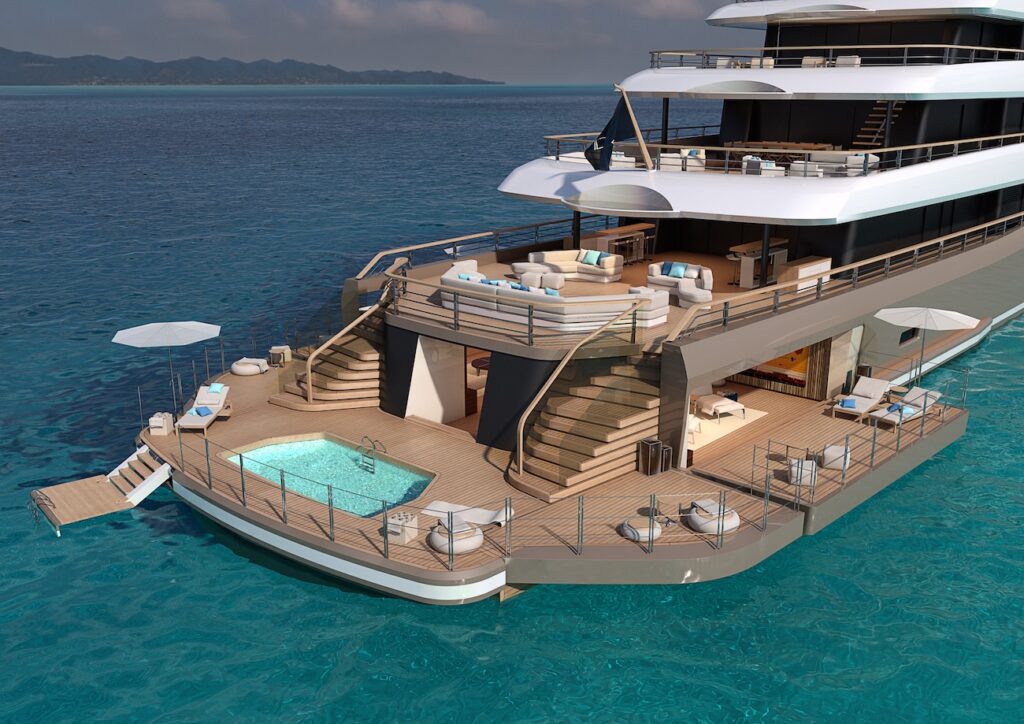
The beach club — the stern area at or near waterline that opens hydraulically to create a floating platform — has become the defining amenity of modern superyacht design. On the best examples, it’s a multi-level space with direct sea access, wet bar, freshwater shower, equipment storage for water toys (jet skis, Seabobs, inflatable slides), and seating that converts from sun lounger configuration to dining.
The beach club on the new 120-metre Project Tanzanite (Amels, 2026) features “open-air water patios” at waterline level — essentially a terrace from which guests step directly into the sea, surrounded by hull on three sides. At anchor in calm Mediterranean waters, it’s a remarkable environment.
Technology on the Water
The technology arms race on superyachts is accelerating, and 2025–2026 represents a step-change in what’s expected at the top tier.
What Top-Tier Superyachts Are Installing Now
- AI-assisted navigation: Collision avoidance systems, weather routing optimisation, and predictive maintenance analytics are becoming standard at the ultra-luxury tier
- Hybrid propulsion: Diesel-electric configurations — common for a decade — are now supplemented by battery storage systems for silent manoeuvring and harbour running
- Azipod propulsion: Electrically driven, steerable thruster pods (as on Amels’ unnamed 110m vessel built for 22 guests) enabling precise manoeuvring without bow thrusters
- Satcom internet (Starlink Maritime): Now the default connectivity solution; provides reliable gigabit-class connectivity in international waters
- Glass-bottom pools: Suspended pools with transparent floors offering ocean views; structural glass engineering at significant hydrostatic pressure
- Anti-paparazzi laser systems (Eclipse): Dazzles digital camera sensors; existence confirmed, independent operational verification limited
- Hydrogen propulsion research: RWD launched a hydrogen-powered superyacht concept in 2024 priced at $647M; the technology is real, fully commercial adoption is 5–10 years out
The 2025–2026 New Builds Changing Everything
The vessels that defined the 2025 delivery season — and those coming in 2026 — represent a genuine evolution in what a superyacht can be.
Lürssen, 2025
The most substantial vessel to launch from German yards in 2025. At 9,079 GT, she was among Lürssen’s first projects to use their new Bremen slipway, purpose-engineered for exceptional structural loads. Interior and full specification remain confidential — standard for Lürssen at this level.
Amels, 2026
The largest Dutch-built superyacht in history, launched by Amels in early 2026. Exterior by Espen Øino, interiors by Zuretti Design. The layout prioritises “architectural flow” with open-air water patios, light-filled lounges, and a multi-deck geometry that has been widely cited as redefining the Amels aesthetic.
Amels/Damen, 2025–26
Naval architecture by Damen Yachting, exterior design by Espen Øino, interior renderings by François Zuretti showing warm tones and sculptural furniture. At 6,083 GT, designed to operate with the lowest noise and vibration levels ever achieved on a vessel of this size. Accommodates 22 guests across 11 cabins, attended by 44 crew. Diesel-electric with Azipod propulsion.
Lürssen, 2025
Delivered to Sergey Brin in 2025, this vessel is double the length of his previous 73.3-metre SilverYachts build. Confirmed as a Lürssen build. Full specification and interiors not publicly disclosed.
Sources: Yachtway/BOATPro; Impact Wealth; Powerboat News
The True Cost of Ownership
This is where the conversation gets real. Buying a superyacht is the entry fee. Operating one is the ongoing commitment, and it’s substantial.
The industry benchmark — consistent across Fraser Yachts, Ocean Independence, Rightboat, and other credible management companies — puts annual running costs at 10–15% of the vessel’s purchase price, every year. That’s not a typo.
| Yacht Purchase Price | Annual Running Cost (10%) | Annual Running Cost (15%) | 5-Year Total (12.5% avg) |
|---|---|---|---|
| $20 million | $2 million | $3 million | $32.5 million |
| $50 million | $5 million | $7.5 million | $81.25 million |
| $100 million | $10 million | $15 million | $162.5 million |
| $500 million | $50 million | $75 million | $812.5 million |
| $600 million (Azzam est.) | $60 million | $90 million | $975 million |
Cost percentages: Fraser Yachts; Ocean Independence. Purchase price estimates are industry approximations.
The largest cost categories are crew (salaries, training, accommodation during layup), fuel, insurance, and periodic refit. A 60-metre yacht can easily spend €500,000 annually on berthing alone at premium Mediterranean marinas. During Grand Prix and major events in Monaco, daily marina rates for large vessels can reach €3,000–€20,000 per day.
A captain on a 100m+ vessel earns $80,000–$200,000 annually. The chef — who may hold a Michelin-starred background — earns comparably to a senior London restaurant chef, with accommodation and expenses included. The chief engineer, responsible for systems whose complexity rivals a small power station, is among the highest-paid crew members. The 44 crew required for the Amels 110m vessel above are earning collectively several million dollars per year in salaries alone.
“On a vessel worth €20 million, annual costs translate to between €2 million and €3 million a year to keep her fully operational — covering everything from crew salaries and fuel to berthing fees, insurance premiums, and routine maintenance.”
Fraser Yachts, Hidden Costs in Yacht Ownership, 2026One mitigation: charter. Placing a vessel on the charter market offsets 30–50% of annual running costs, according to Barnes Yachting. A 60m superyacht with a full amenity package can command €200,000–€500,000 per week on charter. A vessel like Eclipse, if it were ever available for charter (it isn’t), would command several million per week. For owners who want some financial return, charter is the mechanism — but it also means strangers are living in your home at sea, and some owners simply won’t accept that.
Design Trends Reshaping the Industry in 2026
The aesthetics of superyachts are shifting noticeably. A decade ago, the signature interior was heavy on dark wood panelling, gilt fittings, and maximalist furniture — conspicuous luxury as the primary language. Today’s most acclaimed interiors look considerably different.
The Shift Toward Spa Minimalism
Feadship’s Savannah — with Cristina Gherardi’s pale tones, sculptural furniture, and gallery-like calm — is cited repeatedly by designers and owners as a reference point. The trend is toward spaces that feel expansive, quiet, and almost residential rather than palatial. Natural stone, linen, bleached oak, and daylight are the new luxury signals.
Expedition Capability as a Feature
The shift toward expedition-capable vessels is real. Ice-class hulls, extended range, stabilisers optimised for open-ocean passages, and satcom connectivity sufficient for working remotely are now requested features even on vessels whose owners have no intention of going anywhere near Antarctica. The capability is the point — the sense that the vessel could go anywhere, anytime, without limitation.
Sustainability as a Purchase Driver
Hybrid propulsion is now expected on any serious new build at the top tier. Solar panels integrated into deck surfaces, shore-power connectivity to reduce generator running in harbour, and waste management systems meeting or exceeding the latest MARPOL marine pollution standards are moving from optional to standard. Fully hydrogen-powered vessels are in development but not yet commercially available at scale.
Biophilic Design and Wellness
Living walls (vertical gardens maintained by specialist crew), fresh herb gardens supplying the galley, bespoke scent systems throughout the vessel, circadian lighting that adjusts colour temperature through the day, and Scandinavian sauna/contrast therapy sequences — these are the features showing up in 2025–2026 build specifications that wouldn’t have been there five years ago.
Everything You’ve Wondered About Superyachts
What is technically defined as a superyacht?
A superyacht is any private pleasure vessel measuring 24 metres (approximately 79 feet) or longer. Beyond that baseline, the industry informally distinguishes between superyachts (24–60m), megayachts (60–100m), and gigayachts (100m+). The vessels discussed in this guide are primarily in the megayacht and gigayacht categories.
What is the world’s longest private yacht in 2026?
Azzam, built by Lürssen and delivered in 2013, remains the world’s longest private yacht at 180 metres. REV Ocean (183m) technically surpasses it but is classified as a research and expedition vessel with a scientific mission, not purely a private yacht. These distinctions are somewhat semantic, but they’re consistently maintained by the marine industry.
Do superyachts really have submarines?
Yes, verified. Personal submersibles manufactured by companies like U-Boat Worx and Triton Submarines are integrated into superyacht designs via dedicated garage spaces built below the waterline. Entry-level leisure submersibles capable of diving to 100–300m start at around $2 million. Multiple vessels including Eclipse and REV Ocean have confirmed submarine or submersible capabilities.
How much does a superyacht cost to run annually?
The consistent industry benchmark is 10–15% of purchase price per year, covering crew salaries, fuel, maintenance, insurance, docking fees, and periodic refit. On a $100M vessel that’s $10–15M annually, every year, regardless of how much you use it. This is why charter is often used to offset costs.
Is the IMAX cinema on Lady S real?
Yes. The IMAX Private Theatre on Lady S is confirmed in detail by Boat International and Yacht Intelligence, who collaborated on its design and installation. It plays 4K DCPs (the same format used in commercial IMAX theatres), is Dolby Atmos compliant, and features a screen spanning more than one deck. It required structural planning during the vessel’s build phase.
What is the anti-paparazzi laser on Eclipse?
Eclipse reportedly carries a laser system designed to dazzle the sensors of digital cameras used by paparazzi, making photography of the vessel at close range ineffective. The underlying technology (infrared laser dazzlers that saturate CCD/CMOS sensors) exists in military applications. Whether Eclipse’s implementation is fully effective against all camera types hasn’t been independently confirmed. The missile detection system is more widely cited and considered credible by marine security experts.
Can I charter a superyacht with an IMAX cinema or submarine?
In theory, vessels with these features could be chartered if their owners make them available. In practice, the most extreme-specification vessels (Eclipse, Azzam) are not on the charter market. Vessels with glass-bottom pools, outdoor cinema screens, and submersibles can be chartered; your broker will have current availability. Weekly rates for appropriately equipped vessels start at around €100,000 and rise to several million.
What does a snow room on a superyacht actually involve?
A snow room is a climate-controlled chamber maintained at sub-zero temperatures, designed as contrast therapy after a sauna or steam session. On land it requires heavy insulation and industrial refrigeration; at sea those requirements are compounded by the marine environment’s humidity, salt air, condensation challenges, and the structural considerations of thermal expansion differentials. It’s genuinely buildable — several new builds include them — but it’s expensive to install and to run.
Who are the leading superyacht builders in 2026?
For ultra-large custom builds: Lürssen (Germany), Feadship (Netherlands), and Blohm+Voss (Germany). For volume production at the 40–80m tier: Benetti and Azimut (Italy), Heesen (Netherlands), Amels (Netherlands), Oceanco (Netherlands). Turkish yards including Alia and Nebula are gaining credibility in the 50–80m segment. Italian builders collectively hold approximately 54% of global production by unit.
How are superyacht interiors designed — who actually does the work?
Large superyachts typically involve separate studios for naval architecture, exterior design, and interior design. A single vessel might involve Espen Øino (exterior), François Zuretti (interior), and Damen Yachting (naval architecture). Owners with a specific vision often hire an owner’s representative or project manager who interfaces between the yard and all design studios. Build times for 80m+ vessels typically run 3–5 years from contract to delivery.
Are superyachts good investments?
Almost invariably, no — not in a financial return sense. Superyachts depreciate, they have enormous running costs, and the resale market is illiquid. Charter income can offset some costs but rarely covers them fully. The honest framing is that a superyacht is a lifestyle asset and a time-enabling luxury, not an investment vehicle. Owners who try to approach them as investments typically end up disappointed.
What’s changed most dramatically in superyacht design in the last five years?
Two things: the integration of genuine sustainability technology (hybrid propulsion, reduced emissions, solar assistance) as a standard feature rather than a marketing add-on, and the generational shift in owner preferences away from maximalist opulence toward spa-influenced minimalism, wellness amenities, expedition capability, and connectivity for working at sea. The average owner is younger, more tech-literate, and less interested in impressing observers on the dock.
Final Thoughts: More Than a Rich Person’s Toy
There’s an easy, lazy take on superyachts: they’re obscene symbols of inequality, floating vanity projects for people with more money than taste. That take isn’t entirely wrong, but it’s not the whole story either.
The vessels being built right now — particularly the expedition-capable, sustainability-focused, technology-forward builds coming from Lürssen, Feadship, and Amels — represent genuinely remarkable achievements in engineering, naval architecture, and interior design. The IMAX cinema on Lady S required coordination between IMAX Corporation, specialist acoustic engineers, and a yacht builder. The pillar-free main salon on Azzam involved structural problem-solving that a civil engineering firm would respect. The semi-submerged glass-panel lounge on Feadship’s Savannah is an architectural achievement that happens to float.
None of that makes them equitable or necessary. What it makes them is interesting — technically, aesthetically, and culturally. They’re windows into what happens when constraints of cost are removed and the only questions are: what do you actually want, and how do we build it?
The answers, it turns out, include IMAX cinemas, submarine garages, snow rooms, underwater lounges, and swimming pools that become dance floors. Humanity’s extremes are always instructive, even when they’re uncomfortable.
More from the World of Ultra-Luxury
Billionaire Superyachts —And Why They Cost So Much
Mega Yachts With Helicopters, Pools… and Submarines
The Most Extreme Floating Mansions Ever Built at Sea
The Most Stunning Superyachts in the World
Inside a $500 Million Superyacht: What Pure Luxury Actually Looks Like
The Most Insane Yacht Interiors Ever Built
These Yachts Cost More Than Private Islands — Here’s Why
Yacht Amenities You Won’t Believe Exist: Best Guide!
The Most Powerful Superyachts —And What Makes Them So Fast