
The 25 Most Expensive Yachts Ever Built
— And Why They Cost So Much
A fully fact-checked guide to the world’s most extraordinary floating palaces — with verified prices, real specs, the stories behind each vessel, and an honest look at what makes these machines so breathtakingly expensive.
This guide covers the 25 most expensive superyachts ever built, ranked by verified build cost. Before you read on, a few things worth knowing up front:
- The most expensive yacht with a verified build cost is Azzam — $600–605 million — built by Lürssen for the late UAE president. It’s also the world’s longest private yacht at 180 meters (590 ft).
- Eclipse (Roman Abramovich) cost ~$590–700 million — figures vary because some estimates include major post-delivery upgrades. The original contract is most commonly cited at around €550 million (~$700M).
- The “History Supreme” $4.8 billion yacht is a confirmed hoax — it was never built. No official maritime registry, no verified photos, no credible construction records. We cover this in detail, and it doesn’t appear on our list.
- Jeff Bezos’ Koru cost ~$500 million — delivered April 2023 by Oceanco, and requires roughly $25–50 million per year to operate.
- Annual running costs are staggering: industry standards suggest 15–20% of build cost per year. A $600M yacht costs $90–120M a year just to keep operational.
- The superyacht market was valued at ~$31.8 billion in 2024 and is growing. Wealth concentration, geopolitical tensions, and sanctions have made this industry increasingly complex.
- Many of the most expensive yachts are now frozen or seized due to Russian sanctions — Sailing Yacht A ($578M) has sat in Trieste since March 2022.
There’s a moment when a ship stops being a boat and starts being a statement. At 180 meters long — roughly the height of the Washington Monument laid on its side — the Azzam doesn’t just float. It occupies. It commands a marina the way a cathedral commands a street. And it cost, by the most commonly cited figure, around $600 million to build.
That number is almost too abstract to hold in your head. A $600 million yacht. But here’s what makes the superyacht world genuinely fascinating rather than simply obscene: the engineering behind these vessels is extraordinary in ways that go far beyond square footage and gold fixtures. We’re talking about custom-designed propulsion systems capable of pushing 13,000 tons of steel at 30 knots. Satellite defense arrays. Submarine garages. Anti-paparazzi signal detection systems. Hull designs that required years of computational fluid dynamics modeling. When you buy a superyacht at this level, you’re not buying a boat — you’re commissioning a floating engineering program.
I’ve spent considerable time researching this subject, and one thing strikes me every time: the gap between what’s reported and what’s actually true is enormous. The internet is stuffed with lists claiming yachts cost $4.8 billion, or $1.5 billion, or a billion dollars, without a shred of primary-source verification. For this guide, I’ve gone back to Wikipedia citations, Reuters reports, official IMO registries, and the handful of serious trade publications — Boat International, SuperyachtFan, Superyacht Times — that actually do primary reporting on this industry.
What you get here are 25 verified vessels. Real prices, real specs, real owners. Where figures are genuinely disputed, I’ll tell you why — and give you the range. Let’s start with the one number everyone gets wrong.
The $4.8 Billion Hoax You Should Know About
Search for “most expensive yacht in the world” and you’ll still find dozens of articles claiming the title goes to History Supreme — a gold-plated vessel allegedly worth $4.8 billion, designed by British luxury goods designer Stuart Hughes and purchased by a Malaysian billionaire. It appears on lists across the web, including some that should know better.
The problem: it was never built, and it’s not real. As autoevolution’s deep-dive investigation found, the photos were stolen from Italian yacht builder Baia Yachts and used without permission. No official maritime registry has ever listed the vessel. No credible yachting publication — Boat International, Superyacht Times, Lloyd’s Register — has ever reported its construction or delivery. The supposed owner, Robert Kuok, has never confirmed any such purchase, and industry insiders have consistently described the entire story as a PR stunt. When journalists first contacted Stuart Hughes’ representatives, some initially confirmed the reports by email — and then went silent.
We’re not listing it. Not as a footnote, not as an honorable mention. It didn’t happen. The actual record — for a verified, registered, sailing vessel — belongs to Azzam.
The 25 Most Expensive Superyachts Ever Built
Ranked by best-available verified build cost. Prices marked with * reflect the most widely cited industry figure where exact contract terms were never publicly disclosed. All lengths and specifications drawn from Wikipedia, IMO registration data, or Lloyd’s Register where possible.
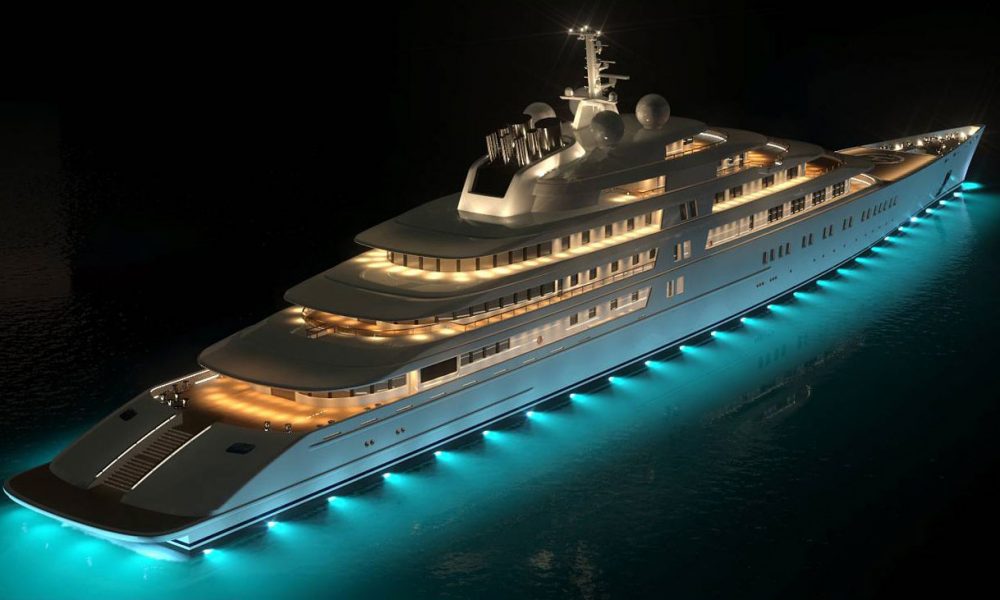
The world’s longest private yacht by any credible measurement. Commissioned by the late Khalifa bin Zayed Al Nahyan, president of the UAE, and now believed to belong to his successor Mohammed bin Zayed, Azzam represents what happens when a head of state decides to build something that simply cannot be equalled — and has the budget to back it.
What makes Azzam’s price tag credible is the engineering beneath the surface. Achieving 32 knots in a 13,000-ton vessel requires a hybrid diesel-and-gas-turbine propulsion system — a configuration more commonly associated with naval warships than pleasure craft. The hull was purpose-designed with thrust-vectoring pump-jets at the stern. Construction required around 4,000 workers over approximately three years. The interior, designed by French designer Christophe Leoni, reportedly incorporates an Empire-style aesthetic with extensive mother-of-pearl inlays — more than a year’s worth of pearl production went into the fit-out. A bullet-proof master suite and missile defense system are widely reported, though never officially confirmed.
The exterior, by Milan-based Nauta Design, is deliberately restrained — a long, clean profile that gives little away. The owner’s preference was speed to a private island near Abu Dhabi, which is why the naval architecture prioritized propulsion over sheer size.
Sources: Wikipedia (IMO 9693367), Boat International, BoatTEST, SuperyachtFanFor three years — from its delivery in December 2010 until Azzam launched in 2013 — Eclipse was the largest private motor yacht in the world. Designed by Terence Disdale, whose textural, classically-weighted aesthetic feels restrained until you look more closely and realize how much controlled detail is in every surface, Eclipse was conceived as Abramovich’s statement vessel after he sold Chelsea FC’s predecessor as a football club to… well, himself.
The price is genuinely contested. Wikipedia cites approximately €340 million at original contract. The most commonly reported figure in specialist publications is around €550 million (~$590–700M depending on exchange rates and delivery date), with post-delivery modifications pushing some estimates higher. What’s not in doubt: Eclipse carries two helicopter pads, 24 guest cabins, two swimming pools, a disco, and a mini-submarine capable of diving to 50 meters. There are also well-sourced reports — though never confirmed officially — of a missile detection system and laser-based anti-paparazzi technology.
As of August 2025, Eclipse left Turkey after two and a half years moored in Marmaris following Western sanctions on Abramovich. Its legal ownership status remains murky.
Sources: Wikipedia (IMO 1009613), YachtWorld, SuperyachtFan, AutoevolutionWhile Azzam is the longest, Dilbar holds an arguably more impressive record: largest in terms of interior volume at 15,917 gross tons, making it the most capacious private motor yacht ever built. It’s also home to the largest swimming pool ever installed on a superyacht — a 180 square meter indoor pool. Usmanov named the vessel after his mother.
The build cost sits in an unusually wide range — early reports cited around $600 million, while some later assessments placed it closer to $800 million when completed luxury fit-out is included. Exterior design is by Espen Øino (Monaco), interior by Winch Design (London). The vessel runs six power plants generating 40,000 combined horsepower and features 1,000 custom-made sofa cushions — that last detail shouldn’t make you laugh, but somehow it does.
Dilbar was seized by German authorities in Hamburg in March 2022 following EU sanctions on Usmanov after Russia’s invasion of Ukraine. It has remained detained since. In April 2025, Usmanov’s press service issued a statement regarding the yacht’s status — the situation remains legally unresolved.
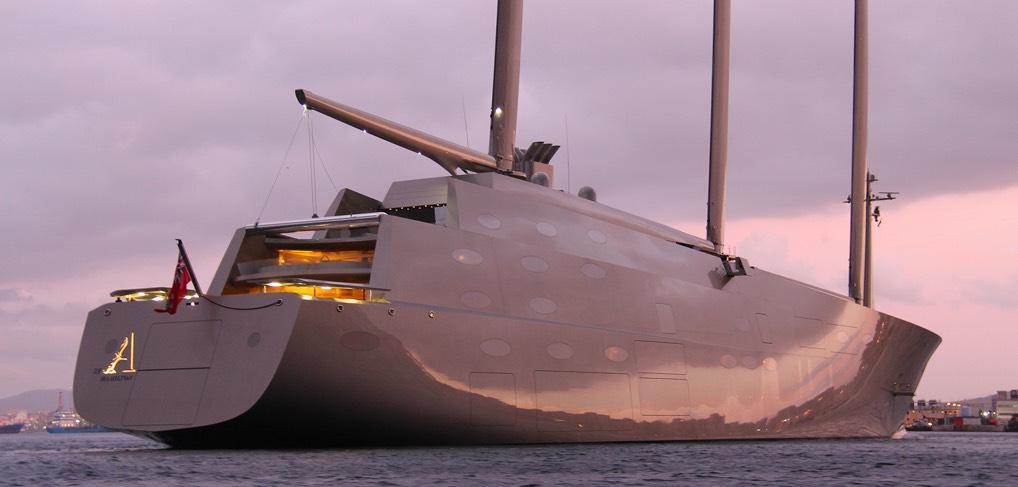
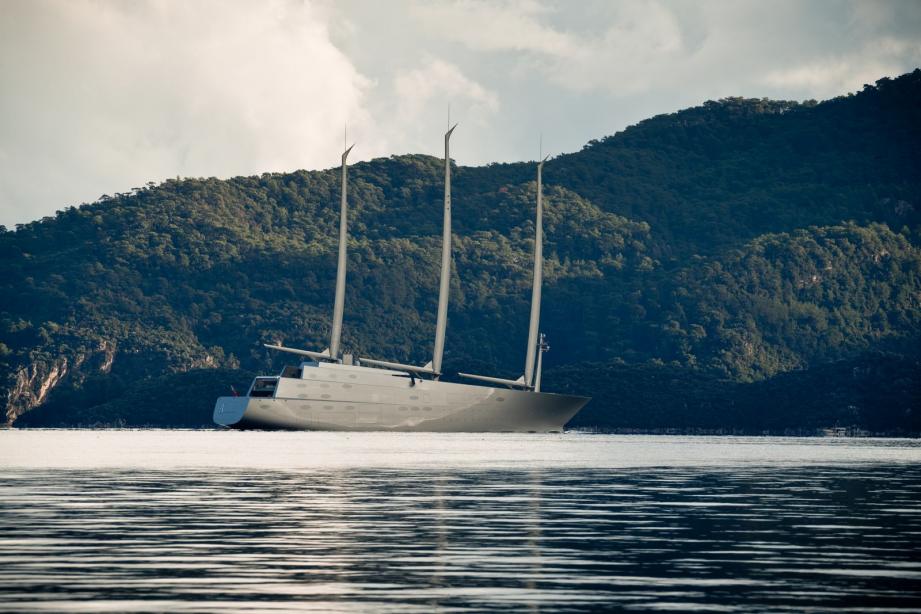
Sources: SuperyachtFan, LuxuryLaunches, Coherent Market InsightsPhilippe Starck’s design for Sailing Yacht A is one of the most genuinely audacious things ever put on water. The hull isn’t a yacht hull — it’s shaped like a submarine running on the surface, torpedo-smooth and black, with three carbon fiber masts rising to 90 meters each. The sails aren’t fabric in any traditional sense; they’re DynaRig hard sails operated by computer. The overall aesthetic is somewhere between a Jules Verne illustration and a contemporary art installation.
When Italian authorities seized the vessel at the port of Trieste in March 2022 following EU sanctions on Melnichenko, Reuters reported its value at approximately €530 million (~$578 million at the time). That remains the most authoritative price figure. The yacht has sat in Trieste ever since — frozen, legally contested, deteriorating slowly despite court-ordered maintenance requirements. It’s one of the most visible symbols of the sanctions crisis in the luxury industry.
The yacht features a glass-bottomed swimming pool and what Nobiskrug describes as the world’s first retractable keel on a vessel of this size.
Sources: Reuters (seizure report, March 2022), SuperyachtFan, Wikipedia, MalaymailNobody expected the world’s second-richest person to order a sailing yacht. That was the mild shock of early 2021 when word got out that Jeff Bezos had commissioned something from Oceanco in Alblasserdam. When the vessel emerged from the shed — all glossy black hull, three masts reaching 70 meters into the Dutch sky, with a carved wooden figurehead at the bow — it turned out to be unlike anything else in the billionaire fleet.
Koru means “new beginnings” in Māori. The yacht’s design was reportedly influenced by Barry Diller’s 93-meter EOS and Black Pearl, the remarkable sailing superyacht built for Russian billionaire Oleg Burlakov. Building it created at least one remarkable cultural moment: Oceanco initially requested Rotterdam’s historic 1927 Koningshaven Bridge be partially dismantled to let the 70-meter masts through. Citizens planned egg-throwing protests. Oceanco backed down and towed the vessel to another yard for mast installation.
Bezos also operates Abeona, a 75-meter support vessel built by Damen Yachting, reportedly costing around $75 million — a chase boat with a helipad since Koru has none. Together, the two vessels cost upwards of $575 million and run at roughly $30 million+ per year combined.
Sources: Wikipedia (IMO 9857298), Robb Report, YachtWorld, SCMP, WikipediaDubai has a strange origin story. Construction actually began for Prince Jefri Bolkiah of Brunei in the mid-1990s, under the name Platinum. Then Brunei’s finances imploded — the prince was accused of diverting billions in state funds — and the half-finished hull sat in a German shipyard. In 2001, Platinum Yachts in Dubai acquired it, the name changed, and the vessel that eventually emerged is now one of the most magnificent ever completed.
Wikipedia cites the cost at US $400 million. Other sources, including SuperyachtFan, cite closer to $500 million when accounting for the full decade of construction and fit-out. The interior, designed by Andrew Winch, features a color-changing glass staircase, handmade mosaic tiles in the swimming pool, and what Winch describes as a bold, immersive approach to color and material — quite different from the beige-and-cream aesthetic that dominates many yachts of this era.
Sources: Wikipedia (IMO listed), SuperyachtFan, YachtingMagazineFlying Fox is the world’s largest yacht available for charter, and it operates at the very top of the private hire market — weekly charter rates exceeding $1 million are not unusual. The owner’s identity has never been confirmed; the vessel is managed through a Luxembourg-registered company. What’s not anonymous is the yacht itself: two helicopter pads large enough for sizeable aircraft, a spa with 12-meter pool, a professional dive center, and five sprawling decks.
The build cost is typically cited in the $400 million range, consistent with Lürssen’s pricing for vessels of this length. Flying Fox frequently appears in the Mediterranean, and occasionally the Caribbean charter market, making it unusual among ultra-luxury yachts in that it regularly earns revenue for its owner.
Before Melnichenko commissioned his sailing masterpiece, he built Motor Yacht A — and it remains one of the most divisive designs in the superyacht world. Philippe Starck’s hull is impossibly angular: a razor-sharp bow, a polished surface that reflects the water below, windows cut at odd angles that look like the eyes of something decidedly non-maritime. Whether it’s beautiful or deeply strange probably depends on how much you love conventional yacht design.
Internally, A has a 2,500-square-foot master bedroom, a glass-bottomed pool, a helicopter hangar, and a separate speedboat dock. The name itself was chosen strategically: it ensures the vessel appears first in alphabetically sorted shipping registers. In 2013, Melnichenko’s company sued Akzo Nobel for $100 million over what it alleged was an unsatisfactory paint job — suggesting that even at $300 million, some things still go wrong.
Sources: SuperyachtFan, Wealthy Gorilla, SoakInsureTopaz is owned by Sheikh Mansour bin Zayed Al Nahyan — yes, the same man who owns Manchester City Football Club. At 147 meters and reportedly costing in the $500 million range, it features a clean, muscular exterior profile by Tim Heywood, with ample space across multiple decks for the 26 guests it can accommodate. It regularly features at the Monaco Yacht Show and is one of the most recognizable yachts in the Gulf fleet.
Rising Sun was built by Oracle’s Larry Ellison specifically to out-measure Paul Allen’s yacht — a classically billionaire motivation. The late Jon Bannenberg, widely considered the father of modern superyacht design, created the exterior. Eighty-two rooms across five decks include a basketball court (doubling as a helicopter pad), a wine cellar, private cinema, and spa. By the time it was finished, Ellison found it too large — one friend memorably described moving through it as “like walking in an empty mall.” Ellison sold it to music mogul David Geffen in 2010 for a reported $590 million (likely reflecting upgrades and appreciated value). The original build cost in 2004 was approximately $200 million.
Sources: SuperyachtFan, LuxuryLaunches, Wall Street Journal (2007 original report)Yachts #11–25: The Extended Ranking
The vessels below are all extraordinary in their own right — each costing north of $150 million. Their price figures carry slightly more uncertainty than the top ten (private transactions, undisclosed contracts), but all are sourced from specialist trade publications or Wikipedia-cited construction records.
| # | Yacht Name | Builder / Year | Owner | Length | Est. Build Cost | Notable Feature |
|---|---|---|---|---|---|---|
| 11 | Kismet | Lürssen / 2014 | Shahid Khan | 122 m (400 ft) | ~$200M | Grand piano, cinema, Jacuzzi deck |
| 12 | Al Said | Lürssen / 2008 | Sultan of Oman | 155 m (508 ft) | ~$300M* | Largest gross tonnage of any private yacht (15,850 GT), concert hall |
| 13 | Octopus | Lürssen / 2003 | Estate of Paul Allen | 126 m (414 ft) | ~$200M | Two submarines, ROV, recording studio |
| 14 | Pelorus | Lürssen / 2003 | Roman Abramovich (prev. various) | 115 m (377 ft) | ~$300M* | Terence Disdale design; helipad, beach club |
| 15 | Lady Moura | Blohm+Voss / 1990 | Nasser Al-Rashid | 105 m (344 ft) | ~$210M* | Gold lettering on hull, one of the first mega-yachts of this generation |
| 16 | Solaris | Lloyd Werft / 2021 | Roman Abramovich (seized) | 140 m (459 ft) | ~$600M* | Ultra-modern exterior; seized in Barcelona, Mar 2022 |
| 17 | Fulk Al Salamah | Lürssen / 1999 | Sultan of Oman | 164 m (538 ft) | ~$340M* | Second-longest private yacht globally, Oman’s royal vessel |
| 18 | Black Pearl | Oceanco / 2018 | Estate of Oleg Burlakov | 106.7 m (350 ft) | ~$180M | Hybrid DynaRig sailing system; inspired Bezos’ Koru |
| 19 | Amadea | Lürssen / 2017 | Suleiman Kerimov (seized) | 106 m (348 ft) | ~$325M* | Seized by US DOJ 2022; used by Fijian courts as evidence |
| 20 | REV Ocean | Vard / 2025 | Kjell Inge Røkke / Research | 183 m (600 ft) | ~$350M* | World’s largest research vessel; scientific not pleasure-focused |
| 21 | Tis | Benetti / 2012 | Viktor Rashnikov | 72 m (236 ft) | ~$150M | One of the most elaborately fitted Benetti vessels of its era |
| 22 | Serene | Fincantieri / 2011 | Mohammed bin Salman (prev. Yuri Shefler) | 134 m (440 ft) | ~$330M | Sold to Saudi crown prince; night club, spa, multiple pools |
| 23 | Tûranor PlanetSolar | Knierim / 2010 | Various (now research) | 35 m (115 ft) | ~$17M | World’s first solar-powered vessel to circumnavigate the globe |
| 24 | Tango | Royal Huisman / 2010 | Viktor Vekselberg (seized) | 77.7 m (255 ft) | ~$120M* | Seized by Spain 2022; among earliest oligarch asset seizures |
| 25 | Yas | ADM Shipyard / 2011 | Abu Dhabi royal family | 72 m (236 ft) | ~$150M* | Features Formula 1 themed design, commissioned for Abu Dhabi GP |
What Actually Drives the Cost?
After spending time with this research, the question that kept coming up is: why does Azzam cost $600 million when a perfectly respectable 80-meter superyacht — still extraordinary by any measure — runs around $50–80 million? What is the billionaire paying for in that extra $520 million?
The honest answer involves several compounding factors, and they’re more interesting than the obvious “gold fixtures” answer most people expect.
1. Scale Creates Exponential Cost Increases
Naval architects will tell you that as you move past about 90 meters in length, costs don’t scale linearly — they accelerate. The number of yards capable of building vessels above 100 meters is tiny. Lürssen, Feadship, Oceanco, Nobiskrug, Blohm+Voss — these are not mass-production facilities. Each vessel is essentially a custom manufacturing project. The workforce required, the specialized equipment, the engineering hours — all of these multiply as you push toward 130, 150, 180 meters. As BoatTEST notes, a 100-meter superyacht typically costs $100–200 million; Azzam is five times that figure.
2. Propulsion Engineering at This Scale Is Warship Territory
Getting a 13,000-ton hull to move at 30 knots requires propulsion solutions borrowed from military naval design. Azzam’s hybrid diesel-gas turbine system with thrust-vectoring pump-jets isn’t available off a shelf. It’s engineered from scratch. Eclipse carries four MTU 20V 1163 TB93 diesel engines and triple screw propellers producing nearly 40,000 horsepower combined. Dilbar runs six power plants. Each of these propulsion systems involves years of design, testing, and certification work.
3. Interior Fit-Out Costs Are Genuinely Staggering
The interior specification of a vessel like Azzam — where more than a year’s pearl production went into the fit-out alone — represents a level of craftsmanship that simply doesn’t scale down in price. Custom furniture, hand-laid mosaics, bespoke art collections, one-off light installations, marble surfaces cut to the exact curves of the hull: these are not items you buy from a catalog. Specialized workshops in Italy, France, and Germany produce them over years.
4. Security and Technology Systems
Anti-missile detection systems. Signal-jamming technology. Encrypted communications. Biometric access control throughout 162 meters of vessel. Submarine garages. Laser-based camera-detection systems. These features — reported across Eclipse, Azzam, and several others — are individually expensive; integrated into a marine platform that must remain functional at sea, in weather, for extended periods, they are extraordinarily so.
5. The Labor of Scale
Azzam’s construction reportedly employed around 4,000 workers over three years. Eclipse involved hundreds of specialists from Blohm+Voss and dozens of contracted workshops. When you buy a $600 million yacht, you’re largely paying for an extraordinary concentration of human skill and time.
In the yachting industry, there’s a well-established benchmark: annual operating costs run at roughly 10–20% of the yacht’s build cost, depending on age and usage. For newer superyachts it trends toward the lower end; for vessels over a decade old it climbs toward 20%.
What this means in practice: a $600 million yacht costs $90–120 million a year to operate. That’s crew salaries, fuel, insurance, dockage, routine maintenance, five-yearly dry-dock surveys, and unexpected repairs. Azzam’s fuel tank — approximately 1,000,000 liters — costs between $800,000 and $1.5 million per fill depending on fuel prices.
Source: Bray Marine International, Insure4Boats analysis, Lengers Yachts (2025). Insure4Boats breakdown here.
The Hidden Price: Annual Running Costs
| Yacht | Build Cost | Est. Annual Running (10–15%) | Weekly Fuel Cost (approx.) | Crew Size |
|---|---|---|---|---|
| Azzam | $605M | $60–90M | $1M–$1.5M | 60 |
| Eclipse | ~$700M | $60–70M | $700K–$1M | 70 |
| Dilbar | ~$800M | ~$60M | $783K (per refuel) | 96 |
| Koru | ~$500M | $25–50M | Lower (sail-assist) | 40 |
| Dubai | ~$400M | ~$50M | $500K–$800K | 88 |
Sanctions, Seizures, and the New Geopolitics of Superyachts
Russia’s February 2022 invasion of Ukraine changed the superyacht industry in ways that are still unfolding. In the months that followed, Western governments seized or froze dozens of superyachts belonging to sanctioned Russian oligarchs. The vessels affected represent billions of dollars in assets — and raise genuinely difficult legal and practical questions that the industry has never had to confront at this scale.
Consider the situation with Sailing Yacht A. Seized in Trieste in March 2022 at a court-assessed value of €530 million, the vessel cannot be sold (legally disputed), cannot be chartered (same), but must be maintained to prevent deterioration — which means Italy bears maintenance costs on a $578 million yacht that doesn’t belong to the state and can’t easily be disposed of. As SuperyachtFan’s 2026 reporting notes, ongoing questions about maintenance, insurance, legal responsibility, and long-term asset management remain unresolved.
Dilbar sits in Hamburg in similar legal limbo. Amadea was seized by the US Department of Justice in 2022 and its status has been contested in Fijian courts. Tango (Viktor Vekselberg) was one of the first assets seized by Spain. Solaris, another Abramovich vessel seized in Barcelona, remains frozen.
“The sanctions question has exposed something the industry never quite had to reckon with: a $600 million yacht is not a liquid asset. You can’t easily sell it, can’t easily move it, and if it sits long enough, it starts to cost its unwilling custodians significant money.”
Analysis based on SuperyachtFan (April 2026), Reuters seizure reporting, and Boat International market intelligenceThe practical effect on the market has been mixed. Shipyards like Lürssen remain busy — there’s no shortage of ultra-wealthy buyers from the Gulf, Asia, and the Americas. But the visibility of seized Russian oligarch yachts has prompted some owners to restructure ownership through trusts and corporate entities in less obvious jurisdictions, adding another layer of opacity to an industry already noted for discretion.
The Superyacht Market in 2025: What the Numbers Actually Show
There are several market research firms covering the superyacht sector, and their figures vary somewhat — which is worth flagging. Coherent Market Insights puts the market at $19–21 billion; 6Wresearch at $30.5 billion; Reanin at $31.8 billion. The discrepancy largely reflects different definitions of “superyacht” (24m+ vs 30m+ vs other cutoffs) and varying methodologies. What all of them agree on is trajectory: the market is growing, driven by increasing concentration of ultra-high-net-worth wealth globally, younger generations of HNWIs entering the market earlier, and continued technological investment in hybrid propulsion and sustainable design.
The most interesting trend in new construction is the emergence of genuine hybrid propulsion. Where vessels like Azzam and Eclipse represent peak fossil-fuel engineering, newer builds from Feadship and Damen are incorporating electric and biofuel hybrid systems with meaningful zero-emission cruising ranges. Feadship’s Project 821, launched 2024 at 119 meters, includes hybrid propulsion as standard. Damen’s new Yacht Support vessels are designed around LNG and zero-emission capability.
This shift isn’t purely altruistic — emission regulations in key cruising areas like Norway’s fjords and parts of the Mediterranean are tightening. Owners who want to anchor where they want, when they want, increasingly need clean propulsion capability to do so.
Frequently Asked Questions
What is the most expensive yacht ever built?
With a verified build cost of approximately $600–605 million, Azzam — a 180-meter motor yacht built by Lürssen for the late UAE president Khalifa bin Zayed Al Nahyan — holds the confirmed record. It was delivered in 2013 and remains the world’s longest private motor yacht. Figures you may have seen claiming a $4.8 billion “History Supreme” yacht are based on a documented hoax that was never built.
Is the History Supreme $4.8 billion yacht real?
No. Multiple investigative reports — including detailed analyses by Autoevolution, FinTelegram, and Admiral Marine — have confirmed that History Supreme was never constructed. The photos used in early reports were stolen from Italian builder Baia Yachts. No official maritime registry has ever listed the vessel, and no credible yachting publication has confirmed its existence. It remains one of the most widely-cited and most thoroughly debunked hoaxes in luxury goods history.
What is the world’s longest private yacht?
Azzam, at 180 meters (590 feet), holds the record for the longest privately owned motor yacht. If research and expedition vessels are included, REV Ocean — delivered 2024–2025 by Norwegian shipyard Vard at 183 meters — is longer, but it functions as a scientific research vessel rather than a private pleasure craft.
How much does it cost to run a superyacht each year?
Industry specialists consistently cite 10–20% of build cost per year as the operating benchmark, with 15% being the most commonly applied figure for newer vessels. Bray Marine International’s data suggests 12% for the first four years, rising to 15% by year seven and 20%+ thereafter. For a $600 million yacht like Azzam, this implies annual running costs of $60–120 million — covering crew, fuel, insurance, dockage, maintenance, and five-yearly dry-dock surveys.
Who owns the most expensive yachts in the world?
The roster is dominated by Gulf royal families (UAE’s Al Nahyan dynasty owns Azzam; Qatar, Oman, and Bahrain royals feature prominently), Russian billionaires (Abramovich, Melnichenko, Usmanov — many of whose vessels are now under sanctions), and tech billionaires (Bezos’ Koru being the most recent high-profile entry). The Gulf royals represent probably the highest concentration of yacht wealth, with multiple vessels per ruling family.
What happened to Roman Abramovich’s yachts after sanctions?
Abramovich moved his main fleet — Eclipse, Solaris, Pelorus, and others — to Turkey and other non-sanctioning jurisdictions before Western sanctions could freeze them. Solaris was seized in Barcelona in 2022; Eclipse spent two and a half years moored in Marmaris, Turkey, before moving in August 2025. Ownership on paper reportedly changed hands in late 2022, though Abramovich’s actual beneficial interest is widely presumed to continue by Western authorities.
How long does it take to build a superyacht of this size?
Typically three to five years for vessels in the 100–180 meter range, from keel-laying to delivery. Azzam was completed in approximately three years — remarkable for its size. Koru took five years. Major delays occur when designs are particularly complex (Sailing Yacht A’s carbon masts required significant development time), when there are supply chain issues, or when owners change their specifications mid-build. Yards often have two-to-three-year order backlogs for their best builders.
Why are so many of the most expensive yachts built in Germany or the Netherlands?
Lürssen (Bremen, Germany), Blohm+Voss (Hamburg), Nobiskrug (Rendsburg, Germany), Feadship and Oceanco (Netherlands) collectively account for the large majority of superyachts above 80 meters. These yards have decades of accumulated expertise, skilled workforces, established supply chains for specialized marine components, and — crucially — the physical infrastructure (dry docks, fabrication halls, waterway access) to handle vessels of this scale. Italian yards (Benetti, Fincantieri) lead the 40–80 meter segment.
Can you charter the most expensive yachts in the world?
Most cannot be chartered privately — they’re genuinely personal vessels for their owners. Flying Fox (Lürssen, 136m) is the notable exception: it’s the world’s largest superyacht available for charter, at rates exceeding $1 million per week. Kismet (Lürssen, 122m) has also been available for charter. Some of the smaller vessels in our extended list occasionally enter the charter market during peak Mediterranean seasons.
What is the cheapest way to experience a superyacht?
Charter rates for superyachts in the 40–60 meter range start from around $50,000–$150,000 per week plus expenses (fuel, port fees, crew gratuity typically another 15–20%). For a group of 8–10, this is expensive but not incomprehensible. Alternatively, fractional ownership programs are emerging — companies like YachtLife and Yachtico offer share-based access to smaller luxury vessels. The mega-yachts on this list are simply not accessible at any price point other than ownership or friendship with the owner.
Are superyachts a good investment?
Almost universally no, in the conventional sense. Yachts depreciate — typical annual depreciation is 7–10% of value. Combined with 10–20% annual running costs, the total cost of ownership for a $100 million yacht can exceed $25–30 million per year before any actual use. Charter income can offset some costs, but the industry is clear that no one seriously buys a superyacht as an appreciating asset. They are purchased as lifestyle assets — expressions of how the owner wants to live — rather than financial instruments.
What is the largest yacht currently under construction (2025)?
Several significant projects are underway but under NDA at the major German yards. Feadship’s Project 821 (119m) launched 2024. Lürssen reportedly has multiple vessels in the 100–130m range in progress. The most ambitious rumored project is a vessel reportedly commissioned by a Gulf royal at approximately 180 meters — which would challenge Azzam’s length record. Yard schedules typically run 2–3 years out, meaning significant 2025 orders won’t emerge until 2027–2028.
Why do superyachts have such large crews?
A vessel like Eclipse (162m) carries 70 crew for roughly 36 guests — nearly a 2:1 ratio. This reflects the complexity of the vessel (engine room, bridge, hospitality, security, medical, dive operations, helicopter operations must all be staffed), maritime safety regulations that mandate specific crew-to-length ratios, and the service standard expected by owners who are spending $60 million a year on operations. Crew salaries alone for a 70-person team can represent $5–8 million annually at industry-standard rates.
Is the superyacht industry environmentally sustainable?
Honestly, it’s a genuine tension. A single trip from Monaco to Ibiza on Eclipse burns more fuel than many families use in a year. The industry is responding — hybrid propulsion, LNG fueling, shore power connectivity, and waste management systems are all advancing quickly. But the fundamental physics of moving very large, very fast vessels long distances will always carry an environmental cost. The more honest framing is that the industry is improving, but remains one of the more fuel-intensive forms of luxury travel per passenger.
Final Thoughts
The most expensive yachts ever built exist at the intersection of extraordinary wealth and extraordinary engineering. What strikes me, after going deep on this research, is how much legitimate technical achievement hides beneath the obvious opulence. Getting 13,000 tons of steel to 32 knots requires solutions that push the boundaries of naval architecture. The carbon fiber masts on Sailing Yacht A represent materials science that didn’t exist twenty years ago. The DynaRig computer-sail system on Black Pearl is, genuinely, remarkable technology.
None of that makes these vessels anything other than the exclusive property of the very, very wealthy. But it’s worth understanding that when you look at a price tag like $600 million, you’re not just looking at gold fixtures and excess — you’re looking at the concentrated output of thousands of highly skilled workers, years of engineering time, and manufacturing capability that exists at only a handful of locations on earth.
The sanctions era has added a dimension that nobody in the industry saw coming: the question of what happens when a $600 million asset becomes legally impossible to sell, use, or maintain. Sailing Yacht A sitting in Trieste, Dilbar in Hamburg — these are the strangest footnotes in the story, and they’re still being written.
What’s certain is that the superyacht industry continues to grow, continues to push technical boundaries, and — through the work of yards like Feadship and Oceanco — is slowly grappling with the question of what sustainable ultra-luxury actually looks like. The answer, over the next decade, will probably cost around $700 million to find out.
Top 10 Most Expensive Cruise Ships Ever Built
The Most Insane Yacht Interiors Ever Built
Inside a $500 Million Superyacht: What Pure Luxury Actually Looks Like
Most Expensive Yachts in the World
The Most Unrealistically Expensive Yachts in the World
The Most Stunning Superyachts in the World
How Billionaires Customize Yachts— And What They Actually Add
The Most Beautiful Luxury Yachts — And What Makes Them Special
The Most Extreme Floating Mansions Ever Built at Sea