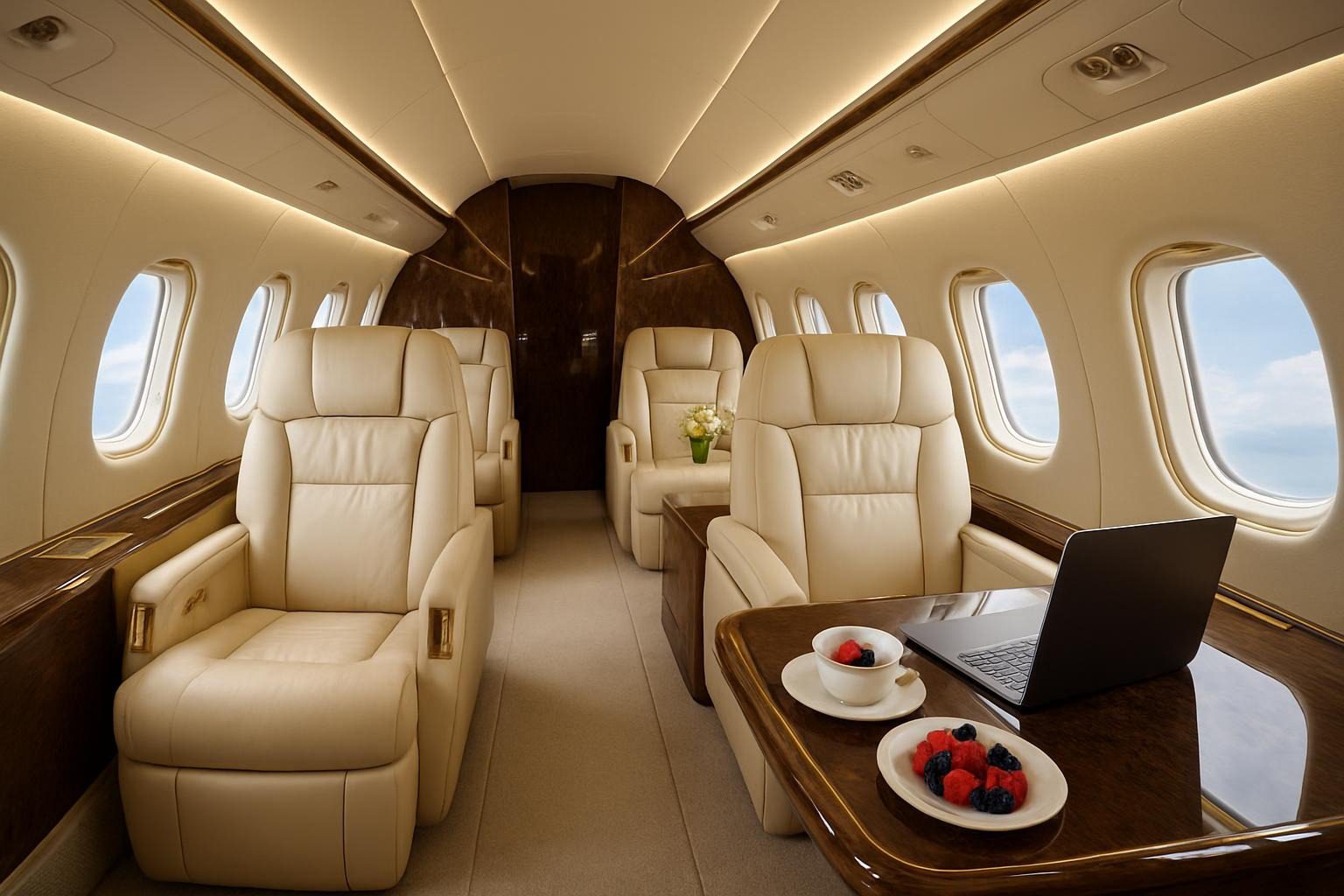
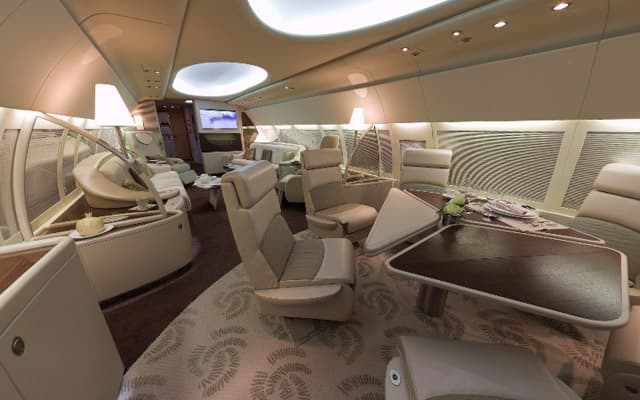
A “green” aircraft is an airframe with no interior—bare walls, no seats, no systems beyond the minimum required to fly. Boeing delivers them that way to VIP customers, who then hand them to a completion center for the actual work. Joseph Lau’s Boeing 787-8 started life as a $153 million green jet. By the time the interior was finished, the total had reached an estimated $367 million. That $214 million gap is what this article is about.
Not the gold fixtures. Not the spiral staircase (which may or may not exist—more on sourcing below). The gap. Because understanding what drives these costs tells you something genuinely interesting about the economics of extreme custom work that the “flying palace” framing completely buries.
Why Widebody Completions Cost This Much
The short answer is regulatory weight. Every material inside a certified aircraft—every seat, every panel, every strip of leather—must be FAA-certified (or EASA-certified for European operators) for flammability, structural integrity, and electromagnetic compatibility. That sofa in the forward lounge isn’t just a sofa. It’s a Supplemental Type Certificate (STC) item that required testing, documentation, and sign-off. The same goes for the lighting system, the entertainment screens, the cabinetry, the floor panels.
This is the part that trips people up. The materials themselves—rare woods, hand-stitched leathers, custom veneers—are not the dominant cost driver. Certification is. A bespoke leather panel that costs $2,000 to fabricate can require $50,000 in engineering and testing documentation to certify for flight. Multiply that by every surface in a widebody fuselage, and the math becomes uncomfortable fast.
Completion centers like Lufthansa Technik, Comlux, and Greenpoint Technologies have developed proprietary STC packages that cover entire aircraft types—this is their competitive moat. A new entrant can’t just decide to complete a 787; they’d need to build the certification library from scratch, which takes years and costs tens of millions before a single panel goes in. The incumbents amortize those costs across multiple projects. Still, for a single one-off completion, the customer absorbs most of the engineering burden. That’s a significant fraction of the headline number.
The leather panel costs $2,000 to make and $50,000 to certify for flight. Multiply that across a widebody fuselage. Now the headline number makes sense.
The Five Most Expensive Aircraft Interiors
The most documented widebody VIP completion by cost, and the one most often cited as a record. Lau, a Hong Kong real estate developer known for his art collection, commissioned the conversion through a completion center; the aircraft was delivered green by Boeing around 2015. Per Luxuo’s coverage, the interior includes multiple bedroom suites, lounge areas, and a gym. A spiral staircase is frequently mentioned in secondary reporting, though the original source for this specific detail is unclear—it has been repeated across publications without a verifiable photograph or primary documentation.
The 787 airframe is notable because its composite fuselage allows for larger windows and better cabin pressurization than aluminum-framed jets—meaningful for passenger comfort on ultra-long flights. For VIP use, it also means slightly different completion challenges, as composite materials require different attachment methods than traditional aluminum.
The $214M interior figure has been widely reported but originates from trade and luxury media estimates, not a disclosed transaction. It is probably the most credible number in this category, but “most credible” is a low bar when the entire category lacks public financial disclosure.
- Airframe
- Boeing 787-8
- Green Aircraft Cost
- ~$153M
- Interior Cost (est.)
- ~$214M
- Total Est. Value
- ~$367M
- Completion Year
- ~2015
- Source Quality
- Trade/luxury media est.
Usmanov, a Russian-Uzbek billionaire with holdings in mining and technology, has been associated with one of the most extensively customized A340s in private aviation. The A340’s four-engine configuration makes it less fuel-efficient than modern twins, but it remains popular for VIP use because of its exceptional range and the psychological preference some owners have for quad-engine aircraft on transoceanic routes. Per AeroCorner’s technical coverage, the A340-300 can seat up to 295 passengers in commercial configuration; in VIP fit, the same space accommodates 25–30 guests in layouts that approach residential square footage.
The ~$162M interior estimate circulates in aviation media but has not been confirmed by any primary disclosure. The ~$400M total is a composite of airframe value and interior estimate. Treat both as order-of-magnitude figures, not verified prices. Usmanov’s assets have been subject to EU and UK sanctions since 2022, which has complicated any public reporting on his fleet.
- Airframe
- Airbus A340-300
- Interior Cost (est.)
- ~$162M
- Total Est. Value
- ~$400M
- Guest Capacity
- ~25–30 VIP
- Source Quality
- Aviation media est.; unverified
HNA Group, the Chinese conglomerate that collapsed spectacularly in 2021 after years of aggressive debt-fueled expansion, commissioned a Boeing Business Jet 787 before its financial implosion. Aviation media reported features including a master suite with heated floors and large-format displays. The completion was documented before HNA’s bankruptcy proceedings began; the aircraft’s current status and ownership are unclear from public sources.
This is worth flagging because it illustrates something the “luxury aviation as investment” narrative ignores entirely: when the owner goes bankrupt, the aircraft enters a distressed sale process where the realized value can be dramatically below the completion cost. HNA liquidated assets under severe time pressure. A one-of-one VIP interior that cost $100M+ to build does not necessarily recover that value at a forced sale, particularly when the buyer pool for such specific configurations is thin.
- Airframe
- Boeing 787-8 BBJ
- Interior Cost (est.)
- >$100M
- Total Est. Value
- ~$324M
- Owner Status
- HNA Group bankrupt 2021
- Current Status
- Unknown from public sources
Hassanal Bolkiah, Sultan of Brunei, is among the world’s most documented collectors of extravagant aircraft—his fleet at peak reportedly included over 100 jets. The Boeing 747-430 VIP fit has been described in aviation media as including gold-plated fixtures and extensive custom woodwork. The 747’s double-deck configuration provides genuinely unusual layout options not available on single-aisle or standard widebody airframes.
Boeing announced the end of 747 production in 2023, with the final delivery completed in February of that year. This matters for maintenance: as the operational fleet shrinks, parts availability narrows, MRO specialists become scarcer, and the cost of keeping an existing 747 airworthy rises. That’s a real ownership cost factor that the headline completion price doesn’t capture. An aircraft worth $220M to build can become increasingly expensive—and eventually impractical—to operate.
- Airframe
- Boeing 747-430
- Interior Cost (est.)
- >$100M
- Total Est. Value
- ~$220M
- Production Status
- 747 production ended Feb 2023
- Source Quality
- Aviation media / fleet reporting
The only narrowbody on this list, and the one with the starkest contrast between interior ambition and airframe economics. A Gulfstream III is a 1970s-era design—Perry’s specific aircraft is a heavily modified G-III with an interior reportedly including a custom theater and personalized finishes. At $125M total, the completion cost exceeds what a brand-new Gulfstream G700 (the current flagship) costs at list price.
That’s a genuine curiosity. An older airframe with a $50M interior investment may have high sentimental or brand value for its owner, but the economics of maintenance, parts obsolescence, and resale are unfavorable compared to a modern platform. No criticism of Perry’s choice—preferences are preferences—but it’s a useful illustration of how “value” in this category is almost entirely subjective.
- Airframe
- Gulfstream III (1970s design)
- Interior Cost (est.)
- ~$50M
- Total Est. Value
- ~$125M
- Comparable New Aircraft
- G700 lists at ~$78M
- Source Quality
- Celebrity aviation media; unverified
The Comparison Table
| Aircraft | Interior Est. | Total Est. | Airframe | Completion Era | Data Confidence |
|---|---|---|---|---|---|
| Lau Boeing 787-8 | ~$214M | ~$367M | 787-8 (widebody) | ~2015 | Low–mediumTrade media estimate |
| Usmanov A340-300 | ~$162M | ~$400M | A340-300 (widebody) | ~2010s | LowUnverified; owner under sanctions |
| HNA Group 787-8 BBJ | >$100M | ~$324M | 787-8 BBJ (widebody) | ~2016–18 | LowOwner bankrupt; status unclear |
| Sultan of Brunei 747-430 | >$100M | ~$220M | 747-430 (widebody) | ~2000s | LowFleet reporting only |
| Tyler Perry G-III | ~$50M | ~$125M | Gulfstream III (narrowbody) | ~2010s | LowCelebrity media; unverified |
The Part Nobody Talks About: Operating Costs
A $214M interior doesn’t fly itself. And the ongoing costs of operating a widebody VIP aircraft are genuinely staggering in a way that makes the completion price look like a one-time line item.
A Boeing 787 burns approximately 5,400 kg of fuel per hour at cruise. At current jet-A prices—roughly $0.70–$1.00 per liter depending on location and contract—a transatlantic flight from London to New York costs somewhere in the range of $40,000–$60,000 in fuel alone. Add crew (a widebody requires two pilots and typically multiple cabin crew), landing fees, handling, insurance, and the base maintenance reserve, and you’re looking at direct operating costs that can run $8,000–$15,000 per flight hour for a large VIP widebody. The exact figure depends heavily on routing, crew structure, and maintenance contracts—these are industry estimates from operators, not published tariffs.
The annual “fixed overhead” for a grounded aircraft—insurance, hangar, crew salaries, airworthiness management—can exceed $5M per year for a widebody, regardless of whether it flies a single hour. People who commission $200M interiors are not, presumably, worrying about this. But it’s worth stating clearly: the completion cost is not the total cost of owning one of these aircraft. It’s the entry fee.
The $214M interior is the entry fee. The ongoing bill—fuel, crew, maintenance, insurance—can run $10,000+ per flight hour on top of that.
When It Goes Wrong: The HNA Cautionary Case
In 2018, HNA Group was one of China’s most aggressive acquirers, having spent years buying stakes in hotels, airlines, airports, and aircraft. Then the credit stopped. By 2021, HNA had filed for bankruptcy with debts exceeding $186 billion, per Reuters’ reporting on the bankruptcy filing. Its aircraft assets—including the VIP 787—entered liquidation processes.
Here’s the thing about a one-of-one $100M+ interior in a distressed sale: the buyer pool is already thin under normal conditions. Under forced liquidation, with a time constraint and a specific airframe configuration that may not suit every prospective buyer’s preferred layout, realized values can fall dramatically short of completion cost. This is not speculation—it follows directly from basic asset liquidity principles. A custom jet interior has no standardized secondary market. Its value on a given day is whatever a small number of qualified buyers are willing to pay, and in a distressed sale, the seller has no negotiating leverage.
The luxury aviation press talks a great deal about appreciation. The HNA case is a useful corrective: at the extreme end, these assets can lose substantial value quickly when the owner’s circumstances change.
What’s Actually Happening in the Market Right Now
Boeing’s 747 production ended in February 2023. That matters because the 747 has been the platform of choice for some of the most ambitious VIP conversions—its double-deck fuselage offers layout possibilities unavailable on any other commercial airframe. As existing 747 VIP jets age, the maintenance cost curve rises and the pool of qualified MRO providers shrinks. New 747 VIP projects are no longer possible. Existing ones become incrementally harder to sustain.
On the Airbus side, the A380 was the obvious next candidate for ultra-wide-body VIP conversion. Airbus ended A380 production in 2021. Several high-profile VIP A380 projects were announced over the years—including one attributed to Prince Al-Waleed bin Talal—but most appear to have stalled or been cancelled as the commercial program wound down. No completed VIP A380 has been publicly documented with verified specifics.
The 787 and A350 are now the realistic platforms for new widebody VIP work. Both are active production programs with long-term parts support. But the conversion market has also become more complicated post-pandemic: supply chain disruptions extended green aircraft delivery timelines, completion center capacity has been stretched, and regulatory requirements have increased. The era of rapid commission-to-delivery widebody completions appears to be over, at least temporarily.
Frequently Asked Questions
What is the most expensive aircraft interior in the world?
Why does FAA certification drive so much of the cost?
Are these aircraft actually good investments?
What happened to the planned VIP Airbus A380 projects?
How do completion center costs break down?
What Comes Next
The widebody VIP market in 2025 is in a constrained but active phase. The 787 and A350 are the platforms, the completion centers are booked, and the supply of green aircraft available for VIP conversion has been restricted by Boeing’s well-documented production challenges over the past several years. The result is a market where new projects are slower and more expensive than they were in 2018, and where existing custom interiors—particularly those on 747s—are becoming incrementally more maintenance-intensive.
The next record, if it comes, will almost certainly be on a 787 or A350. Whether it will be disclosed publicly is another question entirely. One of the most consistent features of this category is opacity: the more extreme the project, the less the owner typically wants it documented. The $214M Lau figure is, paradoxically, well-reported partly because Lau has a public profile through his art collection. Most comparable projects remain entirely undisclosed.
If you’re trying to understand what the actual ceiling of this market is, the honest answer is that nobody outside a handful of completion centers and their clients knows. The published figures are the visible tip. The rest is private.
The more extreme the project, the less the owner wants it documented. The $214M figure exists in the public record partly by accident. Most comparable projects are never disclosed at all.
The Most Expensive Helicopters in the World — And Why Every Price List You’ve Read Is Wrong
These Yachts Cost More Than Private Islands — Here’s Why
Lucid Burns $176,000 Per Vehicle Producing Ultra-Luxury EVs. Nobody Buys
These Yachts Cost Hundreds of Millions — Here’s Why
Leave a Reply