The World’s Most Expensive Art Auctions: Every Record That Rewrote History
From a $125 flea-market find that became a $450 million masterpiece, to a Nazi-confiscated portrait that sold for more than any modern artwork in history — the complete record, updated through 2026.
Three paintings account for more auction revenue than the entire GDP of several small nations. One of them was bought at a New Orleans estate sale for $1,175, sat unrecognized for decades, and then fetched $450 million. Another was seized by Nazis, hidden in a family estate in Austria, and came up for auction for the first time in November 2025 — selling for $236.4 million after a 20-minute bidding war. The art auction market is not merely commerce. It is a collision of history, trauma, obsession, and capital — and the records it sets tell you something about the world that no economic report quite does.
The numbers alone are only part of the story. What makes these sales remarkable isn’t the hammer price — it’s the provenance. Every painting in the top 10 most expensive ever auctioned carries a history that reads like a thriller: confiscation during wartime, decades of ownership disputes, clandestine acquisitions by sovereign wealth funds, or quiet discovery in the back room of a minor auction house. Strip out the drama and you lose half the price.
This guide covers every major auction record set in the modern era — the genuine all-time figures, properly verified, with the real context that explains how they happened. It also tracks how the market has shifted since the record-setting 2022 peak, why 2025 ended as the first growth year in three, and what the May 2026 New York auctions are being watched to confirm.
The All-Time Record That Still Stands
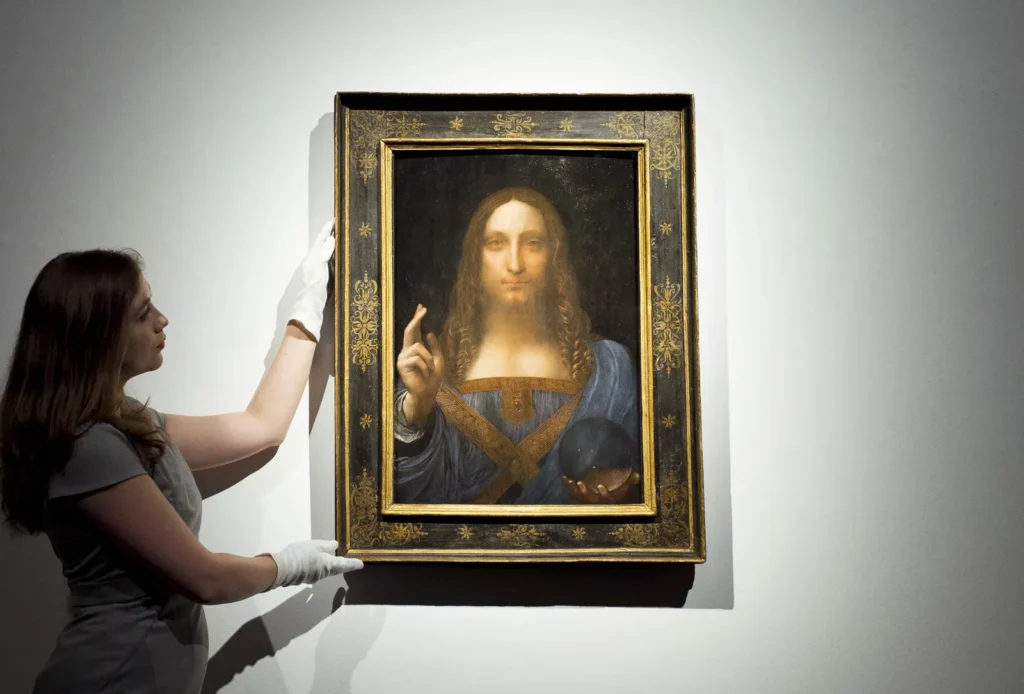
Nobody expected $450 million. Christie’s estimated the Salvator Mundi at $100 million. Even the most aggressive pre-sale whisper numbers topped out around $200 million. What happened on the evening of November 15, 2017, in Rockefeller Center, exceeded every projection — and eight years later, the record still hasn’t been touched.
The backstory is almost impossible to believe as a work of fiction. The painting spent over 150 years missing entirely — vanishing from documented records around 1763. It was rediscovered in the early 2000s in an American private collection, so damaged and over-painted that its true authorship wasn’t immediately obvious. A six-year restoration and authentication process followed. When it was exhibited at the National Gallery London in 2011 as part of an exhibition of Leonardo’s surviving paintings, the art world formally accepted it — mostly. Some attribution questions remain. The Christie’s sale billed it as “The Last da Vinci,” the last known painting by Leonardo in private hands. Whether or not it is entirely autograph, the market made its judgment emphatically.
“The bidding lasted 19 minutes. The room had over 1,000 art collectors, advisors, dealers, and journalists present, with thousands more watching via livestream. Some went quiet when it hit $300 million. At $400 million, there were audible gasps.”
— Christie’s post-sale account, November 2017The Top 10 Most Expensive Artworks Ever Auctioned
What follows is every entry in the verified all-time top 10, with the sale price including buyer’s premium — the number that actually changed hands. All prices in USD.
All prices include buyer’s premium. Sources: Christie’s, Sotheby’s, Phillips official records; ARTnews; Artnet News. Updated June 2026.
| # | Artwork | Artist | Year Made | Auction House | Sale Date | Price (USD) |
|---|---|---|---|---|---|---|
| 1 | Salvator Mundi | Leonardo da Vinci | c. 1500 | Christie’s NY | Nov 2017 | $450,312,500 |
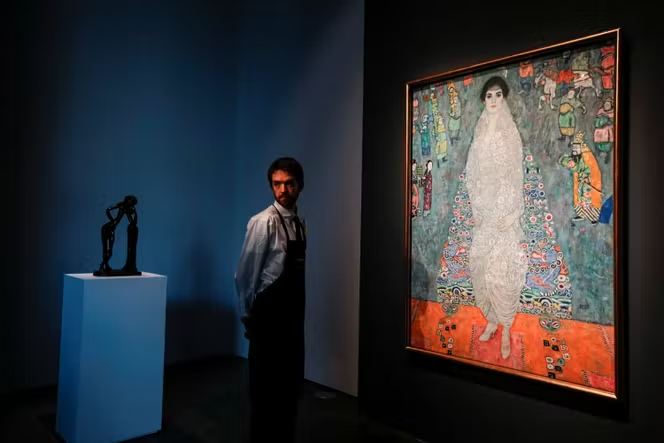
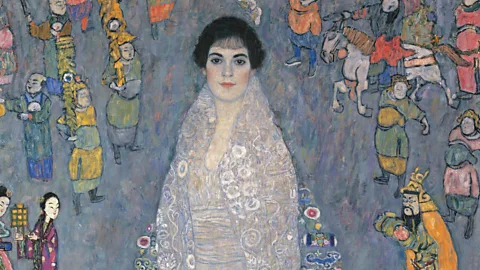
| 2 | Portrait of Elisabeth Lederer | Gustav Klimt | 1914–16 | Sotheby’s NY | Nov 2025 | $236,360,000 |
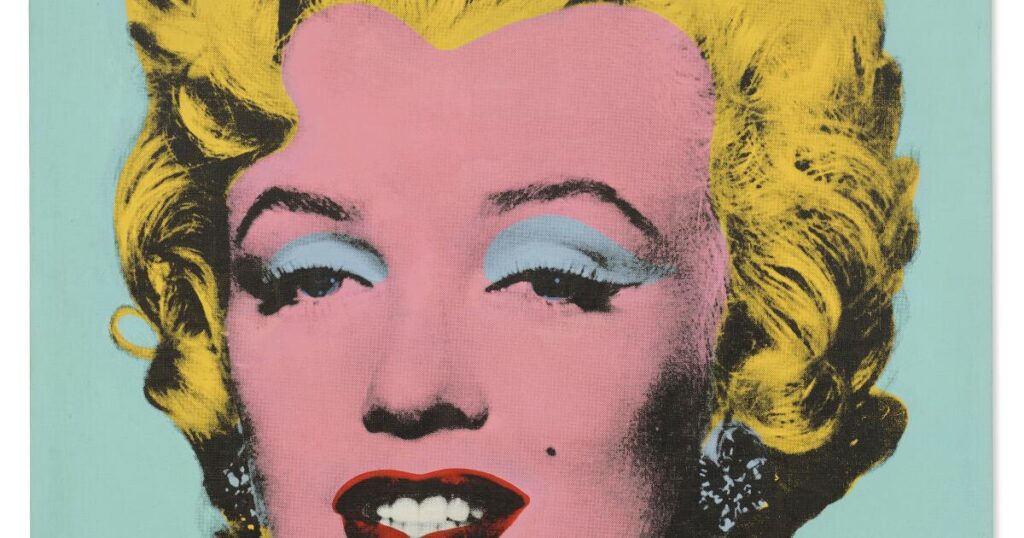
| 3 | Shot Sage Blue Marilyn | Andy Warhol | 1964 | Christie’s NY | May 2022 | $195,040,000 |
| 4 | The Women of Algiers (Version O) | Pablo Picasso | 1955 | Christie’s NY | May 2015 | $179,365,000 |
| 5 | Nu couché | Amedeo Modigliani | 1917–18 | Christie’s NY | Nov 2015 | $170,405,000 |
| 6 | Nu couché (sur le côté gauche) | Amedeo Modigliani | c. 1917 | Sotheby’s NY | May 2018 | $157,159,000 |
| 7 | Three Studies of Lucian Freud | Francis Bacon | 1969 | Christie’s NY | Nov 2013 | $142,405,000 |
| 8 | L’homme au doigt (Pointing Man) | Alberto Giacometti | 1947 | Christie’s NY | May 2015 | $141,285,000 |
| 9 | Dame mit Fächer (Lady with a Fan) | Gustav Klimt | 1917–18 | Sotheby’s London | Jun 2023 | $108,405,000 |
| 10 | Empire of Light (L’Empire des lumières) | René Magritte | 1954 | Christie’s NY | Nov 2024 | $121,175,000 |
| 11 | Meules (Haystacks) | Claude Monet | 1890 | Sotheby’s NY | May 2019 | $110,747,000 |
| 12 | Blumenwiese (Blooming Meadow) | Gustav Klimt | c. 1908 | Sotheby’s NY | Nov 2025 | $86,000,000 |
| 13 | Young Man Holding a Roundel | Sandro Botticelli | c. 1470s | Sotheby’s NY | Jan 2021 | $92,184,000 |
| 14 | Masterpiece (Les Femmes d’Alger) | Pablo Picasso | 1965 | Christie’s NY | Nov 2021 | $103,433,000 |
| 15 | Nymphéas en fleur | Claude Monet | 1914–17 | Sotheby’s NY | Nov 2024 | $65,510,000 |
| 16 | El sueño (La cama) | Frida Kahlo | 1940 | Sotheby’s NY | Nov 2025 | ~$57,000,000 |
| 17 | No. 31 (Yellow Stripe) | Mark Rothko | 1958 | Christie’s NY | Nov 2025 | $62,160,000 |
| 18 | Untitled (ELMAR) | Jean-Michel Basquiat | 1982 | Phillips NY | May 2024 | $46,479,000 |
| 19 | Comp. Large Red Plane (1922) | Piet Mondrian | 1922 | Christie’s NY | Nov 2025 | $47,600,000 |
| 20 | La Lecture (Marie-Thérèse) | Pablo Picasso | 1932 | Christie’s NY | Nov 2025 | $45,500,000 |
November 2025: The Sale That Revived a Market
For three consecutive years — 2022, 2023, 2024 — the art auction market contracted. Combined sales at Christie’s, Sotheby’s, and Phillips fell from a record $7.1 billion in 2022 to roughly $4.1 billion in 2024. Consignments dried up. Collectors who had bought at peak prices sat on their hands. The art world grew quietly anxious.
Then November 2025 happened.
The proximate cause was the Leonard A. Lauder collection — 55 works consigned to Sotheby’s by the estate of the cosmetics heir and legendary collector who died in June at the age of 92. Lauder had donated his unparalleled Cubist collection to the Metropolitan Museum of Art in 2013. What remained was smaller in volume but devastating in quality: three Klimts, Henri Matisse bronzes, Agnes Martin abstractions, a rare Edvard Munch, and a full-length Klimt portrait that had never before been offered at public auction.
The bidding opened at $130 million inside Sotheby’s brand-new headquarters in the refurbished Breuer Building on Madison Avenue — itself a historically loaded venue that Leonard Lauder knew intimately as a longtime trustee of the Whitney Museum, which occupied the Breuer from 1966 to 2014. It narrowed to two phone bidders: one handled by specialist David Galperin, the other by Julian Dawes. The hammer fell with Dawes’s client winning at $205 million. Including fees, the total reached $236.4 million.
The five Klimt pieces from Lauder’s collection sold that evening for a combined $392 million. The full Lauder sale, across two sessions, raised $527.5 million — comfortably ahead of its $400 million estimate. Sotheby’s had guaranteed the entire collection.
The Full 2025 Season: A Year-by-Year Comparison
The 100 most expensive lots auctioned in 2025 totaled $2.13 billion — up from $1.8 billion in 2024 and the strongest year since 2022’s $1.1 billion top-10 alone. The November New York week saw Christie’s, Sotheby’s, and Phillips together clear more than $2 billion in a single seven-day stretch, setting 16 artist auction records.
Sources: Bank of America/ArtTactic U.S. Art Market Report, Spring 2026; Puck News analysis. 2026 figure is a projection based on pre-sale estimates for the May New York season ($1.8B–$2.6B low–high range, Christie’s + Sotheby’s + Phillips + Bonhams).
The 2025 Top 10 at a Glance
| # | Artwork | Artist | Auction House | Price (USD) |
|---|---|---|---|---|
| 1 | Portrait of Elisabeth Lederer (1914–16) | Gustav Klimt | Sotheby’s NY, Nov | $236,360,000 |
| 2 | Blumenwiese (Blooming Meadow, c. 1908) | Gustav Klimt | Sotheby’s NY, Nov | $86,000,000 |
| 3 | Romans Parisiens (Les Livres jaunes, 1887) | Vincent van Gogh | Sotheby’s NY, Nov | ~$65,000,000 |
| 4 | El sueño (La cama, 1940) | Frida Kahlo | Sotheby’s NY, Nov | ~$57,000,000 |
| 5 | No. 31 (Yellow Stripe, 1958) | Mark Rothko | Christie’s NY, Nov | $62,160,000 |
| 6 | Untitled (new-to-market Basquiat, 1982) | Jean-Michel Basquiat | Sotheby’s NY, Nov | ~$55,000,000 |
| 7 | Waldabhang bei Unterach (1916) | Gustav Klimt | Sotheby’s NY, Nov | ~$52,000,000 |
| 8 | Comp. Large Red Plane, 1922 | Piet Mondrian | Christie’s NY, Nov | $47,600,000 |
| 9 | La Lecture (Marie-Thérèse, 1932) | Pablo Picasso | Christie’s NY, Nov | $45,500,000 |
| 10 | Nymphéas, 1907 | Claude Monet | Christie’s NY, Nov | $45,480,000 |
Why These Numbers Exist: The Mechanics of Nine-Figure Sales
A painting that cost $125 at a New Orleans estate sale does not become worth $450 million because someone got lucky. The process by which auction records are set follows a pattern, and understanding it reveals something the headline price always obscures.
Scarcity Is Not What You Think It Is
The Salvator Mundi is one of approximately 16 known surviving paintings by Leonardo da Vinci. That’s not just rare — it’s a category entirely its own. When Christie’s billed it as “The Last da Vinci,” they weren’t being hyperbolic: it was and remains the only known Leonardo in private hands. Most of the others hang in the Louvre, the Hermitage, the Uffizi, the National Gallery. They are institutionally immovable. The Salvator Mundi was the only one that could, in theory, be purchased. That scarcity is structural, not incidental.
The Klimt portraits operate on a similar logic. As Sotheby’s European chairman Oliver Barker noted during the 2025 sale, the Elisabeth Lederer portrait was “really one of the last opportunities to acquire a portrait of this significance by the artist.” Only two full-length named Klimt commissions remain in private hands. After 2025, arguably one does.
Provenance Adds and Subtracts Millions
Art’s provenance — its documented chain of ownership — functions like a property title, except that gaps in that title don’t just lower value, they can invalidate a sale entirely. The Klimt portraits carry the additional weight of wartime confiscation and restitution: they survived the Nazis, which makes them both historically freighted and legally clean (having gone through formal restitution proceedings). That combination — dramatic history, clear title — is extremely valuable.
The Salvator Mundi’s provenance is more complicated. It had a gap of roughly 150 years in its documented history. The authentication process required six years of scholarly examination. Even today, a minority of scholars questions whether the crystal orb was painted by Leonardo himself or a workshop assistant. The market’s answer — $450 million — suggests buyers were comfortable with that uncertainty. Or at least one buyer was.
The Guarantee System and What It Actually Means
Auction guarantees are less well-understood than they should be. When an auction house “guarantees” a consignment, it means the house has promised the seller a minimum price regardless of what the room does. If the bidding falls short, the house — or a third-party “irrevocable bid” investor — covers the gap.
For the 2025 Lauder sale, Sotheby’s guaranteed the entire collection at a figure reported by market sources at roughly $400 million. In the weeks before the auction, it sought third-party investors to provide irrevocable bids on the three main Klimts, jointly valued at $300 million. By the morning of the sale, those backstop bids were in place — visible in Sotheby’s catalog as small symbols next to most lots. This guarantee structure reduces risk for sellers but also means the auction house has significant skin in the outcome. A failed guarantee sale isn’t just embarrassing — it costs money.
The practical effect on price: guarantees allow sellers to consign work they might otherwise hold back. Without the guarantee, the Lauder estate might have taken several major Klimts private. The guarantee brought them to market, generating competition and ultimately the $236.4 million result.
The Role of Phone Bidders — and What We Don’t Know
Almost every nine-figure sale is completed via telephone bid. The buyers at these price levels almost never bid in the room. At the Klimt sale, the winning bid came from a phone bidder working with Sotheby’s specialist Julian Dawes. At the Salvator Mundi sale in 2017, the buyer — later identified in reporting as acting on behalf of Saudi Crown Prince Mohammed bin Salman — bid by phone. Their identity was not disclosed at the hammer.
This opacity is a feature of the market, not a bug. Major collectors at these price levels have powerful incentives to remain anonymous: to prevent inflating the perceived value of works they already own, to avoid kidnapping or security risks, and to preserve negotiating leverage in future private sales. The result is that several of the world’s most expensive paintings are held by owners the public cannot identify, in locations that have never been disclosed.
A Brief History of How Auction Records Got Here
Nine-figure art auction prices are a recent invention. As recently as 1987, a Van Gogh selling for $39.9 million was considered a market-defining event. The march to $100 million, then $200 million, then $450 million happened in roughly 30 years and tracked almost exactly with the expansion of global ultra-high-net-worth wealth.
The Market in 2026: Recovery, Caution, and What May Comes Next
The Bank of America/ArtTactic U.S. Art Market Report for Spring 2026 is, as of this writing, the most comprehensive recent data source on where the market stands. Its headline finding: 2025 ended with $4.55 billion in combined major house sales — an 11.1% increase from 2024 and the first growth year since 2022. The rebound was concentrated in the above-$10 million segment, driven heavily by single-owner collection sales.
But the report’s caveats are important. Sellers remain cautious. Consignment volumes are driven by lifecycle events — deaths, divorces, estate liquidations — rather than opportunistic selling by collectors who believe prices are rising. Guarantee usage is up, meaning auction houses are carrying more risk. And geopolitical uncertainty — the report mentions escalating global conflict directly — could pressure collector confidence.
The May 2026 New York auctions are the clearest signal yet of whether the recovery is real. The pre-sale estimates are remarkable: Christie’s alone is targeting $1 billion to $1.5 billion. Sotheby’s low estimate is $690.4 million — 70% higher than its entire May 2025 hammer total. Combined across Christie’s, Sotheby’s, Phillips, and Bonhams, the season could clear $2.6 billion. If it does, 2026 will likely surpass 2025 as the strongest year since the 2022 peak.
“Nearly half of all major house sales in 2025 came from works priced above $5 million — the very sector of the market that had been missing for three years. That’s not a healthy market structure. It’s a market being held up by trophy lots.”
— Puck News / Wall Power, January 2026The Geography of Ultra-High-Value Buying
New York remains the uncontested center of gravity for nine-figure art sales. Every work in the all-time top 10 was sold in New York — a remarkable geographic concentration that reflects where the deepest pools of collector capital are most readily mobilized for public sale. London and Hong Kong matter for the mid-market and for specific categories (Chinese ink painting, British art, Impressionist works with European provenance), but when it comes to breaking records, it happens at Rockefeller Center or on the Upper East Side.
The buyer geography is less concentrated. The Salvator Mundi’s reported buyer was Saudi. The Klimt and Warhol records involved phone bidders whose identities remain undisclosed but where speculation centers on Gulf and Southeast Asian wealth. The shift of art-collecting capital from North Atlantic wealth to global ultra-high-net-worth buyers is the most structurally significant change in the market since the 1980s.
The $450 Million Question: Will the Record Fall?
Here’s the uncomfortable honest answer: probably not soon, and possibly not in a public auction. The Salvator Mundi record has stood since 2017. The Klimt got to $236 million — remarkable, but still 47% below the Leonardo. Nothing currently visible in the consignment pipeline appears capable of closing that gap.
The works that could theoretically challenge the record are almost all institutionally owned. Vermeer’s Girl with a Pearl Earring is at the Mauritshuis. The Mona Lisa is French national property. The most important privately held works tend to move through private sales — where prices can exceed auction results but are never publicly disclosed and don’t “count” as auction records.
The more likely scenario for the next major auction record: a previously unknown work surfaces (as the Salvator Mundi did), or a major private collection liquidation brings something unprecedented to market. The Lauder sale was five years in the making. The next equivalent event — a collection of comparable depth and quality coming to public auction for the first time — is not currently scheduled. Which is precisely what makes auction records feel like history rather than news: they don’t arrive on a predictable schedule.
The buyer’s premium — the fee paid to the auction house on top of the hammer price — has grown significantly over the decades. At Christie’s and Sotheby’s, the premium on a $200 million sale is roughly 15%. On the Klimt’s $205 million hammer price, the $31.4 million premium took the final price to $236.4 million.
For sellers, this is invisible — they receive the hammer price. For buyers, it means the “real” cost of a trophy work is always higher than the number that makes the headline. At ultra-high price levels, some buyers negotiate bespoke premium arrangements directly with auction houses. The details of those arrangements are never disclosed publicly.
What this means practically: the gap between “auction record” and “price paid” is real, and at nine figures, it runs into the tens of millions. The $450 million Salvator Mundi cost its buyer approximately $450.3 million. The $236 million Klimt cost its buyer $236.36 million. The numbers you read are the complete numbers — but the mechanics behind them reward scrutiny.
For a broader look at luxury price records across categories — from rare cars and watches to private islands and yachts — the team at MostExpensives.com tracks the upper edge of what money can buy across every market imaginable. The patterns that emerge when you look at art alongside other luxury categories are genuinely surprising: the volatility of art prices, relative to, say, rare whisky or classic cars, is much lower than most people assume.
What These Numbers Actually Mean
A painting does not have an intrinsic price. It has a context, a history, a moment, and a set of bidders with specific motivations on a specific evening. The Salvator Mundi was worth $1,175 in a New Orleans estate sale and $450 million seven years later in Rockefeller Center — not because the canvas changed, but because the context did. Authentication, provenance research, institutional exhibition, masterful salesmanship, and a global pool of buyers who had never existed before all converged.
That’s the real lesson of auction records. They are not measurements of a painting’s beauty or cultural importance. The Mona Lisa has never been sold and is effectively priceless in the literal sense — no transaction defines its value. The works that reach $100 million or $200 million or $450 million at auction are, in most cases, works that can be sold: privately held, legally clear, of sufficient quality to attract international competition, and available at a moment when the right buyers are active.
The fact that a Nazi-looted portrait of a Viennese woman can sell for $236 million in 2025, after hanging above a cosmetics heir’s dining table for 40 years, while never once having been publicly offered — that’s not an economic event. It’s a compressed history of the 20th century, converted into a number by two anonymous phone bidders in the middle of a Tuesday evening in New York.
Explore more world-record prices across luxury categories — art, real estate, cars, watches, and beyond.
Browse All Records at MostExpensives.comMost Expensive Modern Art 2025—Record Prices Revealed
The 12 Most Expensive Sculptures in the World Ever Sold
Most Expensive Custom and Limited Cars: Best Guide 2025-2026
https://www.mostexpensives.com/blog/
Leave a Reply