
Last Updated: May 2026 · Verified auction data from Sotheby’s, Christie’s & Phillips
The Most Expensive Rings in the World: The Real Pricing Framework Behind Record-Breaking Stones
The gap between a $50,000 diamond ring and a $71 million one is not a matter of taste. It is a specific combination of measurable, verifiable factors — and the collectors who understand them navigate this market in a way that looks almost unfair to those who don’t.
Most guides hand you a ranked list and stop there. What they skip is the operating logic: why these stones cost what they cost, what inflects price at the margin, and how the same framework applies whether you’re studying auction records or making a considered purchase at a fraction of that scale.
TL;DR
Record ring prices are driven by the simultaneous convergence of four factors: gemological classification (GIA color intensity grade), geological rarity (diamond Type), provenance depth, and auction-room dynamics. Missing any one of these costs you 40–60% of the price story.
This article draws on verified auction records from Sotheby’s, Christie’s, and Phillips; GIA published rarity data; and the documented histories of the world’s most significant diamond rings. No fabricated statistics. No unverified private sale figures treated as confirmed fact.
What “Most Expensive Rings” Actually Means — and Why Most Definitions Miss the Point
The most expensive rings in the world are priced on converging scarcity: geological rarity, gemological perfection, irreproducible provenance, and the attention of a small number of extraordinarily wealthy buyers competing simultaneously. Remove any one of those four factors and the price can drop by 40–60%.
The Working Definition Practitioners Actually Use
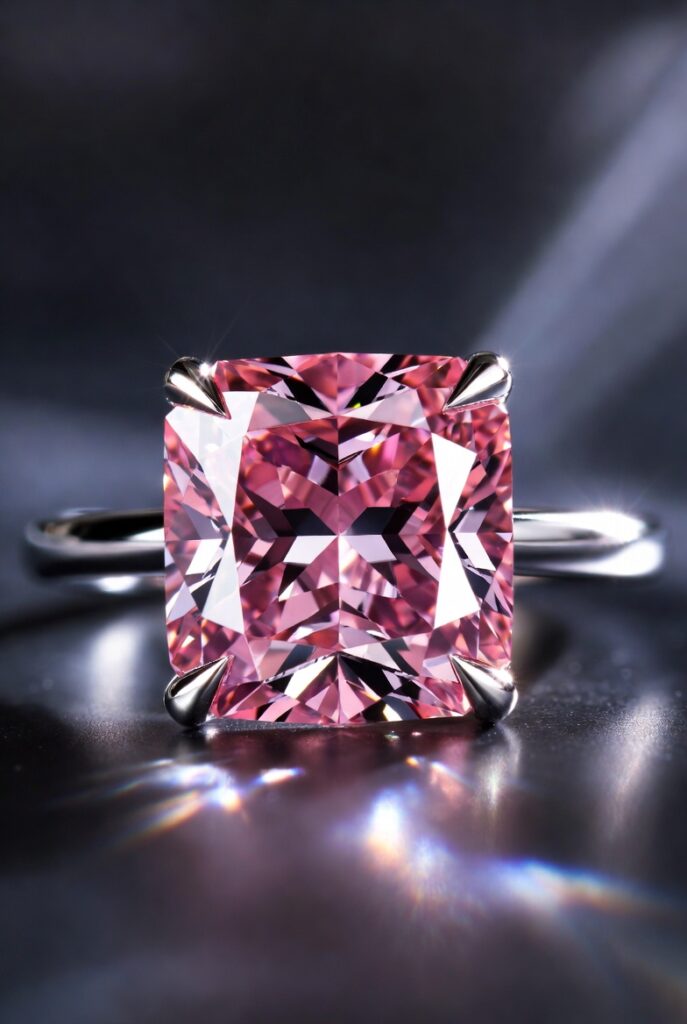
A record-priced ring is not the most beautiful or the largest. It is the stone that sits at the intersection of all scarcity variables at once. The Pink Star — the confirmed auction record-holder at $71.2 million — is 59.6 carats, Fancy Vivid Pink by GIA grading, Internally Flawless, and classified as Type IIa (the purest diamond composition possible). Every one of those attributes is independently rare. Together, they are nearly impossible to replicate.
Auction specialists and serious collectors work from this definition. The ring setting is the context in which the stone is presented, but the stone is the asset. A Cartier or Graff mount adds a layer of prestige, but at the top end of this market, the mount rarely accounts for more than a few percentage points of the total price.
Why the Textbook Version Creates Confusion
Most consumer-facing content leads with carat weight. This actively misleads. A 30-carat brown diamond is worth a fraction of a 10-carat Fancy Vivid Blue. The GIA’s grading system for colored diamonds — evaluating hue, tone, and saturation across nine intensity grades — is the mechanism that actually drives price for the world’s most expensive stones.
How the Most Expensive Ring Market Actually Works: The Real Three-Phase Framework
The pricing logic behind record rings follows a three-phase structure. Experienced collectors and auction house specialists navigate all three instinctively. Most buyers skip Phase 1 entirely — and pay for it.
Phase 1
Gemological Classification — The Foundation Most Buyers Skip
Before provenance, before aesthetics, before the auction room atmosphere, price originates in gemological classification. The GIA grades colored diamonds on three axes: hue (spectral color), tone (lightness/darkness), and saturation (intensity). The highest grade — Fancy Vivid — commands exponentially more than Fancy Intense or Fancy Light of the same color.
According to GIA published research, only one in 10,000 natural diamonds shows enough color to be classified as “fancy.” Fewer than one in 25,000 reach the intensity levels required for higher grades. This is the geological foundation of every price recorded in this market.
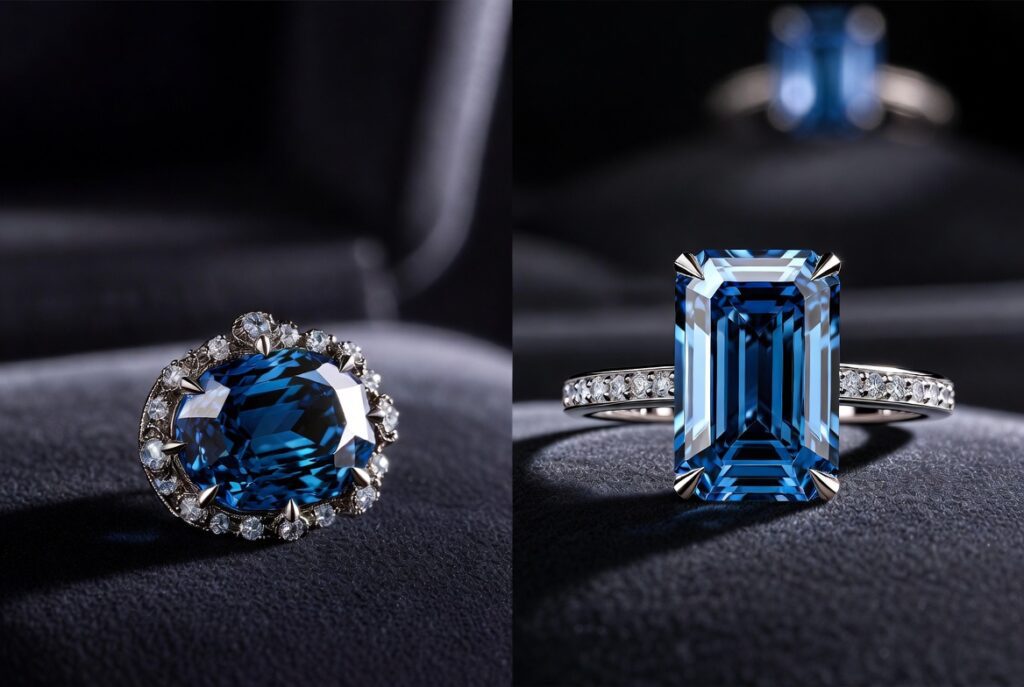
The Oppenheimer Blue, which sold at Christie’s Geneva in 2016 for $57.5 million, is a 14.62-carat Fancy Vivid Blue — the largest of its type ever auctioned. Its size is notable. Its Fancy Vivid classification is the reason it sold for $3.93 million per carat.
The Phase 1 mistake: Assuming clarity is the dominant driver. For colored stones, color intensity outranks clarity at every carat weight. A Fancy Vivid stone with minor inclusions will consistently outperform a Fancy Light stone with flawless clarity. Most buyers learn this after their first serious encounter with the secondary market — not before.
Phase 2
Provenance and the Auction Mechanism — Where Most of the Value Is Built
Provenance operates on two levels, and most analysis only addresses one of them.
Level 1 — Documented ownership history. The Wittelsbach-Graff Diamond, a 31.06-carat Type IIb blue stone, passed through Bavarian and Habsburg royal collections over 400 years. Laurence Graff acquired it at Christie’s London in December 2008 for $23.4 million. After recutting it from VS2 to Internally Flawless clarity — a deeply controversial decision that drew criticism from the German Historical Museum and Sotheby’s own specialists — the stone reportedly sold privately to the Emir of Qatar for approximately $80 million. That is a reported estimate, not a confirmed auction record. But the 240%-plus appreciation reflects what verified royal provenance adds to a stone that is already gemologically extraordinary.
Level 2 — The auction mechanism itself. When Christie’s or Sotheby’s stages a white-glove sale in Geneva or Hong Kong with serious bidders competing for a single stone, competitive pressure creates price discovery that private negotiation cannot replicate. The Blue Moon Diamond — 12.03 carats, Fancy Vivid Blue, Flawless — sold at Sotheby’s Geneva in 2015 for $48.4 million. A Hong Kong billionaire purchased it as a gift for his daughter, who named it “Sweet Josephine.” The stone’s gemological perfection and the competitive bidding dynamic together produced that price. Neither factor alone gets there.
World Record Ring Prices: Verified Benchmark Data
| Ring | Stone Type | Carats | GIA Color Grade | Clarity | Sale Price | Venue | Year |
|---|---|---|---|---|---|---|---|
| Wittelsbach-Graff | Blue Diamond (Type IIb) | 31.06 ct | Fancy Deep Blue | IF | ~$80MReported private estimate | Private (ex-Graff) | 2011 |
| Pink Star | Pink Diamond (Type IIa) | 59.60 ct | Fancy Vivid Pink | IF | $71.2MConfirmed auction | Sotheby’s Hong Kong | 2017 |
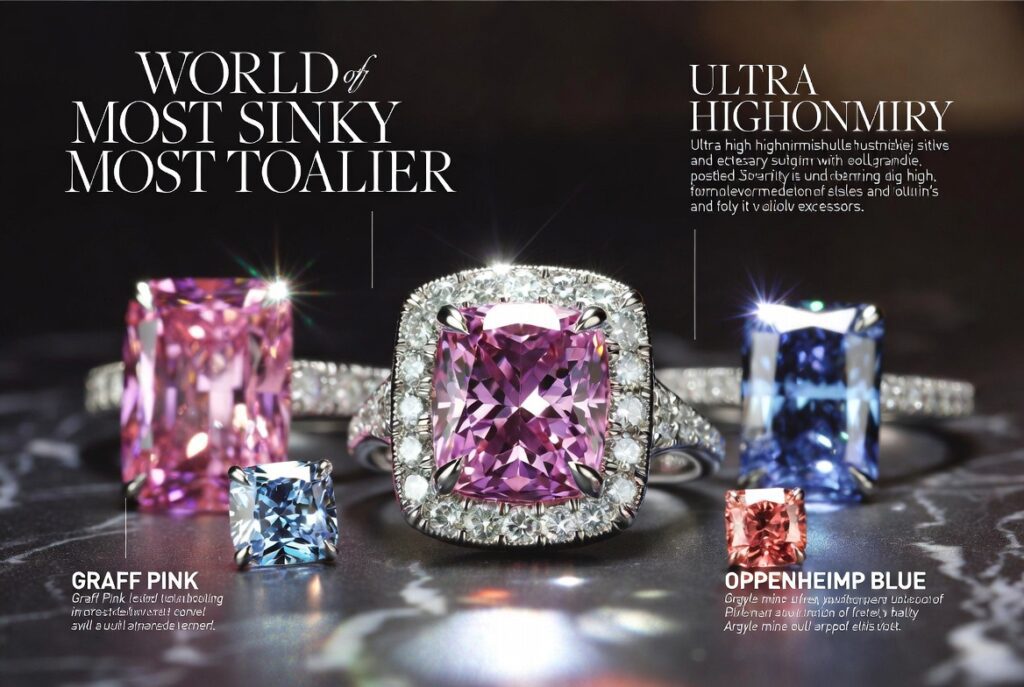
| Oppenheimer Blue | Blue Diamond | 14.62 ct | Fancy Vivid Blue | IF | $57.5MConfirmed auction | Christie’s Geneva | 2016 |
| Blue Moon “Sweet Josephine” | Blue Diamond | 12.03 ct | Fancy Vivid Blue | FL | $48.4MConfirmed auction | Sotheby’s Geneva | 2015 |
| Graff Pink | Pink Diamond | 24.78 ct | Fancy Intense Pink | IF | $46.2MConfirmed auction | Sotheby’s Geneva | 2010 |
| Eden Rose | Pink Diamond | 10.20 ct | Fancy Intense Pink | — | $13.3MConfirmed auction | Christie’s 2024 | 2024 |
| Argyle Phoenix | Red Diamond | 1.56 ct | Fancy Red | — | $4.2MConfirmed auction | Phillips Geneva | 2024 |
Sources: Sotheby’s, Christie’s, and Phillips published auction results. The Wittelsbach-Graff private sale figure is a widely reported estimate — the only verified public transaction for that stone is the 2008 Christie’s auction at $23.4M. All prices are hammer prices; buyer’s premiums of 20–25% apply in addition.
Phase 3
Sustaining and Realising Value — Where Most Collectors Lose the Game
The buyers of record-priced rings are not purely sentiment-driven. Serious collectors — Laurence Graff being the canonical example — buy stones they believe are underpriced relative to their rarity factors, hold them as supply dynamics tighten, then reposition into a market that has caught up.
Graff purchased the Graff Pink for $46.2 million in 2010 — a world record at the time. That purchase was timed against the impending closure of the Argyle mine in Western Australia, which produced over 90% of the world’s natural pink diamonds. The mine closed in 2020. Anyone who understood that supply dynamic in 2010 knew that Fancy Vivid Pink prices had one structural direction to travel.
Collecting for aesthetics while ignoring supply-side mechanics. A beautiful ring with excellent provenance, built around a stone type still supported by active mining supply, will not perform like a stone from an exhausted geological source. The framework is always supply-first, then aesthetics.
The Mistakes That Quietly Destroy Results in This Market
Mistake 1: Optimising for Carat Weight When Color Intensity Drives Price Per Carat
The cognitive error here is anchoring to size because size is visible, immediately intuitive, and expressed as a single number. But price per carat at the top of this market moves in the opposite direction from what intuition suggests.
The Argyle Phoenix — 1.56 carats of Fancy Red — sold at Phillips Geneva in May 2024 for $4.2 million, purchased by Laurence Graff. That is $2.69 million per carat for a stone smaller than most engagement rings. The Eden Rose, a 10.20-carat Fancy Intense Pink, sold at Christie’s in June 2024 for $13.3 million — $1.3 million per carat. The Phoenix outperformed the Eden Rose on a per-carat basis by more than 2:1, because natural red diamonds are categorically rarer than pink. According to GIA, red is the rarest color a natural diamond can express. Only a handful of certified Fancy Red diamonds exist worldwide.
Before looking at carat weight, can you rank two stones by the rarity of their color grade? If not, you are optimising the wrong variable.
The contrarian insight most content avoids: carat size is the least reliable predictor of price per carat at the top end of this market. This contradicts the instinct almost every buyer brings to their first serious engagement with high-value diamond rings.
Mistake 2: Treating Auction Prices as Liquid Market Values
A record auction price reflects the convergence of the right stone, the right bidders, and a specific competitive moment. It is price discovery, not standing market value.
The diamond market above $10 million is thin — perhaps a few dozen transactions globally per year. Prices reflect the specific dynamics of a given auction room on a given day. Buyer’s premiums at the major houses run 20–25% above hammer price. A stone that “sells for $50 million” in press coverage typically costs the buyer $61–62 million all-in. This matters for estate valuation, insurance appraisal, and any resale calculation.
The Wittelsbach-Graff’s reported $80 million figure — cited widely as a price benchmark — is an estimate for a private transaction. The only verified public transaction for that stone is the 2008 Christie’s auction at $23.4 million. Both figures appear in the same articles with the same apparent authority. They are not the same type of number.
When you cite a ring’s value from an auction record, are you accounting for the buyer’s premium, the currency rate at the date of sale, and whether the figure is a confirmed hammer price or a reported private estimate?
What’s Driving the Most Expensive Ring Market Right Now (2025–2026)
The Argyle Supply Story Is Now Fully in Motion
The Argyle mine’s 2020 closure has had five years to compound through the market. The secondary market for certified Argyle pink diamonds — particularly those with Argyle’s own provenance papers — is showing consistent appreciation. The 6.21-carat Fancy Vivid Pink ring sold at Phillips Geneva in May 2024 for $12 million. The trajectory is structural, not cyclical: no new Argyle pinks are entering the market. The existing certified supply is finite and dispersing into permanent collections.
Lab-Grown Diamonds Have Clarified the Investment Thesis for Natural Stones
Lab-grown diamonds have collapsed in retail price. A 4-carat CVD lab stone retails for approximately $6,000 in 2026; a comparable natural stone exceeds $60,000. That divergence has done something counterintuitive: it has made the rarity premium for exceptional natural fancy-colored stones more legible, not less. When any buyer can acquire a colorless 2-carat diamond for under $2,000 in lab-grown form, the question “why pay $57 million for a blue diamond?” becomes answerable in a single sentence. No laboratory process produces a natural Type IIb blue diamond. Geological formation of one requires conditions that occur, perhaps, once in tens of millions of years.
GIA Grading Refinements Are Shifting Borderline Valuations
GIA’s grading methods now incorporate AI-assisted color analysis, improving consistency at the subtle end of the saturation scale. Stones previously borderline between “Fancy Intense” and “Fancy Vivid” are being evaluated with greater precision. Market data from 2025 suggests that diamonds with upgraded classifications have commanded 15–25% premiums over previous valuations in comparable categories. For owners of high-value stones with older GIA certificates, a regrading assessment is worth investigating.
Color Intensity Grade: The Non-Linear Price Impact
| GIA Intensity Grade | Approximate Rarity | Typical Range (Pink, 5ct) | Relative Premium vs. Fancy Light |
|---|---|---|---|
| Fancy Light | 1 in ~10,000 diamonds | $150K – $400K | Baseline |
| Fancy | Subset of fancy color | $400K – $1.2M | 2–4× |
| Fancy Intense | Rarer than Fancy | $1M – $4M | 5–15× |
| Fancy Vivid | Fewer than 1 in 25,000 | $4M – $15M+ | 20–60× |
| Fancy Deep / Dark | Extremely rare (color-specific) | Varies widely | Context-dependent |
Price ranges are illustrative estimates for comparable pink diamonds based on public auction data. Actual prices depend on carat weight, clarity, cut, provenance, and auction dynamics. Rarity data: GIA published research.
Before/After: What Tracking Supply Data Actually Produces
A collector who tracked Argyle mine declining output through 2015–2018 — information publicly available in Rio Tinto’s operational reports — could have acquired a certified 3-carat Fancy Vivid Pink at roughly $1–1.5 million. By 2024, comparable post-closure stones in the secondary market were trading at $3–5 million. That is a 3–5× move driven entirely by a supply story visible in public documents, years before the price appreciation appeared in auction headlines.
Tools and Sources: What to Trust and What to Flag
| Tool / Source | Best Used For | Cost |
|---|---|---|
| GIA Report Check | Verifying any GIA certificate by report number — the non-negotiable first step before engaging with any stone’s claimed value | Free |
| Sotheby’s Auction Archive | Comparable sales research; pre-sale catalogue essays from specialist gemologists on record-breaking stones | Free |
| Christie’s Results Archive | “Magnificent Jewels” sale results from Geneva and Hong Kong — the primary price benchmarks for this market | Free |
| Phillips Auction Archive | Tracking Argyle pinks and red diamonds; 2024 Geneva results showed consistent strength in these categories | Free |
| Natural Diamonds Council | GIA-commissioned rarity statistics and supply trend research; the primary source for the 1-in-10,000 fancy color classification data | Free |
| PriceScope Diamond Tool | White diamond price benchmarking by cut, color, clarity, and carat; less useful for fancy colored stones | Free |
| RapNet / Rapaport Report | Industry-standard wholesale diamond pricing; trade-facing, used by dealers and estate professionals | Paid (trade) |
Flag These for Accuracy Issues
Generic luxury rankings of the most expensive rings consistently mix two types of figures without distinguishing them: confirmed auction prices (verifiable in published house records) and reported private sale estimates (unverified). The Wittelsbach-Graff’s $80 million figure is the canonical example — presented as a confirmed record across much of the web, it is an estimate for a private deal. Several sources also present Grace Kelly’s Cartier ring in “inflation-adjusted” terms, conflating historical purchase price with modern appraisal in ways that are not comparable to auction results.
For deep analysis of how these figures are sourced and what they actually represent, the verified auction record methodology at MostExpensives.com walks through each transaction in detail.
Your 30-Day Action Plan: Building Real Fluency in This Market
Week 1–2: Get the Foundation Right
- Days 1–3: Pull the GIA report on any stone you are evaluating. Verify it at gia.edu/report-check using the report number. Identify its color grade, Type classification (IIa, IIb, or I), and whether it carries a “Fancy Vivid” designation. Spend 20 minutes reading GIA’s own research on what the Fancy Vivid classification requires. This is not optional groundwork — it is the entire foundation.
- Days 4–7: Search the Christie’s and Sotheby’s online archives for the last three “Magnificent Jewels” sales in Geneva and Hong Kong. Build a simple spreadsheet tracking color grade, carat weight, Type classification, clarity, and price-per-carat for every stone sold above $5 million. You will see the pattern clearly within 15–20 entries.
- Days 8–14: Read two primary sources: GIA’s published rarity statistics for fancy colored diamonds, and one pre-sale catalogue essay from a record auction (the Pink Star and the Oppenheimer Blue both have detailed notes in the Sotheby’s and Christie’s archives). These are the benchmark documents the market works from.
Three highest-leverage moves for Week 1:
- Verify GIA classification of every stone you reference before citing its value.
- Distinguish confirmed auction prices from reported private sale estimates in every source you read.
- Learn the Type IIa/IIb classification system — it underpins the gemological logic of every record price in this market.
Week 3–4: Cross-Reference, Quantify, and Map Supply
- Days 15–21: Cross-reference price-per-carat data against color intensity grades. Run the comparison for pink stones alone: Fancy Light versus Fancy Intense versus Fancy Vivid, across comparable carat weights and clarity. The price relationship is non-linear — Fancy Vivid commands a premium that Fancy Intense cannot approach, even with superior clarity. Quantify this premium from your own collected auction data rather than relying on estimates in secondary articles.
- Days 22–30: Map supply context onto your data. Which stones carry Argyle provenance papers? Which blue diamonds are confirmed Type IIb? What is the mining status of the sources behind the stones commanding the highest per-carat prices? The supply story is always behind the price story, and it is consistently visible in advance for those reading the right primary sources.
You can explain — without reference to external sources — why the Argyle Phoenix sold for more per carat than the Eden Rose in 2024, despite being 8.64 carats smaller. If you can answer that from first principles, you understand how this market actually works.
Frequently Asked Questions
What is the most expensive ring in the world right now?
The confirmed auction record belongs to the Pink Star Diamond Ring, which sold at Sotheby’s Hong Kong in April 2017 for $71.2 million (hammer price). The Pink Star is a 59.60-carat Fancy Vivid Pink, Internally Flawless, Type IIa diamond — every attribute sits at the extreme end of rarity. A private sale of the Wittelsbach-Graff Diamond is widely reported at approximately $80 million, but this is an unverified private transaction estimate, not a confirmed public record. The only verified public transaction for the Wittelsbach-Graff is Graff’s $23.4 million purchase at Christie’s in 2008.
Why are blue and pink diamonds so much more expensive than white diamonds?
Blue and pink diamonds form under extremely rare geological conditions — pink color is caused by structural distortion during formation; blue by the presence of boron at the parts-per-million level. According to GIA research, fewer than one in 10,000 natural diamonds shows enough color to be classified as “fancy” at any level. White (colorless) diamonds can be produced in laboratories at scale for under $1,000 per carat today. Natural fancy color cannot be replicated in a lab, which is precisely why the most expensive diamonds in the world are almost exclusively fancy-colored natural stones.
What is the Wittelsbach-Graff Diamond, and why is it controversial?
The Wittelsbach-Graff is a 31.06-carat Type IIb blue diamond with a documented history spanning 400 years of European royalty. Laurence Graff purchased it at Christie’s London in 2008 for $23.4 million. The controversy: Graff had the diamond recut by three expert cutters, removing 4.5 carats and elevating clarity from VS2 to Internally Flawless. This improved its gemological grade dramatically but destroyed its original 17th-century cutting style. Critics — including the German Historical Museum’s director and Sotheby’s own specialists — described it as cultural vandalism. Graff argued he had revealed the stone’s true beauty. The gemological community has never fully resolved the debate.
What is a GIA Type IIa or Type IIb diamond, and why does it matter for price?
Type IIa diamonds contain essentially no nitrogen — they are the structurally purest diamonds that exist, representing less than 2% of all gem-quality diamonds. The Pink Star is Type IIa. Type IIb diamonds contain boron instead of nitrogen, giving them their blue color and making them semi-conductive — a property unique among gemstones. The Oppenheimer Blue and Hope Diamond are Type IIb. Both classifications command significant premiums, and GIA certification specifically identifies Type classification. Any ring claiming record-level value should be verified against this classification before the price is taken at face value.
What does “hammer price” mean, and how much does a buyer actually pay?
The hammer price is the price at which bidding stops — the number reported in press coverage. The buyer additionally pays a buyer’s premium to the auction house, which at Christie’s and Sotheby’s is typically 20–26% of the hammer price. A ring with a $50 million hammer price therefore costs the buyer approximately $60–63 million all-in. This distinction matters for insurance valuation, resale calculations, and any comparison between auction results and private sale figures.
Is this market accessible to buyers without hundred-million-dollar budgets?
Yes — the same scarcity logic that drives $71 million records operates at every price point. A 1-carat certified Argyle pink with a Fancy Intense color grade has structural supply support: the mine is closed, and certified Argyle provenance papers are finite. GIA data shows that colored diamonds begin at the Fancy Light grade, accessible at five and six figures. The framework — color intensity first, then Type classification, then provenance, then supply context — applies identically at $200,000 and $20 million.
How do I verify whether a ring’s stated value is accurate?
Start by identifying the source type. Confirmed auction prices are verifiable in Sotheby’s, Christie’s, and Phillips published archives. Private sale figures — like the Wittelsbach-Graff’s $80 million — are reported estimates; treat them as such. Insurance appraisals reflect replacement cost, not market value. Retail prices include jeweller markup of 50–100% over wholesale. Each figure measures something different and cannot be directly compared. The GIA report is the only document that objectively defines what the stone actually is — start there.
What happened to the Argyle mine, and why does it affect ring values?
The Argyle mine in Western Australia, operated by Rio Tinto, closed in November 2020 after 37 years of production. During its operation, it produced over 90% of the world’s natural pink and red diamonds. Its closure means no new Argyle-origin stones are entering the market. The existing certified supply — stones with Argyle’s own provenance papers — is finite and dispersing into permanent collections. This is the structural supply story behind consistent appreciation for fancy pink and red diamonds in the 2020–2026 period, and why the Argyle Phoenix sold for a record $2.69M per carat in 2024.
What is the rarest color a natural diamond can be?
Natural red. GIA classifies only a handful of stones globally as Fancy Red — the 1.56-carat Argyle Phoenix, sold at Phillips Geneva in May 2024 for $4.2 million, is among the most significant recent examples at $2.69M per carat. Red color in diamonds is caused by plastic deformation of the crystal lattice during formation — the same mechanism that produces pink, but far more extreme. There is no confirmed mechanism for producing natural red color in a laboratory setting, making red diamonds the only category in which supply is effectively fixed at the number of stones already discovered.
Who is Laurence Graff, and why does he appear in so many record transactions?
Laurence Graff is a British billionaire jeweler and founder of Graff Diamonds. Over five decades, he has consistently acquired the world’s most significant colored diamonds at auction and through private transactions — the Wittelsbach-Graff ($23.4M at Christie’s, 2008), the Graff Pink ($46.2M at Sotheby’s, 2010), and the Argyle Phoenix ($4.2M at Phillips, 2024) are among the most notable. His acquisition strategy — identifying gemological quality underpriced relative to rarity — has made him the single most influential buyer in the record-ring market over the past 30 years. His repeated presence at the top of every auction reflects not sentiment, but supply intelligence.
What makes a ring “investment grade” versus simply expensive?
Investment-grade rings combine: (1) GIA-certified fancy colored diamond of Fancy Intense or Fancy Vivid intensity; (2) Type IIa or IIb classification; (3) documented provenance; and (4) a stone from a source with constrained or exhausted supply. The absence of any single factor typically reduces liquidity at resale. White diamonds, regardless of carat weight or clarity, are generally not investment-grade in the same sense — lab-grown production has compressed the resale premium to near zero at most price points below exceptional historic specimens.
How long should a high-value ring be held to see meaningful appreciation?
The strongest documented appreciation cycles in this market have run 5–15 years, tied to supply exhaustion events rather than short-term demand fluctuations. The Argyle supply story became visible in public mining reports by 2015; meaningful appreciation for certified Argyle pinks compounded through 2020–2024. Short-term market fluctuations are real — the average natural diamond price per carat was down 2.7% month-on-month in April 2025 — but are secondary to the multi-year structural supply dynamics that drive record outcomes at the top of this market.
Take the Framework Into the Market
Pull a pre-sale catalogue from the most recent Christie’s or Sotheby’s “Magnificent Jewels” sale — available free through their online archives. Read the specialist essay on the lead lot. It will tell you exactly which rarity factors justified the estimate, in the language the market actually uses. That is where fluency is built: not from ranked lists, but from primary source analysis of specific stones and specific prices.
Explore the Full Ring Rankings →Categories
World’s Most Expensive Diamond Watches: Gems Worth Fortunes
The 15 Most Expensive Necklaces in the World: Verified Records & 2025 Market Reality
Leave a Reply