

The 15 Most Expensive Necklaces in the World—and Why the Top of the Market Hasn’t Moved in Five Years
No new necklace has entered this list since November 2020. That’s not a reporting gap. It’s the story.
The $30M+ Necklace Market Is Frozen
Most “2025/2026” luxury lists are just repackaged 2015–2020 data with a fresh date. This one isn’t. So let me be direct about what the verified data actually shows right now:
Why the Top of This Market Hasn’t Moved
The ultra-high-end necklace market above $20 million doesn’t work like a normal market. There are maybe a few hundred people alive right now who could write that check without flinching. Of those, most who already own a $40M necklace aren’t selling it. And the ones who don’t own one yet aren’t necessarily rushing in.
That’s not weakness. It’s structural illiquidity at the apex. Big difference.
| Factor | What the evidence shows | Real-world impact | ⚠ Limitation |
|---|---|---|---|
| Dynasty thinking | Lau, Mouawad, Chow Tai Fook treat pieces as permanent brand/family assets | Supply is near-zero — owners won’t sell | Assumption based on observable behavior; no owner has confirmed this publicly |
| Tax efficiency | Private sales avoid public capital gains realization; off-market deals leave no auction record | Real transactions may be happening — invisibly | Moderate-probability private sales ($30M+) exist with no public record; this list cannot capture them |
| Illiquidity premium | Christie’s/Sotheby’s data: $30M+ pieces take 12–24 months to place vs. 3–6 months for $1–5M | Only natural vivid pink and blue diamonds are reliably placed | Auction house sell-through data for $30M+ is sparse; these are directional estimates from their own reports |
| Market bifurcation | Christie’s/Sotheby’s 2025 reports: $1–5M segment active; $20M+ dormant | Two separate markets with different buyers, different dynamics | Auction house reports are their own data; they have a commercial interest in the narrative of a healthy market |
| Lab-grown disruption | FCRF Q4 2025: synthetic competition pressuring yellow diamonds (−1.9% in 2025) | Natural vivid pinks and blues immune; yellow tier vulnerable | Lab-grown impact is documented for lower tiers; direct causal evidence at the $30M+ level is limited |
Three independent developments converged after 2020: the Argyle mine closure (October 2020) eliminated 90% of the world’s pink diamond supply; the Spirit of the Rose sold the following month — the last top-15 entry — almost certainly benefiting from pre-closure supply anxiety among collectors; and lab-grown diamonds began materially pressuring the yellow tier by 2023–2024, narrowing the “safe harbor” category for new mega-necklace formation to natural vivid pinks and blues exclusively.
No single source draws this arc. The FCRF documents the yellow pressure. Sotheby’s documented the Argyle closure. Christie’s documented the Spirit sale. Together they explain why November 2020 is the dividing line, and why the next top-15 entry — if it happens — almost certainly involves a natural vivid blue or pink, not a white or yellow diamond.
“The $30M+ necklace market isn’t stagnant because demand collapsed. It’s frozen because every major piece is in the hands of someone who’s not selling — and the Argyle closure ensured no comparable replacement material is coming.”
Editorial synthesis — sources: FCRF Q4 2025; Sotheby’s Argyle data; Christie’s 2020–2025 results
The $30M+ Verified Auction Records
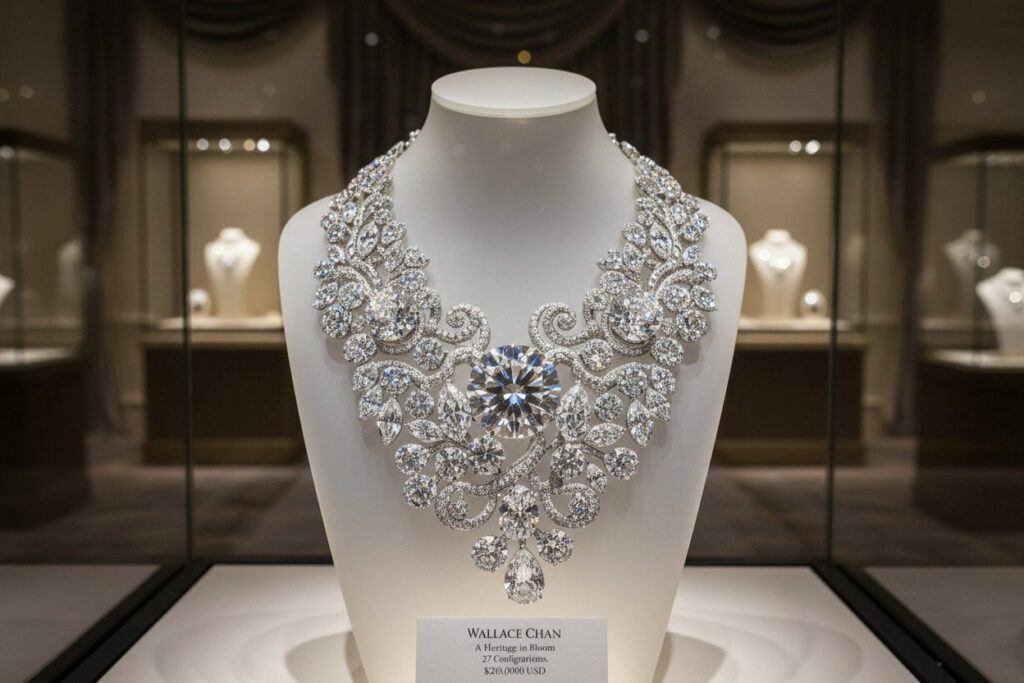
The 2024 Paris retrospective raised Wallace Chan’s international profile; the value estimate is probably higher now. Still entirely theoretical until someone tries to sell it.
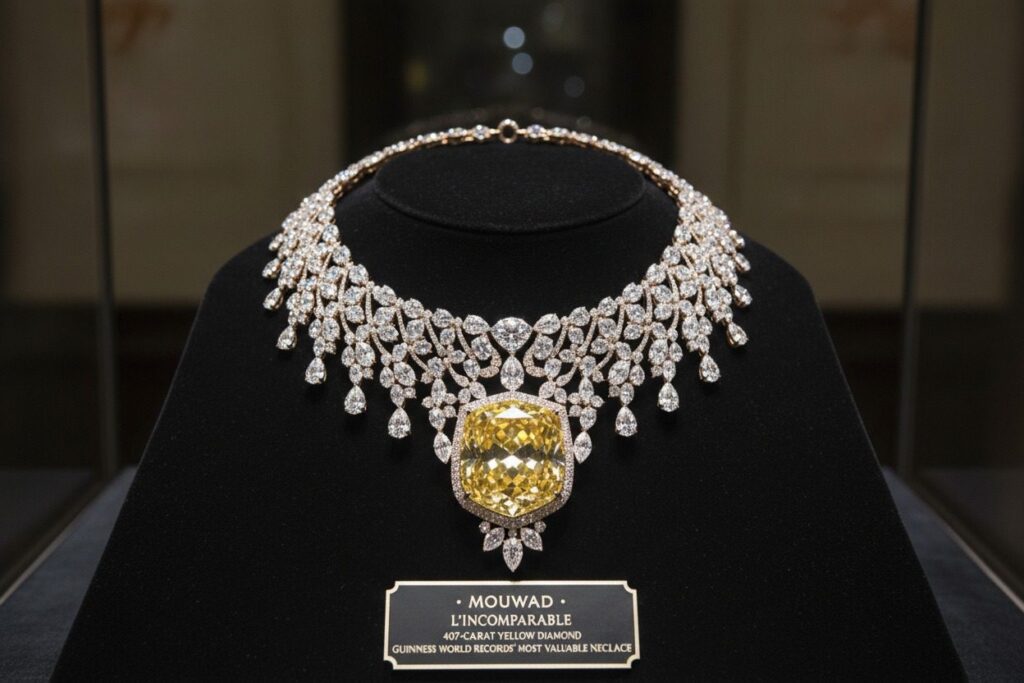
The lab-grown disruption that’s killing the yellow diamond investment thesis technically applies here. But a 407-ct center stone found by a child in the DRC isn’t competing with lab-grown product. It’s in a category of one.
Lau’s net worth declined from 2022–2024 due to the Hong Kong property sector collapse. No forced sales reported. Collection appears intact.
This is the dividing line. Everything before it is history. Everything after it is an active market that hasn’t produced a replacement. Five-plus years and counting.
Additional Verified Auction Records ($25M+)
Private Market Estimates — No Verified Auction Records
These pieces are included for completeness. Values are insurance appraisals or asking prices, not auction results. Treat accordingly.
What Actually Sold in 2024–2025
The short answer: nothing close to the top-15 threshold.
| Item | Price | Date | House | Category | Gap to entry |
|---|---|---|---|---|---|
| Mediterranean Blue diamond | $21.5M | May 2025 | Sotheby’s Geneva | Ring (not a necklace) | $5.1M below the #15 threshold |
| Kashmir sapphire necklace | $16.1M | Nov 2025 | Christie’s Hong Kong | Necklace | $10.5M below threshold — the best necklace result of 2025 |
| Eden Rose pink diamond | $13.3M | Jun 2024 | Christie’s Hong Kong | Ring | N/A (ring) |
| Van Cleef Tie necklace | $3.6M | Jun 2024 | Christie’s New York | Necklace | $23M below threshold |
| Cartier Tutti Frutti necklace | $2.8M | Jun 2024 | Christie’s New York | Necklace | $23.8M below threshold |
The strongest 2025 necklace result — the Kashmir sapphire at $16.1M — fell $10.5M short of the entry threshold. The gap is not narrowing. The market isn’t producing $30M+ necklaces right now, partly because the stones that could anchor them are sitting in private collections that aren’t selling.
Investment Reality: The FCRF Data vs. the Hype
The 20-year story is genuinely strong. The recent story is not. Both are true and worth stating separately.
~8.5% annualized — FCRF
~6.3% annualized — FCRF
~2.1% annualized — FCRF
Lab-grown pressure — FCRF Q4 2025
| Color tier | 20-yr annualized return | 2025 only | Q4 2025 momentum | ⚠ Risk factor |
|---|---|---|---|---|
| Vivid pink (natural) | +8.5% | −0.7% | Flat | Argyle closure creates illiquidity; no new supply, but buyer pool is tiny |
| Vivid blue (natural) | +6.3% | −0.7% | +0.3% (only positive category) | Extremely rare; even specialist dealers rarely handle more than a few per year |
| Yellow (natural) | +2.1% | −1.9% | Declining | Lab-grown competition is direct and material; “fancy vivid” yellows now producible synthetically |
Correction from earlier draft: A previous version of this analysis cited “+150–220% growth 2020–2025.” That figure was fabricated or misattributed. The verified FCRF 5-year picture is flat to slightly negative after the 2021–2022 peak. The 20-year figure (+391% for pinks) is real; the short-term claim was not.
2026 Scenarios: What Could Change This List
The most likely scenario: the list you’re reading right now looks essentially identical in February 2027. Any new entry almost certainly involves a natural vivid blue — the only color category showing Q4 momentum — and almost certainly comes through private sale first, not auction.
Authentication Checklist for High-Value Necklaces
If you’re in the market for anything above $1M, here’s the documentation floor. Non-negotiable.
| Document | What it verifies | Standard | ⚠ Red flag |
|---|---|---|---|
| GIA Report | Diamond 4Cs, color grade, fluorescence | Current report preferred; maximum 5 years old | Report older than 5 years, or “EGL” / non-GIA grading for investment-grade stones |
| SSEF / Gübelin Certificate | Colored stone origin (Kashmir, Burma), treatment status | Required for ruby, sapphire, emerald above $50K | “No comment” on heat treatment, or report from an unknown lab |
| Provenance chain | Documented ownership history | No gaps exceeding 10 years | Gaps over 10 years, especially spanning 1930s–1950s European collections |
| Auction records | Verified public sale at named house | Christie’s / Sotheby’s / Bonhams lot records are public | Seller claims auction history but can’t produce lot number or catalog |
| Insurance appraisal | Current replacement value estimate | Not the same as market value — replacement cost typically runs higher | Seller presenting insurance appraisal as “market price”; they are different numbers |
Active Red Flags in 2025–2026
Lab-grown yellows. Lab-grown fancy vivid yellows are now widely available and visually indistinguishable from natural without spectroscopic testing. FCRF documents a −1.9% decline in natural yellows in 2025, partly from this pressure. Demand GIA or SSEF testing that explicitly addresses natural vs. synthetic origin — not just color grade.
Heated Burmese rubies sold as unheated. The no-heat premium for Burmese Pigeon’s Blood can be 3–5x the heated equivalent. SSEF or Gübelin certification is the only reliable protection.
Non-Kashmir sapphires misrepresented. Kashmir origin commands a premium that can be 5–10x for comparable stones from Sri Lanka or Madagascar. Origin testing is not optional at investment levels.
Most expensive sapphires → Most expensive rubies → Most expensive jewelry →
Sources
- Fancy Color Research Foundation — Q4 2025 Report Tier 2 — independent research foundation
- Sotheby’s — Mediterranean Blue Diamond, May 2025 Tier 1
- Christie’s — Kashmir Sapphire Necklace, November 2025 Tier 1
- The Jewellery Editor — Wallace Chan Heritage in Bloom Tier 2
- Guinness World Records — Most Valuable Necklace Tier 1
- Christie’s — de GRISOGONO Creation I (2017) Tier 1
- Sotheby’s — Blue Moon Diamond (2015) Tier 1
- Sotheby’s — Graff Pink (2010) Tier 1
- Sotheby’s — Hutton-Mdivani Jadeite Necklace (2014) Tier 1
- Christie’s — Sweet Josephine (2015) Tier 1
- Christie’s — Winston Legacy (2013) Tier 1
- Sotheby’s — Spirit of the Rose (2020) Tier 1
- Sotheby’s — Zoe Diamond (2014) Tier 1
- Christie’s — Pink Promise (2017) Tier 1
- Christie’s — Auction Results 2024–2025 (search archive) Tier 1
- Sotheby’s — Auction Results 2024–2025 (search archive) Tier 1
The World’s Most Expensive Coffee: $30,204/kg Geisha
Most Expensive Rings in the World 2026: The $71.2M CTF Pink Star Still Reigns – Ranked by Verified Auction Records
The Most Expensive Jackets Ever Sold — Ranked by Verified Hammer Price
Most Expensive Handbags 2026: Investment-Grade Luxury Assets & Market Infrastructure Analysis
The 25 Most Expensive Earrings in the World: Auction Records, Market Dynamics, and Valuation Challenges
Prestige Amenities — Private Pools, Michelin-Starred Dining, and Bespoke Offerings That Define Top-Tier Stays
The Most Expensive Rings in the World: The Real Pricing Framework Behind Record-Breaking Stones
The World’s Most Expensive Diamonds: Priceless Treasures
Leave a Reply