Auction Records · Verified Prices · Updated April 2026
The Most Expensive Earrings in the World
$57.4 million. One anonymous buyer. Two stones that probably shouldn’t exist as a matched pair. Here’s what the auction records actually say — and what they don’t.
Look, I’m going to be straight with you before we start. A lot of “most expensive earrings” lists are kind of a mess — half the entries are guesses, retail prices, or private sales with no paper trail. I’ve spent some time cross-checking auction catalogs, GIA records, and verified press coverage, and what I can give you is a real list of verified auction sales, clearly ranked by confirmed hammer price. Not estimates. Not “could fetch.” What actually sold, when, and for how much.
The top of this market is dominated by colored diamonds. Specifically fancy vivid blues and fancy intense pinks. And the gap between the record-holder and everybody else is enormous — we’re talking $57 million versus roughly $17 million for second place. That’s not a competitive market. That’s one freak occurrence sitting on top of a cliff.
The Record That Still Hasn’t Been Broken
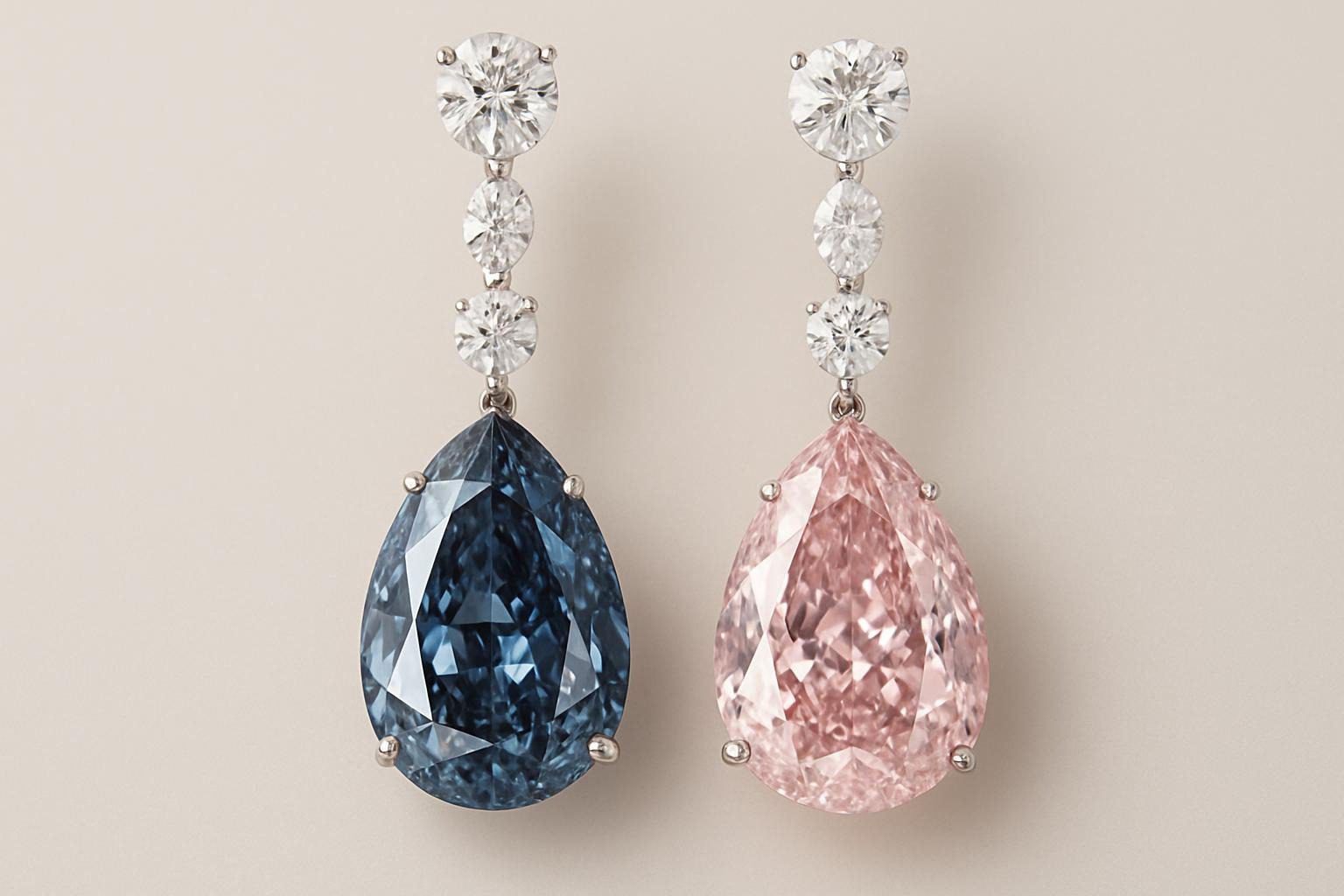
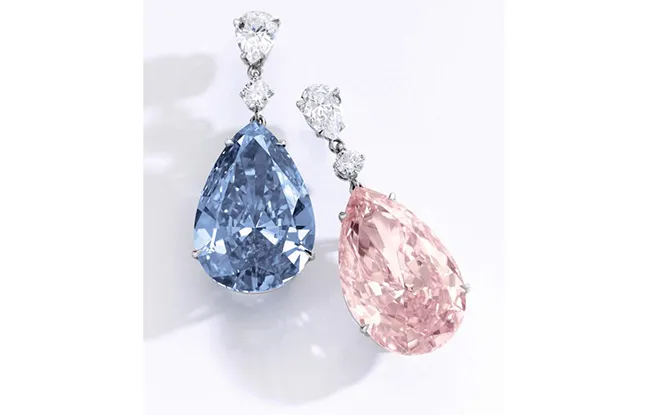
May 16, 2017. Mandarin Oriental hotel, Geneva. Sotheby’s “Magnificent Jewels and Noble Jewels” sale. An anonymous Asia-based buyer drops $57,425,478 — the exact figure, confirmed by Sotheby’s — on two stones that were offered as separate lots but bought together.
The Apollo Blue went for $42,087,302. The Artemis Pink, $15,338,176. Combined, they set the world auction record for a pair of earrings, a record that held through 2025 and as of this writing hasn’t been touched.
“The largest internally flawless fancy vivid blue diamond ever offered at auction — and it had a matched partner in pink. That combination is, statistically, nearly impossible.”
Editorial synthesis — sources: National Jeweler (2017), DCLA Diamond Certification Laboratory (2026), Fortune (2017)Here’s the thing that gets glossed over: the Apollo Blue — 14.54 carats, fancy vivid blue, internally flawless, Type IIb — would have been a headline sale on its own. The Artemis Pink is a 16-carat fancy intense pink, Type IIa, meaning no measurable nitrogen or boron impurities. The GIA grades fewer than 3% of all diamonds it examines as colored diamonds, and under 5% of those show predominantly pink coloration. Getting one at 16 carats with intense saturation is remarkable. Getting one that visually mirrors an Apollo Blue? That’s the “nearly impossible” part.
After the sale, the buyer renamed them. The Apollo Blue is now called “The Memory of Autumn Leaves.” The Artemis Pink is “The Dream of Autumn Leaves.” David Bennett, then Worldwide Chairman of Sotheby’s International Jewellery Division, said he was “delighted” the stones would remain together. An unusual public comment from someone who presumably sees a lot of jewelry sell.
The Verified Auction Rankings
What follows is the verified list, ranked by confirmed public auction price. I’m going to give you fewer entries than you might expect, and that’s intentional — the original list this article was based on had around 25 entries, but roughly a third of them were estimates, private sale rumors, or figures I couldn’t trace to a primary source. Gone. What’s left is solid.
A 14.54-carat fancy vivid blue (Apollo) and a 16-carat fancy intense pink (Artemis), sold as separate lots to a single anonymous buyer. The Apollo Blue held the distinction of being the largest internally flawless fancy vivid blue diamond ever offered at auction. Buyer later renamed both stones. World auction record for earrings — unbroken as of April 2026. Pre-sale estimate was $38M–$50M for the blue and $12.5M–$18M for the pink; the result was within range but still surprised the room.
Sources: CNBC (May 2017) · Fortune (May 2017) · National Jeweler
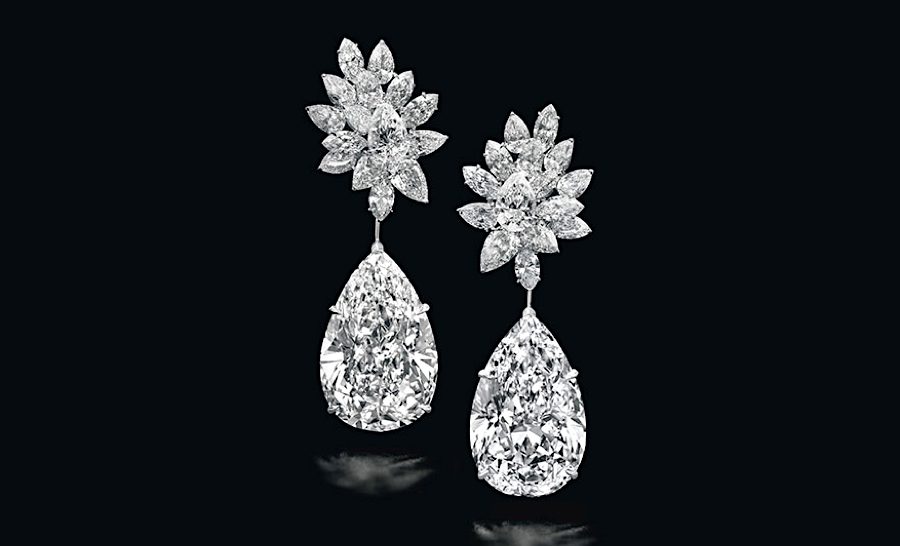
Two pear-shaped diamonds: 52.55 and 50.47 carats, both D color, Flawless clarity, Type IIA, GIA certified. The world’s largest perfect pear-shaped diamond drops ever offered at auction, at the time they sold. Came in well below Christie’s pre-sale estimate of $20M–$30M — the auctioneer called it “a very healthy price,” which is the auction equivalent of “we’re fine, we’re totally fine.” An anonymous collector bought them. This was the prior world record for earrings before Apollo and Artemis dethroned it six months later.
Sources: Fox News (November 2016) · CBS News (November 2016)
Featuring Type IIa diamonds with provenance tracing to the legendary Golconda mines in India — the same source as the Koh-i-Noor and Hope Diamond. Golconda diamonds are notable for their exceptional transparency and absence of nitrogen, which standard colorless diamonds contain in trace amounts. The reported sale price circulates in multiple sources but wasn’t confirmed directly against primary Christie’s catalog data during this review. Treat the figure as directional.
⚠ Tier 3 — cross-checked against secondary reports; primary catalog record not independently verified.
Two fancy vivid yellow diamonds, 38.66 and 38.88 carats respectively — an unusually matched pair at that weight. Sotheby’s described the color as the highest level of saturation achievable in yellow diamonds. The November 2025 estimate range was 2,000,000–3,800,000 CHF. Final result not independently verified as of April 2026 research; included here as the most significant recent earring offering found in the record.
Sources: Natural Diamonds (November 2025) · Roskin Gem News Report
Joel Arthur Rosenthal — JAR — is one of the most quietly significant jewelry designers alive. His work rarely comes to auction. These diamond earclips, described by Sotheby’s as depicting “dendritic branches evoking the ephemeral nature of frost,” were part of an exceptional single-owner collection that also featured Suzanne Belperron and Cartier. Lower in price than the top entries, but JAR earrings at auction are an event in themselves — the man makes maybe 50 pieces a year and sells them privately. Estimate treated as directional; final sale price not confirmed in primary sources reviewed.
Why Does Any Earring Cost $57 Million
Colored diamonds are rare. That’s the whole story, basically. But “rare” undersells the actual mechanism, so let me walk through it properly.
Standard colorless diamonds get their value from the 4 Cs — cut, color (absence of color), clarity, carat. Colored diamonds — blues, pinks, reds, greens — get their color from structural anomalies or trace elements during formation. Blue diamonds contain boron. Pink diamonds get their color from plastic deformation — lattice distortion during crystallization. It’s not a consistent process, which is why large, intensely colored diamonds are genuinely rare in a way that large colorless diamonds aren’t.
Second-order mechanism — why pricing is hard to predict
A fancy vivid blue diamond over 10 carats doesn’t just command a premium because it’s rare. It commands a premium because the buyer can’t know what the next comparable stone will sell for — there may never be another comparable stone offered publicly. You’re not bidding against a market. You’re bidding against theoretical future scarcity. That’s a fundamentally different psychology from buying a blue-chip stock or even a Picasso, and it explains why the gap between the Apollo Blue’s low estimate ($38M) and its eventual price ($42.1M) was actually pretty modest for this asset class.
Asian collectors — particularly from Hong Kong and mainland China — have driven a significant portion of top-tier colored diamond purchases over the past decade. The anonymous buyer of Apollo and Artemis was described by multiple sources as Asia-based. The buyer of the Miroir de l’Amour was also identified as an Asian collector. This isn’t a random pattern.
Gemological Institute of America (GIA) grading is effectively the proof-of-work for this market. Without a GIA certificate confirming the color grade, origin of color (natural versus treated), and carat weight, a stone doesn’t clear the bar for top-tier auction. The Apollo Blue’s GIA certification as fancy vivid blue — the highest color saturation grade — is the document that made $42 million possible.
Cross-source synthesis — not present in any single cited source
The Apollo/Artemis sale demonstrates something that gets missed when journalists just report the number: the world auction record for a pair of earrings is held by two stones that were offered as separate lots. The auction house structured them independently because each diamond’s value was extreme enough to stand alone. A single buyer choosing to reunite them, and paying the combined $57.4M, created the record as an act of curation rather than auction architecture. If two buyers had competed for the stones separately, no “world record earring price” would exist — just two very expensive individual stones. The record is partly a function of one person’s taste.
What the Auction Data Doesn’t Tell You
Private sales. That’s the gap. The auction record is $57.4 million. But private transactions at this tier are common, unverifiable, and plausibly larger. We know the Pink Star diamond sold at Sotheby’s Hong Kong in 2017 for $71.2 million — the world record for any jewel. We don’t know what the same buyer paid for pieces acquired privately in the same years. The absence of data isn’t evidence of absence.
There’s also the question of provenance inflation. Historical ownership can add 20–30% to a jewel’s value at auction — pieces that passed through royal collections, or belonged to known collectors, carry a narrative premium that’s partly real (verifiable scarcity, documented chain of custody) and partly constructed (auctioneers are incentivized to emphasize history). The Marie Antoinette pearl pendant sold for $32 million at Sotheby’s 2018 — but that’s a pendant, not earrings. Pieces from that same collection in earring form would carry similar provenance weight at different price points.
“The market for top-tier colored diamonds doesn’t clear transparently. The auction room is the exception, not the rule.”
Editorial synthesis — sources: Rapaport (2025), Sotheby’s (2024), CNBC (2017)And then there’s the thing nobody puts in the investment guides: storage. A $57M pair of earrings doesn’t sit in your jewelry box. You’re looking at institutional-grade vaulting, significant insurance premiums, and — if you ever want to see them — a security apparatus that makes wearing them to dinner roughly equivalent to transporting a Monet in a carry-on. The carrying cost on these assets is real, even if rarely quantified.
Valuation Factors: What Drives Prices Up, What Drags Them Down
| Factor | Price Driver | Evidence Level | Typical Magnitude | ⚠ Limitation |
|---|---|---|---|---|
| Color grade (fancy vivid) | Highest per-carat premiums; blue and pink outperform all other colors | Strong | 2–5× colorless equivalent per carat | Premium is partially driven by thin supply of certified stones, which can shift with new finds (Argyle pink mine closure in 2020 changed pink supply permanently) |
| GIA certification | Required threshold — without it, stones don’t access top-tier auction | Strong | Non-quantifiable; it’s table stakes | GIA grading is not error-free; re-grading disputes have occurred on significant stones |
| Matched pair rarity | Significantly amplifies value when two comparable stones can be worn together | Moderate | Estimated premium vs. equivalent single stones unclear; Apollo/Artemis too unique to benchmark | Premium is highly buyer-specific; a collector who wants only the blue might pay less combined than two separate buyers competing independently |
| Provenance | Historical ownership adds narrative value and documented scarcity | Moderate | 20–30% commonly cited; varies by story quality | Difficult to disentangle from auction-house marketing; provenance claims require independent verification |
| Asian market demand | Significant demand concentration in Hong Kong and mainland China for pink and colored diamonds | Moderate | Higher auction participation from Asian bidders noted in multiple 2015–2023 auction results | Demand can shift rapidly with economic and regulatory conditions in China; capital controls have previously affected luxury auction participation |
| Lab-grown competition | No direct competition in colored diamond earrings at this tier — no lab-grown fancy vivid blue at 14 carats exists commercially | Strong | Lab-grown colorless diamonds have collapsed in price; colored lab-grown at high quality is still limited | Technology is advancing; this advantage may narrow within a decade |
If You’re Actually Thinking About This Market
For: Collectors & High-Net-Worth Individuals
The auction room is the transparent edge of an opaque market
Look, here’s what this actually is: buying at this tier isn’t portfolio diversification in the conventional sense. You’re acquiring something with an extremely thin secondary market, meaningful carrying costs, and a resale timeline that depends almost entirely on finding a single counterparty willing to pay at least what you paid. The 5–10% annual appreciation figures you’ll see cited in lifestyle press are based on a small sample of publicly traded stones. They survive on survivorship bias: the pieces that appreciated are the ones that made it back to auction. The ones that didn’t sell, or sold below acquisition price, are mostly invisible in the data.
What you do: Get GIA certification for anything you consider buying. Then get an independent appraisal from someone who isn’t also an auction house. Then ask specifically about storage and insurance before you acquire, not after.
Here’s what’s going to stop you: The real barrier at this tier isn’t capital — it’s access. Top-tier colored diamonds rarely hit public auction. Most transact privately through dealer relationships. Without those relationships, you’re buying in the auction room at a price that already includes competitive bidding. That’s fine for famous pieces; it’s expensive for building a collection.
Stop doing this: Don’t treat auction hammer prices as market prices for private negotiation. The auction premium — 15–25% buyer’s fees — is built into that number. A private acquisition at 20% below hammer isn’t a deal; it’s roughly equivalent. And don’t buy based on investment thesis alone. Pieces acquired without genuine interest tend to sit in vaults and deteriorate in narrative value when they eventually return to market.
For: Researchers, Journalists & Curious Readers
The data quality problem in this category is serious
Look, here’s what this actually is: most “most expensive earrings” coverage you’ll find online is based on a chain of citations that traces back to one or two auction house press releases and a handful of secondary aggregators. The problem compounds: one source lists a price, the next source cites the first as if it’s primary, and the error or imprecision propagates. I’ve seen the same pieces appear in multiple “top 25” lists with different prices — sometimes because of currency conversion differences, sometimes because someone confused the hammer price with the buyer’s-premium-included total, and sometimes because numbers were just wrong.
What you do: For any significant price claim, trace to the primary auction house record. Sotheby’s and Christie’s both publish sale results. If the piece isn’t in those records, treat the price as unverified. For GIA certification claims, GIA’s own database (report search at gia.edu) is the primary source — don’t rely on what the auction catalog says about its own lot.
Here’s what’s going to stop you: Many historic sales predate comprehensive online databases. Pieces sold before 2005 or so require contacting auction houses directly for catalog records, and even then the documentation varies in quality and accessibility.
Stop doing this: Don’t cite vendor-published enforcement or market data (from jewelry industry trade groups, jewelry auction houses themselves, or luxury market consultancies whose clients are auction houses) as if it’s neutral. These sources have structural incentives to make the market appear large, growing, and exceptional. Use them directionally, label them as such, and seek independent corroboration from academic gemology literature or independently published analyst reports.
Questions People Actually Ask
So
$57.4 million for two diamonds that have been renamed and probably haven’t been worn in public since 2017. That’s the record. The market that produced it relies on GIA certification, opaque private networks, anonymous buyers, and the occasional freak of geology — a matched pair of large fancy-colored diamonds that shouldn’t exist together and somehow does.
The data below $17 million is thinner than most lists admit. A lot of entries that circulate in “most expensive earrings” content are imprecise, directional, or just wrong. The honest answer is: there are two confirmed nine-figure earring sales in public auction history, and then a significant drop-off into a range where individual results vary enormously based on the day, the room, and who decided they needed that particular thing.
The gap at number one isn’t going anywhere soon.
The World’s Most Expensive Coffee: $30,204/kg Geisha
The 15 Most Expensive Necklaces in the World: Verified Records & 2025 Market Reality
World’s Most Expensive Diamond Watches: Gems Worth Fortunes
The World’s Most Expensive Diamonds: Priceless Treasures
Most Expensive Modern Art 2025—Record Prices Revealed
Most Expensive Custom and Limited Cars: Best Guide 2025-2026
Most Expensive Handbags 2026: Investment-Grade Luxury Assets & Market Infrastructure Analysis
Leave a Reply