TL;DR
- In August 2025, a 20kg lot of washed Geisha from Hacienda La Esmeralda sold for $30,204/kg — tripling the previous world record set in 2024.
- The buyer: Julith Coffee, a Dubai roastery that had been open for one week. They paid $604,080 total and are serving approximately 400 cups at ~$980 each.
- The coffee scored 98/100 — the highest score ever recorded in any international competition; six of 22 judges gave it a perfect 100.
- Behind the price: a combination of genuine quality, extreme scarcity (20kg total), and an emerging Middle East/Asia collector market treating rare coffee like fine wine.
World record price
Highest ever recorded
Entire world supply
Over 12 hours
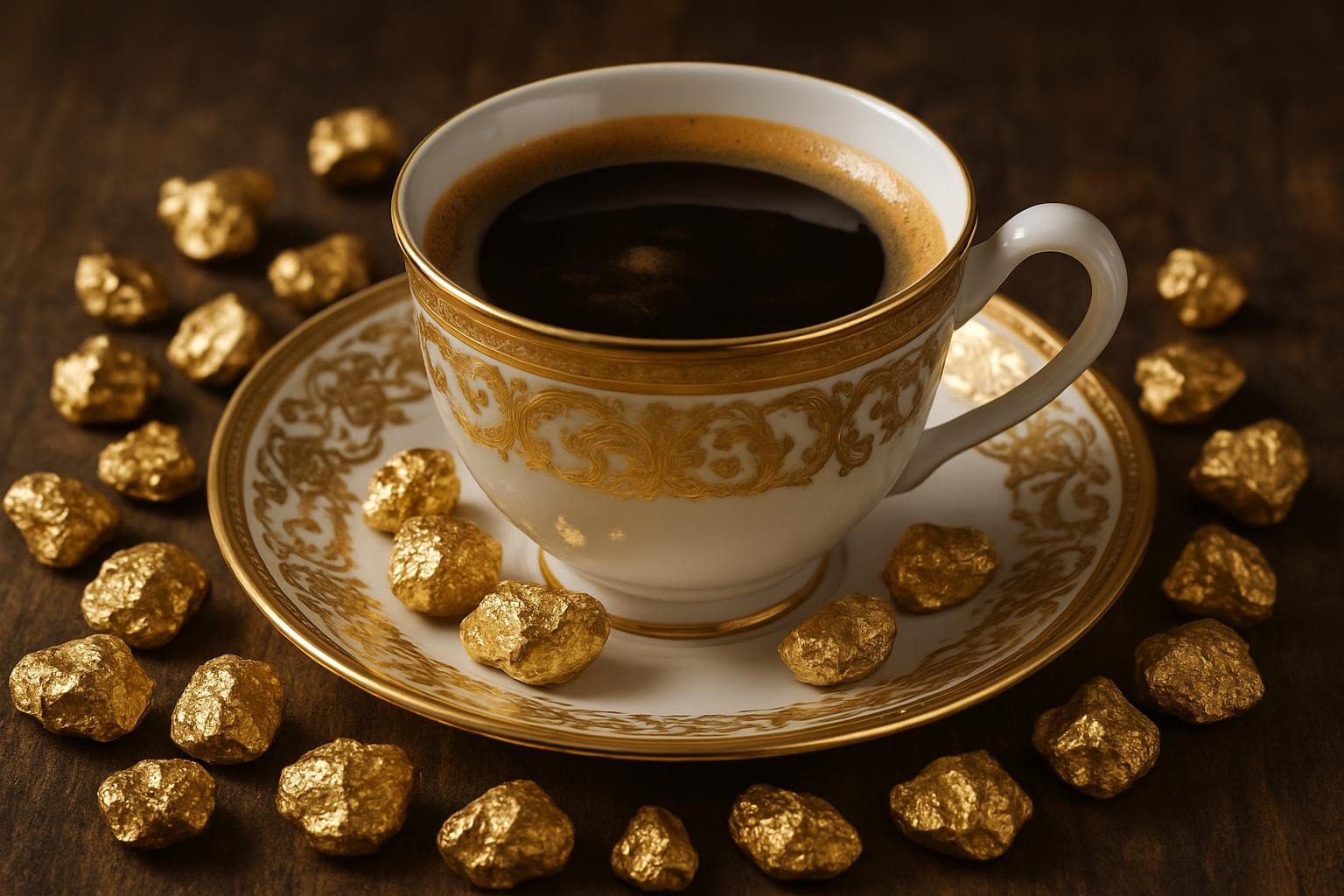
On August 6, 2025, Julith Coffee — a Dubai roastery that had posted its first Instagram photo eight weeks earlier — walked away from the Best of Panama online auction with every kilogram of the most expensive coffee ever sold at public auction. They paid $604,080 for a 20-kilogram lot of washed Geisha. At that price, just to break even on the beans themselves — before labour, equipment, or the cost of running a café — they’d need to charge around $545 per double espresso.
They’re charging $980 a cup. And there’s a waitlist.
This is not a story about hype. It’s a story about what happens when a single Ethiopian-origin varietal, discovered on a neglected Panamanian farm in the 1990s, meets two decades of careful farming, a global specialty coffee obsession, and a buyer class that treats rare agricultural lots the way others treat vintage Burgundy.
What Actually Happened at the Best of Panama 2025
The Specialty Coffee Association of Panama (SCAP) has run the Best of Panama competition since 1996. Originally a showcase for Panamanian diversity, it became something else entirely after 2004 — the year that Hacienda La Esmeralda first submitted its Geisha lots and the coffee world realized it had never tasted anything like it.
The 2025 edition ran on August 6. 50 lots, 1,000 kilograms total, auctioned online over 12 hours to buyers across China, Japan, South Korea, the UAE, the US, Canada, and Europe. The competition judging — a separate process completed in June — had already established that something unusual was happening: Hacienda La Esmeralda’s washed Geisha scored 98 points out of 100 from a panel of 22 international judges. Six of those judges gave it a perfect 100. Their natural Geisha scored 97. Both are new world records in coffee evaluation. It was also the first time in the competition’s 29-year history that one farm swept every category.
Then came the auction. The washed Geisha lot — labelled Nido 7, referring to a specific high-altitude plot on the Esmeralda estate — attracted 549 bids before Julith Coffee in Dubai secured it at $30,204 per kilogram. That’s 3× the previous record of $10,013/kg, set just one year earlier.
“This is not a gimmick or a marketing stunt — we’re not serving it in a gold cup with extravagant extras. The Nido 7 Geisha is a remarkable coffee that only a handful of people on the planet will ever taste.”
Serkan Sağsöz, Head Roaster & Co-founder, Julith Coffee — AFP, November 2025Best of Panama Washed Geisha — World Record Prices Over Time
The Farm: Hacienda La Esmeralda and the Geisha Origin Story
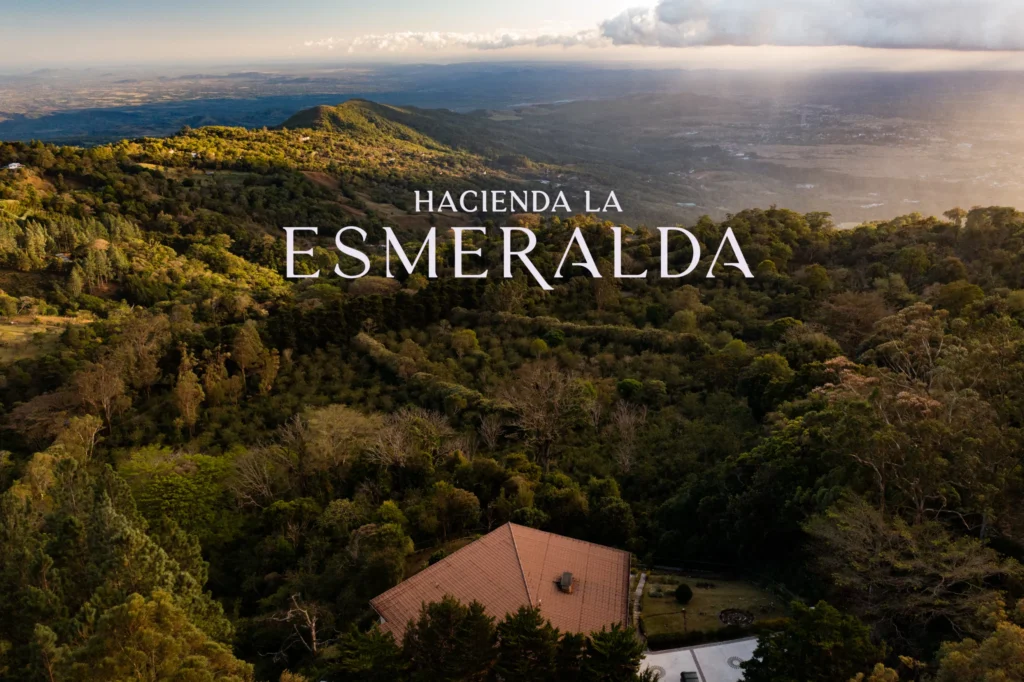
The land that became Hacienda La Esmeralda was first consolidated as a single estate by a Swede named Hans Elliot in 1940. Rudolph Peterson, a Swedish-American banker, bought it in 1967. Coffee had been grown on these slopes near Boquete since at least 1890 — the volcanic soil, 1,600–2,020m elevation, and cool Pacific-facing microclimate were always suited to it.
The Geisha varietal itself traces to the forests of southwest Ethiopia, near the town of Gesha. It was collected by researchers in the 1930s and spent decades in various gene banks and research stations, mostly ignored because its yields are low and its plants are finicky. It arrived in Panama via Costa Rica in the 1960s, where it sat in one corner of Hacienda La Esmeralda doing essentially nothing until the late 1990s — when Rachel Peterson’s father, a biologist, noticed it was the only plant on the farm not getting hammered by fungal disease during the wet season.
They isolated it. Processed it separately. Entered it in the 2004 Best of Panama competition — and the room of judges went quiet in a way that people who were there still talk about. It sold for $21/lb. At a time when commodity coffee was trading around $1–2/lb, that was so shocking that some buyers thought it was an error.
It wasn’t an error. It tasted like jasmine, bergamot, tangerine, and something faintly floral that nobody could quite name. The Peterson family spent the next two decades building the infrastructure to produce it with increasing precision: lot separation, altitude-specific harvesting, climate-controlled drying.
The Nido 7 plot — “nido” meaning nest in Spanish — sits at approximately 2,020 metres above sea level on the westernmost section of the estate, overlooking Volcán Barú. The 2025 lot underwent 48-hour cold-temperature fermentation, followed by climate-controlled drying. That’s the process behind the 98-point score.
| Lot | Process | Score | Price/kg | Buyer |
|---|---|---|---|---|
| Nido 7 GW-01 | Washed Geisha | 98.00 | $30,204 | Julith Coffee, Dubai |
| GN-01 | Natural Geisha | 97.00 | $23,608 | JD.com, China |
| V-01 (Laurina) | Varietal Natural | 92.88 | $8,040 | Beijing Specialty Drink Co. |
| Source: Specialty Coffee Association of Panama (SCAP) / Global Coffee Report, August 2025. Total auction: $2,861,200 from 50 lots. Average: $2,861.20/kg. | ||||
The Buyer: A Week-Old Dubai Roastery That Paid $604,080
Julith Coffee opened its Al Quoz café — in a Dubai neighbourhood that has become an unlikely hub for serious coffee — on August 1, 2025. Five days later, it was the winning bidder for the most expensive coffee lot in history. Its head roaster, Serkan Sağsöz, is a three-time Turkish Barista Champion and former Turkish Roasting Champion. He described the coffee in a November 2025 interview with AFP: “white floral notes like jasmine, citrus flavors like orange and bergamot, and a hint of apricot and peach. It’s like honey — delicate and sweet.”
From 20 kilograms of green coffee, roasted and ground, you can produce roughly 400 double espresso servings — which is exactly what Julith plans. At AED 3,600 per cup (~$980), they’ll generate around $392,000 in revenue from those 400 cups. A portion of beans has been reserved for Dubai’s ruling family. Asian buyers, Emirati enthusiasts, and “coffee collectors” have reportedly reached out hoping to acquire some of the raw beans. The café has declined.
The $980 cup is now the most expensive cup of coffee publicly sold, eclipsing the previous Guinness record holder — another Dubai café that charged AED 2,500 (~$680) just weeks before Julith’s opening.
The Economics, Plainly
20kg green coffee × $30,204/kg = $604,080 total lot cost
~400 cups served × $980/cup = ~$392,000 gross revenue from cup sales
Implied shortfall (before any other revenue): ~$212,000
The economics only work if Julith views the purchase primarily as a brand-building exercise — which, given the global media coverage it generated, is a reasonable read.
Why the Price Tripled in One Year
The 2024 record was $10,013/kg, set by Lamastus Family Estate’s Elida Geisha Natural. The jump to $30,204 in 2025 isn’t fully explained by quality improvement alone — a 98-point score is exceptional, but the 2024 lot was also exceptional. Something else is driving the trajectory.
Factor 1: The Middle East Has Entered the Market
For most of Best of Panama’s history, the dominant buyers were Japanese, South Korean, and Taiwanese specialty roasters. These markets have decades of investment in single-origin coffee culture and treat top lots as flagship products. The 2025 auction added a significant new player: Gulf buyers, primarily from Dubai and the UAE, who are building specialty coffee culture rapidly and for whom the status dimension of owning “the world’s most expensive coffee” has genuine marketing value in a market that understands luxury signalling.
Factor 2: Coffee Auctions Are Becoming Collectible Markets PROBABLE
Industry analysts at Global Coffee Report have noted that the auction dynamic increasingly resembles fine wine or rare whisky sales — where price itself becomes part of the product. The 2025 weighted average across all 50 lots was $2,861/kg — more than double 2024’s average of around $1,300/kg. This isn’t a single anomalous lot; it’s a market-wide shift. SPECULATIVE Whether this is sustainable or represents a speculative bubble is genuinely unclear. I haven’t seen data that would let me make a confident call either way.
Factor 3: Supply Cannot Scale
The Nido 7 plot produced 20 kilograms. That’s not a choice — it’s a function of plot size, altitude, and yield. Geisha plants at 2,000m produce significantly less fruit per tree than lower-altitude varieties. The only way to get more Nido 7 Geisha is to wait another year. This structural scarcity is permanent, and buyers know it.
| Year | Coffee | Price/kg | Record Status |
|---|---|---|---|
| 2004 | Hacienda La Esmeralda Geisha (BoP debut) | ~$21/lb (~$46/kg) | First time Geisha auctioned |
| 2022 | Elida Estate Gesha Natural (Lamastus) | $12,068/kg | Previous record at time |
| Sept 2024 | Elida Aguacatillo Gesha Honey (Lamastus) | $13,518/kg | Broke 2022 record by $1,450 |
| Nov 2024 | Elida Geisha Natural Vuelta (Lamastus, BoP) | $10,013/kg | BoP record before 2025 |
| Aug 2025 | Nido 7 Washed Geisha (Hacienda La Esmeralda) | $30,204/kg | Current world record ✓ |
| Sources: Perfect Daily Grind, Sprudge, Global Coffee Report, SCAP | |||
What Does It Actually Taste Like?
Geisha’s flavour profile is genuinely unusual in a way that’s difficult to convey to someone who’s never tasted it. Most good coffee tastes like coffee — rich, bitter, roasty, with fruit or chocolate notes in the background. Geisha tastes, to most people who encounter it for the first time, like something that shouldn’t be coffee at all.
Sağsöz describes the Nido 7 as: “white floral notes like jasmine, citrus like orange and bergamot, and a hint of apricot, peach, and honey.” The washed process — where the fruit is removed before drying — keeps the flavour exceptionally clean and transparent. You get terroir, not fermentation. The 2,020m altitude slows ripening, increasing the concentration of aromatic compounds.
It is, by the accounts of the 22 international judges who scored it, the best-tasting coffee ever evaluated at any formal competition. That may also be true. Or the score reflects a panel already primed to expect something extraordinary. Both things can be true simultaneously.
For context on what a 98-point score means: specialty coffee typically uses a 100-point scale developed by the Specialty Coffee Association, with 80+ qualifying as “specialty” grade, 90+ considered outstanding, and scores above 95 essentially unheard of before recent Panama results. The previous benchmark was around 96.5. The Nido 7 beating it by 1.5 points represents, statistically, an outlier at the extreme end of what the current scoring system can capture.
⚠ What Could Be Wrong Here
A few things I’d push back on before anyone draws conclusions:
The score is not independently replicable — yet. 98/100 from a specific panel of 22 judges in a specific context is a remarkable data point, not a universal truth. Blind tasting scores for the same coffee in different panels can vary by 3–5 points. Nobody has published a second blind evaluation. SPECULATIVE
The price reflects a market dynamic, not just quality. Julith paid 3× the previous record. That’s not a 3× quality improvement — the previous record lot was also extraordinary. Something about the buyer pool in 2025 drove the price to a level that quality alone doesn’t explain. This isn’t criticism; it’s just how auctions work when new money enters a category.
The economics of the $980 cup don’t add up to profit. This is transparently a brand-building exercise. That’s not dishonest — it’s explicit — but readers should understand that Julith’s $980 cup price is a marketing proposition as much as a product pricing decision. As one industry source noted in Global Coffee Report, the café would need to charge ~$545 per 18-gram double shot just to recover bean costs. They’re charging nearly twice that and still won’t break even on the lot alone.
Panama’s Broader Position in Specialty Coffee
Panama is a tiny coffee producer by volume — it exports a fraction of what Colombia, Ethiopia, or Brazil ship annually. What it has, in the Boquete highlands around Volcán Barú, is a cluster of microclimates and farming families who have spent decades investing in quality over quantity.
Richard Koyner, president of the Specialty Coffee Association of Panama, said after the August auction that the result “undoubtedly positions Panama as the country of the world’s finest coffees.” Panamanian President José Raúl Mulino publicly congratulated the Esmeralda team. In total, the 2025 Best of Panama generated $2,861,200 in sales from 50 lots — nearly double 2024’s $1,388,719. Thirty of the 50 lots exceeded $1,000/kg.
None of this volume matters to the commodity coffee market. Panama’s entire specialty output wouldn’t fill a single container ship’s worth of Brazilian commodity coffee. What it matters to is the roughly $50B global specialty coffee market, where provenance, score, and story are the product — and Panama’s story is currently unmatched.
Questions People Actually Ask
What is the most expensive coffee in the world right now?
As of late 2025: the Nido 7 Washed Geisha from Hacienda La Esmeralda in Panama, sold at the Best of Panama 2025 auction for $30,204/kg ($13,705/lb). The entire 20kg lot was purchased by Julith Coffee in Dubai for $604,080.
Where can you taste the $30,204/kg Geisha?
Only at Julith Coffee in Al Quoz, Dubai — and only around 400 cups exist. Price per cup: AED 3,600 (~$980 USD). A portion has been reserved for Dubai’s ruling family. They are not selling beans externally.
Is Panama Geisha different from Ethiopian Gesha?
Same plant, different names. “Gesha” refers to the Ethiopian village of origin; “Geisha” is the Japanese phonetic rendering that became standard in specialty coffee circles after the 2004 Best of Panama. Some farms and publications use one term, some use the other. The Specialty Coffee Association uses “Gesha” in formal documentation; most market usage is “Geisha.”
Why is washed Geisha more expensive than natural?
Not always — in 2025 the washed lot (Nido 7) scored higher than the natural and fetched a higher price. Generally, washed processing removes the fruit before drying, producing a cleaner cup that showcases terroir rather than fermentation. For a coffee scoring 98 points on transparency and floral character, washed processing is the argument for why it scored what it scored.
Will prices keep rising?
Honestly: I don’t know, and I’d be skeptical of anyone who says they do. The structural factors — fixed plot size, new Gulf and Asian buyers, collector-market dynamics — suggest continued pressure upward. But record-breaking auctions often represent a peak in that cycle. The 2026 auction will tell us more than any prediction can.
What happened to the 2024 world record coffee?
The Lamastus Family Estates Elida Geisha Natural at the 2024 Best of Panama sold for $10,013/kg — a record that stood for about 12 months before Esmeralda’s 2025 lot tripled it. Lamastus also held a separate private auction in September 2024 where an Aguacatillo Gesha Honey sold for $13,518/kg to South Korea’s Cupping Post.
Is Hacienda La Esmeralda’s Geisha available elsewhere, at any price?
Yes — Esmeralda sells various lots through its own private auctions and directly to select roasters year-round. Expect to pay $200–$800/kg for non-competition lots depending on processing and plot. Several specialty roasters in the US, Europe, and Asia carry Esmeralda Geisha in small quantities. The competition lots — Nido 7 included — are exclusively auctioned through SCAP’s Best of Panama process.
The 25 Most Expensive Earrings in the World: Auction Records, Market Dynamics, and Valuation Challenges
The 15 Most Expensive Necklaces in the World: Verified Records & 2025 Market Reality
The Most Expensive Patek Philippe Watches Ever Sold: Records, Record Holders, and the Forces Behind the Prices
Inside a $500 Million Superyacht: What Pure Luxury Actually Looks Like
Most Expensive Modern Art 2025—Record Prices Revealed
Leave a Reply