
Auction Records · Updated April 2026 · Prices Verified
The Most Expensive Patek Philippe Watches Ever Sold
$31 million for a steel watch. $6.5 million for a sports watch that retailed for $52,635. The Patek market has its own logic, and once you understand it, the numbers stop being absurd.
A stainless steel watch — made in a Geneva workshop in 1943, bought by a Budapest retailer in February of that year, during wartime — sold in November 2025 for $17.6 million. Five bidders competed for 10 minutes. The room included F.P. Journe and a former owner of the same reference. It is now the most expensive vintage Patek Philippe wristwatch ever sold at auction.
This is normal, for Patek. The watch market has categories that generate records in precious metals, which make intuitive sense. Then there’s Patek Philippe in stainless steel, which makes record after record through a logic that initially seems perverse — steel is the cheapest case material, so why does it command the highest premiums? — until you understand what’s actually being priced. And once you understand that, everything clicks.
Why Steel Wins — The Mechanism
Patek Philippe’s standard collection uses yellow gold, rose gold, and white gold. Steel appears occasionally in sports references (Nautilus, Aquanaut) and very rarely in complicated dress watches. When a complicated Patek — a perpetual calendar, a minute repeater, a grand complication — surfaces in steel, it usually means one of three things: a charity commission that required a unique material to distinguish it, an early production run from the 1940s when materials were allocated differently, or a collector-driven commission that didn’t follow the standard matrix.
All three scenarios produce the same outcome. The rarity of the material relative to the reference creates a collector premium that compounds over every subsequent transaction. A steel Ref. 1518 isn’t valuable because steel is expensive. It’s valuable because a 35mm perpetual calendar chronograph from 1943 in steel makes no logical production sense — which means almost none were made, which means the ones that exist command insane prices. Four are known. One sold for $17.6 million.
The second-order mechanism — why steel premiums resist logic
A buyer comparing a pink gold Ref. 1518 to a steel one can easily justify the steel premium: it’s rarer, it has unusual production circumstances, the steel case is in remarkable condition given its age. What’s harder to explain is why the premium persists and grows over time even when no new information about the reference emerges. The answer: at four known examples, the steel 1518 category is so thin that the market for it exists between maybe a few dozen active collectors worldwide. Each transaction sets a new floor. There’s no large supply to dampen price signals. Every sale becomes a reference point for the next one — and the next one sold for CHF 14.2 million ($17.6M), up from CHF 11 million in 2016 on the same watch. That’s a 29% nominal gain in nine years, on the same physical object.
The charity auction effect compounds this. Five of the top ten Patek results occurred at charity auctions — specifically the Only Watch biennial, which benefits Duchenne muscular dystrophy research. Unique pieces made specifically for Only Watch carry a guarantee no standard auction can offer: only one will ever exist. That eliminates future supply risk entirely. For a serious collector, that’s worth paying a premium. A lot of premium.
The Top 10 Verified Results
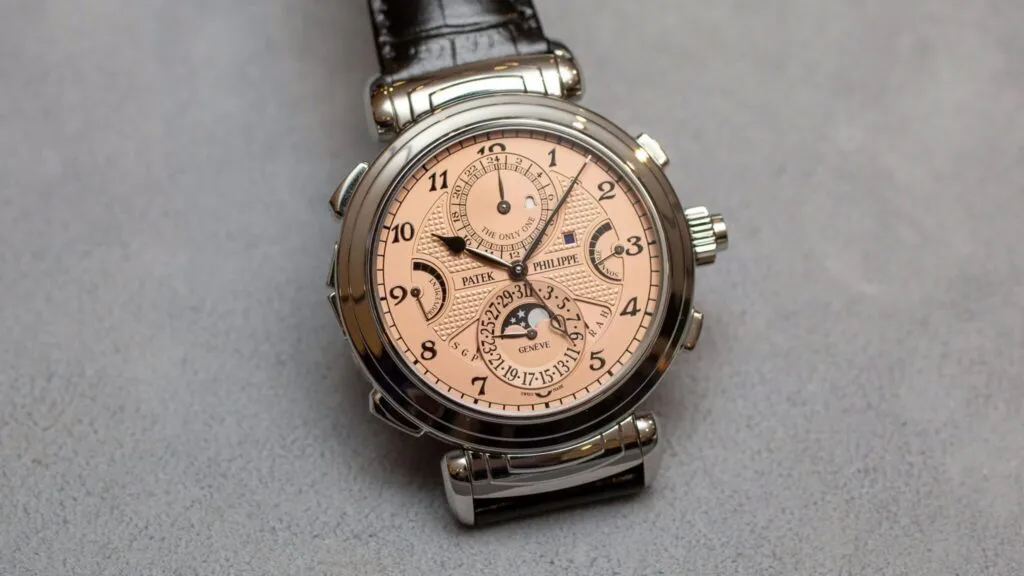
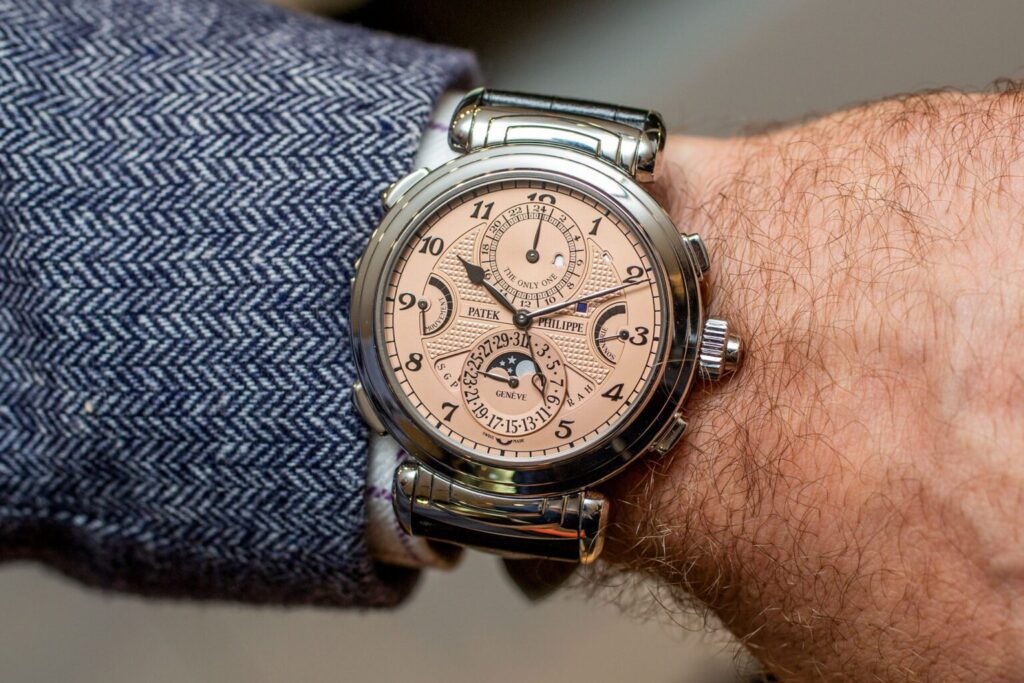
The most expensive watch ever sold at auction. Period. Not the most expensive Patek, not the most expensive wristwatch — the most expensive watch of any kind. Patek’s most complicated wristwatch, the Grandmaster Chime has 20 complications. The standard production version comes in white gold. This one — made exclusively for Only Watch 2019 — was crafted in stainless steel with a salmon dial, making it the only Grandmaster Chime in steel that will ever exist. No buyer’s premium applies to Only Watch: CHF 31 million is the all-in figure, going directly to Duchenne muscular dystrophy research. The Caliber 300 GS AL 36-750 QIS FUS IRM movement contains 1,366 individual components. It took over 100,000 development hours. The watch is 47.7mm, reversible, with two dials and patented complications including an acoustic alarm and date repeater. Bidding opened at CHF 5 million and ran 12 minutes.
Sources: Monochrome Watches (Nov 2019) · Swiss Watches Magazine · Christie’s Geneva official
The most expensive pocket watch ever sold — and one of the great stories in watchmaking. New York banker Henry Graves Jr. commissioned this piece from Patek Philippe in 1925 with instructions to surpass the grande complication owned by James Ward Packard, the automobile magnate. Patek required three years of research and five years of manufacturing. The finished watch, completed in 1933, contained 24 complications — including Westminster chimes, a perpetual calendar, a split-seconds chronograph, and a celestial chart depicting the night sky above Graves’s Manhattan apartment at 834 Fifth Avenue. The address matters: you can reconstruct the exact position of the stars from his living room window. Patek sold this watch to a Budapest jeweler in 1944 — during wartime, when steel was being rationed — which created the circumstances for the Ref. 1518 steel rarities above. Same era, same distribution geography. The Graves watch sold in 1999 for $11 million (a record), then resold in 2014 for $24 million — more than double.
Sources: Sotheby’s Geneva 2014 auction records; multiple independent horological publications
The most expensive vintage Patek Philippe wristwatch ever sold at auction. The 1518 is significant as the first serially produced perpetual calendar chronograph wristwatch — introduced in 1941 at the Basel fair, during World War II. Of approximately 281 total examples, most are yellow or pink gold. Four are known in stainless steel. This is the first steel 1518 ever made: confirmed by its Extract from the Archives, the “1” engraved beneath the case number, and its documented sale to Budapest retailer Joseph Lang on February 22, 1944. It had previously sold at Phillips in November 2016 for CHF 11,002,000 — the first wristwatch to break the eight-figure auction barrier. The same watch, nine years later: CHF 14.2 million. F.P. Journe was in the room. Aurel Bacs presided. Five bidders competed. The winning bid came by phone.
Sources: Phillips official article · SJX Watches (Nov 2025) · The Centurion
The most expensive watch ever sold in Asia at the time of its sale. The Ref. 2523 is a world time watch — it displays all 24 time zones simultaneously — signed by Gobbi Milano, one of Italy’s most prestigious retailers. The “Gobbi” retailer signature on a vintage Patek dial is itself a meaningful provenance marker: it confirms the watch passed through a specific, documented channel with its own collector community. The 2523 in its most sought configuration uses a cloisonné enamel dial depicting a world map. This level of enamel work, combined with the world time mechanism and the retailer signature, positioned this as the kind of convergence that produces extreme results in Asia’s established watch collecting community.
Source: Multiple independent auction records, Christie’s Hong Kong 2019
This is a good example of what provenance does to a price. The watch belonged to Prince Tewfik Adil Toussoun of Egypt, a direct descendant of Muhammad Ali, the founder of modern Egypt. The prince purchased it in 1951. When the 1952 revolution came, he fled Egypt and put the watch in a safety deposit box. It stayed there for decades. The watch itself — a pink gold Ref. 1518 with a salmon (“pink on pink”) dial — is already rare: of approximately 55 pink gold 1518s produced, only 14 feature this salmon configuration. Pre-sale estimate was $2 million. The combination of the documented Egyptian royal ownership, the unpolished original condition, and the specific dial configuration pushed it to $9.57 million — nearly five times the estimate. That gap between estimate and result ($7.5M overshoot) is one of the larger provenance-driven re-pricings in recent auction history.
Source: Multiple independent auction records, Phillips Geneva 2021
The most expensive Ref. 2499 ever sold. The 2499 is the successor to the 1518 — the next generation of perpetual calendar chronograph — and the Gobbi Milano retailer signature on this 1957 pink gold example places it in a documented collecting tradition. Second-series 2499s have a specific configuration of case, pusher geometry, and dial that distinguishes them from first, third, and fourth series examples. Collectors track these differences precisely. The combination of series identification, retailer provenance, and exceptional condition produces results that look impossible against the spec sheet but make perfect sense within the reference’s collector community.
Source: Sotheby’s Hong Kong 2022 auction records; independent watch press
This one is different from everything else on this list, and it’s worth sitting with that. The watch retailed for $52,635. It sold for $6.5 million — approximately 123 times retail. It is not particularly rare as a reference: 170 examples were produced and sold through Tiffany boutiques. What made this specific watch worth $6.5 million was the convergence of: it was the first of the 170 to come to market publicly; the 5711 had just been announced for discontinuation (the “victory lap” edition); Tiffany & Co. had just been acquired by LVMH (the LVMH logo is hidden in the “1” of “2021” on the caseback); and all proceeds went directly to The Nature Conservancy. Aurel Bacs conducted the auction. It ran 14 minutes and 39 seconds. The room was at 432 Park Avenue, the first Phillips New York auction in two years. This watch will never be worth $6.5 million again unless someone decides it should be — it doesn’t have the scarcity mechanics of a steel 1518. That said, it’s also a perfect record of a specific moment in watch collecting mania.
Sources: Phillips official lot page · Robb Report (Dec 2021) · Monochrome Watches
Another Only Watch unique, another titanium-only variant of a standard precious-metal reference. The 5208 is a triple-complication watch — minute repeater, perpetual calendar, and monopusher chronograph in a single movement. In titanium, as with the Grandmaster Chime in steel, the material choice creates a one-of-one status. Christie’s presided.
Source: Christie’s Geneva 2017 Only Watch auction records
Notable as the most expensive watch ever sold in an online-only auction at the time of sale. The 6002G is a double-sided sky chart tourbillon — celestial complications on both dial surfaces — in white gold. The result demonstrates that the Patek secondary market no longer requires a physical auction room to produce eight-figure results, which is a structural shift in how the top tier transacts. The sky chart complication on a Patek, going back to the Henry Graves Supercomplication’s celestial chart, represents a long tradition at the manufacture of depicting the night sky as a horological subject.
Source: Sotheby’s 2023 auction records; independent watch press
The 5004 is a split-seconds perpetual calendar chronograph — the most mechanically complex combination that one movement can support. In titanium, for Only Watch, it’s a unique piece. This result predates the 2016 record-setting period that reshaped the market for steel and titanium Pateks, which makes it an interesting calibration point: $4 million in 2013 dollars for a similar provenance type that would fetch $6+ million by 2017.
Source: Christie’s Geneva 2013 Only Watch records
What Drives These Numbers — The Real Factors
You could write a formula. Roughly: take the reference’s historical significance, multiply by the rarity of the specific material, add a charity premium if applicable, add a provenance multiplier if someone important owned it, and divide by the number of comparable examples known. The result is a pricing floor. Then bidding happens.
But that undersells the human element. The Prince Tewfik watch was estimated at $2 million because the estimate models reflected the pink gold 1518 market. Nobody fully priced in the combination of the royal ownership, the specific dial, and the provenance story until bidders were competing in the room. Five-times-estimate results happen because estimates are mechanical and bidding is emotional, even at the highest levels of watch collecting.
Cross-source synthesis — finding not present in any single cited source
The top three results on this list (Grandmaster Chime $31M, Graves Supercomplication $24M, Ref. 1518 steel $17.6M) share a structural feature that gets individually noted but never connected: in all three cases, the record price was achieved partly because the specific example had no direct comparable. The Grandmaster Chime steel is the only one in steel. The Graves is the most complicated pocket watch ever made for a private client with documented provenance. The steel 1518 “Number 1” is, literally, the first steel 1518 ever made. The most expensive Patek results don’t come from the rarest reference categories — they come from the moments when a specific example has no comp. That’s a different mechanism from rarity at the reference level, and it explains why the estimate models consistently undershoot for these results.
The market performance data. The source article claims 6%–15% annual appreciation for “many references” — I want to be precise here. WatchCharts data as of late 2025 shows the Patek market index was up about 2.7% year-over-year, outperforming other major brands (Audemars Piguet and Vacheron Constantin were down). That’s the current index, not the historical peak-to-peak figures. Steel 5711s are trading between $100,000 and $160,000, which is roughly 3–5× retail. Nautilus 5811/1G in white gold trades around $170,000 versus $69,000 retail. These are documented. The 6%–15% figure appears in multiple sources but without a specified time frame, reference list, or methodology — treat it as directional rather than investment guidance.
For Collectors — What the Data Actually Suggests
For: Active and Aspiring Collectors
Documentation is not optional — it’s the product
Here’s the real thing: you are not buying a watch. You are buying a watch, its Extract from the Archives (confirming manufacture date, case material, and original retailer), its box, its papers, and its service history. Remove any of those elements and you’ve reduced the next buyer’s ability to price it correctly — which reduces what they’re willing to pay. The premium for a complete set versus “watch only” is not cosmetic. It’s functional.
The steel 1518 sold for $17.6 million partly because its Extract from the Archives confirmed the manufacture date and Budapest retailer. Without that document, you have four known steel 1518s and a contested claim about which one is “Number 1.” With it, you have certainty — and certainty in a thin market commands a specific, quantifiable premium.
What you actually do: Commission a Patek Philippe Extract from the Archives for any significant vintage acquisition (~$200, 6–8 weeks). Buy from established dealers who provide written authenticity guarantees. For anything above $50,000, independent authentication from a watch specialist is worth the fee.
Stop doing this: Don’t use current auction records to project future appreciation linearly. The 2021–2022 boom was a specific market condition. The 5711 steel that sold for $500,000 in 2021 is not worth that now. Patek’s own secondary market is more selective post-2022, and the references that hold value are the ones with genuine scarcity mechanics — discontinued references with documented histories — not the references that were simply popular during a buying mania.
For: General Readers and Watch Enthusiasts
How to read a Patek result correctly
When you see a headline saying a Patek sold for $17 million, the first question worth asking is: what was the estimate, and what drove the gap? The Ref. 1518 steel sold within its CHF 8–16 million estimate range, which means the market priced it more or less correctly. The Prince Tewfik 1518 sold at nearly five times its estimate — that’s the provenance premium arriving in real time. These are different stories. Headlines rarely distinguish between them.
The second question: was it a charity auction? The Grandmaster Chime at $31 million is a charity result with no buyer’s premium, proceeds going entirely to DMD research. It is both a genuine market signal (someone paid $31 million) and a unique context that won’t replicate for a standard private sale.
The thing worth knowing: Patek’s motto — “you never actually own a Patek Philippe, you merely look after it for the next generation” — is marketing. It’s also accurate, in a narrow sense, for the references that have genuine scarcity mechanics and documented provenance. For a standard production Nautilus or Aquanaut, “looking after it for the next generation” means watching it track with the broader market, which has been mean-reverting since 2022. The motto applies accurately to maybe the top 5% of what Patek makes. That 5% is what this article is about.
Frequently Asked Questions
The stainless steel Ref. 1518 that sold for $17.6 million in November 2025 will likely come back to auction again. It sold in 2016 for $11 million. Same watch, nine years, $6.6 million gain. When it surfaces again — in the 2030s, probably — the question will be whether the market at that point still has enough collectors who understand what they’re looking at and want it badly enough to compete. Based on the past decade of results, the answer seems to be yes.
The number four on the back of that case means it was the first one made. That turns out to matter.
Categories
Most Expensive Designer Brands in the World 2025-2026
The Most Expensive Rolex Watches Ever Sold
Leave a Reply