

The World’s Most Expensive Apartments:
Sky-High Luxury in 2026
In April 2026, a record-shattering $554 million Monaco apartment changed everything the luxury market thought it knew about price ceilings. Here is the full picture — every record deal, every city, every force driving the numbers.
“The most expensive apartment in the world” gets written about twice a year. The actual record is broken once a decade, if that — and when it is, it reveals something genuine about how wealth moves across the planet.
The $554 Million Record, Properly Explained
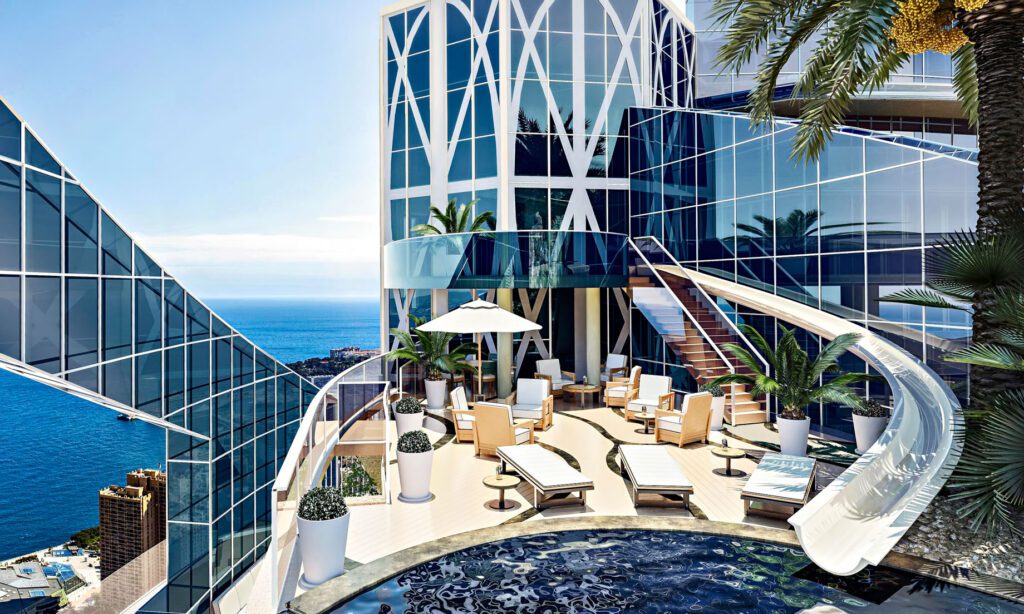
The deal was finalised in 2024. It took until April 2026 for Bloomberg to surface it from Monaco’s property registers and preliminary deeds. Ukrainian billionaire Rinat Akhmetov, through his holding company System Capital Management, had purchased a five-floor waterfront apartment inside the Le Renzo building in Monaco’s newest district — Mareterra — for €471 million ($554 million).
The numbers are disorienting at first. Bloomberg, which broke the story, reports the apartment spans approximately 2,500 square metres — not counting the balconies and terraces overlooking the Mediterranean. That works out to roughly $221,000 per square metre, a figure that makes Monaco’s already staggering €71,167 average look almost moderate.
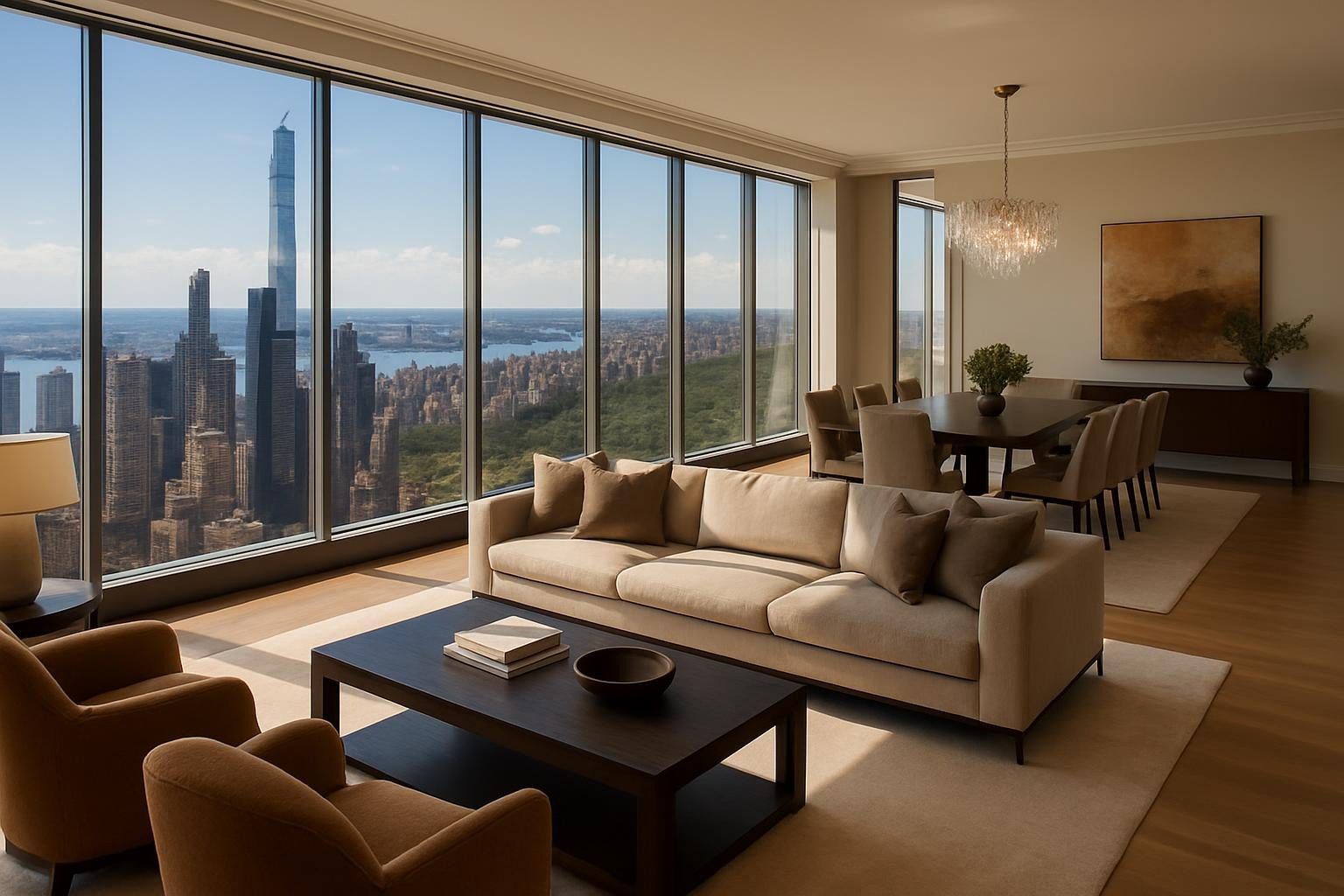
The previous record holder was Ken Griffin’s 220 Central Park South penthouse, purchased for $238 million in 2019. The Akhmetov transaction doesn’t just beat it — it more than doubles it. The second-place record in Manhattan has stood for seven years. Nobody in New York has come close. That gap tells you something real about the difference between the top tier of global luxury and everything else.
The 21-room property includes a private swimming pool, a jacuzzi, and at least eight parking spaces. The Mareterra district itself is brand-new: built on reclaimed land, inaugurated by Prince Albert II in 2024, and designed explicitly to extend Monaco’s coastline — and its tax-haven real estate inventory — in a principality that otherwise has nowhere left to build. SCM confirmed the acquisition but declined to discuss price, noting only that it had invested in the Le Renzo project on the primary market in 2021 — before the full-scale Russian invasion of Ukraine.
According to the Monaco Tribune, citing data from Monaco’s statistical institute IMSEE, certain properties in Mareterra are already trading above €100,000 per square metre. The district was inaugurated in 2024. Within two years, it has moved past every price benchmark the global luxury market had previously established.
The 10 Most Expensive Apartments Ever Sold
Ranked deals only — verified transactions, not asking prices. The distinction matters more than it might seem: in this segment, properties routinely list for multiples of what they actually trade for. The numbers below come from confirmed sale records or direct reporting from Bloomberg, The Real Deal, and primary property registers.
Five floors, 21 rooms, approximately 2,500 m² excluding terraces. Private pool, jacuzzi, 8+ parking spaces. Buyer: Rinat Akhmetov via System Capital Management. Confirmed by Monaco property registers and Bloomberg Businessweek. Price per m²: ~$221,000.
Four full floors, approximately 24,000 sq ft (~2,230 m²). Buyer: Ken Griffin (Citadel). Still the most expensive home ever sold in the United States. ~$9,916 per sq ft on sale. Designed by Robert A.M. Stern Architects, developed by Vornado Realty Trust.
44,214 sq ft over multiple levels. Private car lift for direct vehicle access. Rooftop pool, private cinema, multiple kitchens. Scheduled for completion Q4 2026. Branded collaboration between Bugatti and Binghatti Developers. Fastest sell-out of any Dubai super-prime project.
Six bedrooms, over 31,000 sq ft. Part of an Aman-branded beachfront development. One of the most significant ultra-prime transactions in Dubai’s 2026 year-to-date tally — which already shows Dubai leading the world in $10M+ sales volume for the third consecutive year.
77,000 sq ft — larger than the White House. Triplex with 8 bedrooms, indoor and outdoor theatres, a cryogenic spa, full basketball court, mini-golf course, meditation garden. Currently the largest individual penthouse unit in Dubai by floor area.
Buyer later revealed to be Michael Dell, founder of Dell Technologies. Held the NYC residential record for five years before Griffin’s 220 CPS purchase. Located two blocks from Billionaires’ Row. The first Manhattan apartment to cross nine figures.
Floors 107–108, 21,000 sq ft. Rooftop pool overlooking the Burj Khalifa, spa, screening room, billiards room, 12 parking spaces. Shell unit — buyer specifies full fit-out. The most prestigious residential address in the world’s tallest building.
London’s most expensive residential sale and the second-highest globally — until the Akhmetov Monaco deal was revealed. Developer Nick Candy’s former principal residence. Set the European record before being eclipsed within months.
The Most Expensive Cities by Price Per Square Metre
Headline sales grab attention. But price per square metre reveals the structural reality: which cities are simply expensive at every price point, and which are expensive only at the trophy level. The Henley & Partners 2025 rankings calculate this on prime 100–200 m² apartments in city centres.
Sources: Luxury Living Index 2026 (RestProperty), Henley & Partners Wealth Report 2025, Knight Frank PIRI 100 (2026). Monaco prime includes Mareterra data from IMSEE February 2026 report.
One city that most lists underplay: Saint-Jean-Cap-Ferrat, a small peninsula between Nice and Monaco on the French Riviera. Henley & Partners ranks it fifth globally by prime price per square metre — and it is where Akhmetov also owns Villa Les Cèdres, acquired in 2019 for €200 million. The Riviera corridor between Monaco and Cap-Ferrat is effectively the densest concentration of ultra-prime residential real estate on earth by land area.
And Tokyo. The Knight Frank 2026 Wealth Report flags it as the global outlier: prime new-build apartment prices surged 58.5% in a single year, driven by a weak yen making Japanese luxury irresistible to dollar- and euro-denominated buyers. That is not a sign of a healthy, stable market. It is a currency trade wearing a property trade’s jacket.
Over 40% of residents are millionaires. Tax-haven status. Physically cannot expand except by land reclamation. In 2025, Monaco’s prime average crossed €70,000/m² for the first time, per IMSEE.
Home to ~384,500 millionaires — more than any city on earth. Manhattan’s Billionaires’ Row stretches along 57th Street and southern Central Park. No apartment has crossed Griffin’s 2019 record since.
Mayfair, Knightsbridge, and Belgravia anchor global pricing. Nick Candy’s Chelsea mansion sold for $350M+ in 2025 — was briefly Europe’s record before Monaco reset everything.
500 super-prime ($10M+) sales in 2025 alone — the world’s most active ultra-luxury market by transaction volume. Middle East was the best-performing global region in prime real estate at +9.4%.
Long-standing global lead in average condo pricing. Limited land, extreme population density, and enduring status as an Asian financial hub. Knight Frank flags a super-prime rebound trajectory for 2026.
Asia’s most regulated luxury market. Viewed as a “safe harbour” for Southeast Asian and Indian wealth. Average rent of $3,300/month is the highest in Asia. Ultra-mobility buyers park capital here precisely because the market is boring by design.
Dubai: A Luxury Apartment Market Unlike Any Other
By volume of nine-figure transactions, Dubai is now the undisputed capital of trophy apartment sales. 500 properties changed hands at $10 million or above in 2025 alone — a figure no other city comes close to matching. That is not a sign of irrational exuberance. It is what happens when you build a tax-zero jurisdiction in the centre of a time zone connecting European, Indian, and Gulf wealth.
The Bugatti Residences Sky Mansion, sold for AED 750 million (~$204 million) in 2025, illustrates something specific about how Dubai markets ultra-luxury: branded residences are doing the heavy lifting. Four Seasons, Aman, Armani, Bugatti, Jacob & Co — the logic is that billionaires buy brands they already trust. You are not selling them a floor plan. You are selling them a world they already inhabit.
“In March 2026, a six-bedroom penthouse at Aman Residences Dubai sold for AED 422 million, marking one of the most significant ultra-prime transactions of the year so far.”
— Engel & Völkers UAE, May 2026
The Burj Khalifa sits slightly apart from the branded-residence conversation. Its duplex Sky Palace — floors 107 and 108, 21,000 sq ft, currently listed for around $51 million — is priced as a shell unit. The buyer specifies the fit-out. That is a deliberate structure: it keeps the headline price low while the final cost, once interiors are commissioned, will land considerably higher. In a market where asking prices regularly run 30–40% above transaction prices, the inverse is also possible.
The one number Dubai doesn’t advertise
The Burj Khalifa rents a penthouse unit for $3.2 million annually, confirmed by The National in March 2026. That works out to roughly $267,000 per month. The capital value on that unit, if priced at a 3% yield — the rough upper bound in Dubai’s super-prime market — would be around $107 million. At 2%, it would approach $160 million. Yield compression at the ultra-prime level is how rental income figures translate into sale prices in this tier. Most buyers in this segment are not yield-seeking. The rent is irrelevant to them. But it is a useful benchmark for anyone trying to reverse-engineer how the listed prices came to exist.
New York: Billionaires’ Row by the Numbers
Ken Griffin’s 220 Central Park South penthouse has held the US residential record since January 2019 — seven years and counting. Nobody in Manhattan has come within $100 million of it. The average closing price at 220 CPS across its first ten sales was $6,742 per square foot. Griffin’s unit closed at $9,916 per square foot.
For context: as of July 2020, the average price per square foot for a New York City condo was $1,110. Griffin’s apartment traded at nine times that. And the city of New York, for property tax purposes, values the apartment at $9.4 million — a fact that became front-page news in early 2026 amid a local political fight over mansion tax reform.
| Property | Price | Year | Buyer | $/sqft |
|---|---|---|---|---|
| 220 Central Park South, PH | $238M | 2019 | Ken Griffin | ~$9,916 |
| 220 CPS, PH 76 | $99.9M | 2020 | Undisclosed | ~$12,164 |
| 220 CPS — Multiple units | $92.7M | 2019 | Daniel Och | N/A |
| One57 — Full-Floor Duplex | $100.5M | 2014 | Michael Dell | ~$6,800 |
| 432 Park Ave — Three Units | $91.1M | 2017 | Undisclosed | N/A (25% disc.) |
The one thing that stands out reviewing these numbers: 220 Central Park South dominates. Three of the top five Manhattan transactions of all time occurred in the same building. Robert A.M. Stern’s pre-war design approach — limestone exterior, high ceilings, views of Central Park from every angle — created something the market hasn’t been able to replicate in six years of trying. Visit mostexpensives.com for ongoing tracking of record-setting property transactions worldwide.
What Actually Drives These Prices
The usual explanations — location, scarcity, prestige — are true but incomplete. Three specific mechanisms are doing most of the work at the very top of the market.
Mechanism 1: The tax arbitrage
Monaco has no income tax, no capital gains tax, no inheritance tax on Monegasque residents, and no wealth tax. For a billionaire earning $200 million a year, relocating nominal residence to Monaco — which requires spending at least 183 days there annually — can be worth tens of millions annually in tax savings. The $554 million apartment is not just real estate. It is a structure. The price makes more sense when you factor in what the residency qualification unlocks over a ten-year horizon.
Mechanism 2: The ultra-mobility shift
Knight Frank’s 2026 Wealth Report identifies a structural change in how UHNWIs use their homes: a growing proportion spend fewer than 90 days per year in any single residence. This “base-hopping” pattern has created explosive demand for branded, fully managed, turnkey residences — properties you can lock, leave, and return to without maintenance friction. The Four Seasons, Aman, and Raffles residences aren’t priced like hotels. They’re priced like the permanent option value to have the hotel experience whenever you need it.
Mechanism 3: The billionaire population pipeline
As of 2026, the global UHNWI population — individuals worth more than $30 million — has reached 713,626, up 32% since 2021. According to Knight Frank, 89 new people cross the $30 million threshold every single day. The pipeline of potential buyers for $50M+ apartments is not shrinking. It is growing faster than inventory at the top. That structural supply-demand imbalance is the most important driver of all, and the one least likely to reverse in the near term.
The global UHNWI population is projected to grow by 28% over the next five years. The billionaire population in India is forecast to grow by 77% by 2031, and by 60% in Australia. New buyers from markets that haven’t historically been major players in Monaco or Mareterra are entering the pool. The question is not whether these prices are rational. It is whether the buyer pool is large enough and growing fast enough to absorb the inventory. Currently, the evidence says yes.
The 2026 Luxury Apartment Market: Who Is Buying and Where
The Knight Frank PIRI 100 — the Prime International Residential Index — recorded an average global prime price rise of 3.2% in 2025. The Middle East led at +9.4%. Asia-Pacific came in at +3.6%. Europe at +3.3%. North America was the only region that declined, at -0.9%, driven by price falls in Canada rather than the US.
That aggregate hides the real story. The divergence between the top 1% of properties and everything else is widening. As Inman’s luxury outlook noted, the top tier is now behaving less like traditional housing and more like a distinct global asset class — decoupled from mortgage rates, local employment trends, and mainstream affordability pressures. The forces moving it are wealth creation, family office capital allocation, and inflation hedging. Not the 30-year fixed rate.
The branded residence factor
The Savills Branded Residences Report 2025/26 tracks 186 active branded residence developments globally. Four Seasons remains the most influential operator, with Mandarin Oriental and Aman following in the ultra-luxury tier. Among non-hotel brands, Armani, Missoni, Fendi, Pininfarina, and Bugatti have all translated design identities into residential product — sometimes successfully, sometimes not. The Bugatti Sky Mansion’s AED 750 million sale in 2025 suggests the car-as-lifestyle brand extension can work at the absolute apex of the market.
What the Savills data also reveals: Paris, Monaco, Sydney, and Hong Kong are significantly underdeveloped as branded residence markets relative to their wealth density. Monaco’s issue is obvious — there is barely room to build anything at all. Paris faces planning restrictions. The implication is that as new supply eventually enters these markets, it will command premium pricing even by current standards.
The Uncomfortable Math
A $554 million apartment. A building where prices exceed €100,000 per square metre. A market where 89 new people per day are crossing the threshold at which these purchases become conceivable.
None of this is going to reverse on its own. The structural forces — tax arbitrage, ultra-mobility, billionaire population growth — are directionally aligned, and they have been for fifteen years. The question of whether this represents the rational allocation of capital or something closer to its opposite is worth sitting with, but it will not change the transaction data.
What might change it: meaningful global minimum tax frameworks, coordinated wealth tax legislation, or a major shift in the geopolitics of tax havens like Monaco. As of mid-2026, none of those are imminent. The OECD’s global minimum tax agreement covers corporate income, not personal wealth. Monaco is not subject to it.
There is one number that keeps surfacing when you dig into this market for long enough. Griffin’s 220 Central Park South penthouse is currently valued by New York City for property tax purposes at $9.4 million — not $238 million. The assessed value is less than 4% of the purchase price. Everything I’ve described above exists inside that gap.
A Timeline of Record-Breaking Sales
Reference: Key Metrics by Market (2025–2026)
| City / Market | Prime avg. price/m² | 2025 growth | Top recorded sale | Key driver |
|---|---|---|---|---|
| Monaco | €71,167 ($78k) | +2.2% | $554M (Le Renzo) | Tax haven, zero new land |
| London (prime) | $46,359 | +3.3% | $350M+ (Chelsea) | Legacy wealth, heritage stock |
| New York (prime) | $27,500–$33,513 | -0.9% (N. America) | $238M (220 CPS) | Millionaire density, finance |
| Dubai (prime) | $15,000–$25,000 | +25.1% | $204M (Bugatti Sky Mansion) | Tax-free, volume of $10M+ deals |
| Hong Kong | $25,339 | Declining, rebound forecast | N/A (listed 2026) | Asian financial hub, density |
| Singapore | $19,600 | Stable | N/A | Safe-harbour capital, regulation |
| Tokyo (prime new-build) | Fast rising | +58.5% | N/A | Weak yen, foreign buyers |
Sources: Knight Frank PIRI 100 (2026); Luxury Living Index 2026 (RestProperty); IMSEE Monaco (Feb 2026); Engel & Völkers UAE; Numbeo city-centre data.
How Ultra-Luxury Real Estate Marketing Sells Myths About Wealth Preservation: The $238 Million Illusion
The $238 Million Penthouse That Refuses to Be Broken—And Why Most $50M+ Celebrity Homes Are Losing Millions Right Now
Lucid Burns $176,000 Per Vehicle Producing Ultra-Luxury EVs. Nobody Buys
The Most Expensive Patek Philippe Watches Ever Sold: Records, Record Holders, and the Forces Behind the Prices
Most Expensive Modern Art 2025—Record Prices Revealed
Leave a Reply