
Most Expensive Rolex Watches: The Eight Records That Define a Market
From a $17.75 million Daytona that sat in a drawer for decades, to a Sultan’s bespoke commission — why the rarest Rolex watches have become the most liquid trophies in the alternative asset world.
In October 2017, twelve minutes of bidding at a Phillips auction in New York transferred a single wristwatch — originally a gift, then a drawer ornament, then a rumor — for $17.75 million. The buyer was anonymous. The seller was James Cox, the former boyfriend of Paul Newman’s daughter Nell, to whom Newman had casually given the watch decades earlier. Cox had barely acknowledged it existed. That gap between indifference and $17.75 million is the Rolex story in miniature.
The auction record has held for eight years. The collector market has produced a second tier of extraordinary sales in the interim — pieces commanding five and six million dollars that, in any other category, would be the story. In the Rolex context, they are footnotes to the Newman. Understanding why requires a working theory of what actually drives value here. The answer is not what most buyers assume when they first encounter these numbers.
Three Forces, Not One
Most coverage of record-breaking watch sales treats provenance, rarity, and materials as interchangeable explanations. They’re not. Each drives value through a distinct mechanism, and the watches that break records are the ones where all three converge at the same moment in the same lot.
Provenance is the most emotionally powerful force — and the least replicable. Newman’s Daytona didn’t become valuable because Newman wore it. Plenty of famous people have worn Rolex watches without producing eight-figure auction results. It became valuable because Newman wore that specific reference, which was already a collector’s grail because of its “exotic” Art Deco dial configuration, at the precise moment when the vintage watch market had matured enough to pay for cultural mythology at scale. Remove any of those conditions and the number collapses.
Rarity is more structural. Only eight examples of the Daytona Ref. 6270 “The King” are known to exist, each commissioned by Sultan Qaboos bin Said of Oman and retailed through Asprey of London in the early 1980s. The watch that sold at Sotheby’s in October 2025 for $5.23 million was not famous before the auction. It became famous because of the structural impossibility of replication. Eight examples, zero production possibility, one available. That arithmetic does most of the valuation work.
The third force — materials and configuration — matters most for the gem-set category. When a piece invents an aesthetic category that the entire luxury industry later follows, the original commands a premium no subsequent example can match. Including Rolex’s own production.
“The watches that break records are not the most expensive watches Rolex ever made. They are the ones where rarity, provenance, and the market’s readiness to pay for mythology arrive at the same lot on the same day.”
— Auction Analysis, February 2026The Eight Watches That Define the Market
These are ranked by realized price — the only objective measure the market provides. Each entry includes the mechanism behind the result, because the number alone teaches nothing.
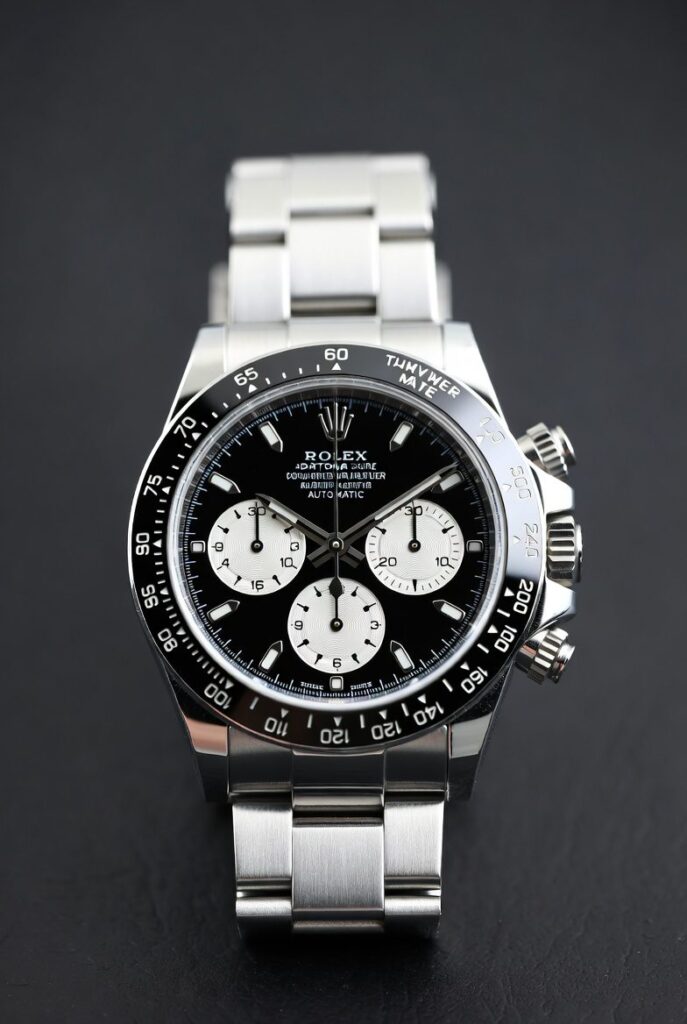
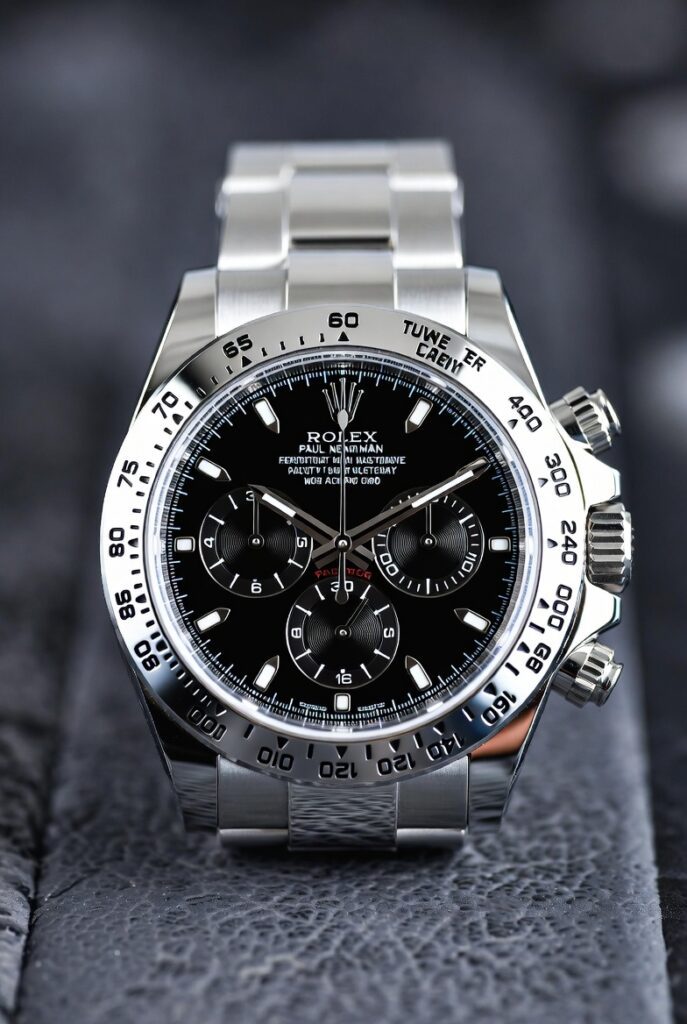
Newman’s wife, Joanne Woodward, gave him this watch in 1972 to mark the start of his professional racing career, having the caseback engraved “DRIVE CAREFULLY ME.” He later gave it to James Cox — his daughter Nell’s boyfriend — who held it for decades before it resurfaced in 2016.
The dial had already earned the name “Paul Newman dial” before anyone knew Newman’s own example still existed. When it did surface, bidding lasted twelve minutes. The result obliterated the previous Rolex record — set just six months earlier by the Bao Dai Ref. 6062 — and stands unchallenged today. The original retail price of a Daytona Ref. 6239 in the early 1970s was approximately $210. That’s an appreciation of over 8,400,000%. No asset class can explain it. Only history can.
Produced in 1994, this was the first Rainbow Daytona ever made — predating the configuration’s commercial acknowledgment by Rolex by years. Its bezel carries 36 baguette-cut rainbow sapphires; the dial is diamond-paved with rainbow sapphire hour markers.
Modern Rainbow Daytonas retail for over $400,000 and sell for more on the secondary market. The prototype of any successful category commands a premium that no subsequent example — including Rolex’s own production — can match. This was the only known example of this reference to appear at public auction, confirming that category-originator premium as structural rather than sentimental. The result was $6.28 million. It won’t be replicated.
The Ref. 6062 is Rolex’s most complicated vintage reference — an automatic with triple calendar and moon phase, produced only briefly in the early 1950s. This yellow gold example with diamond “stelline” (star-shaped) hour markers and a black dial is one of only three known to exist in this exact configuration. Its November 2025 sale set a new record for the model, exceeding its pre-sale high estimate of $5 million by 24%.
The result pushed the famous “Bao Dai” 6062 — which had held the reference record since 2017 — into fourth place overall. Two Ref. 6062s in the top seven. That’s not a coincidence. It’s the market pricing the rarest complication Rolex ever produced in its most scarce surviving configurations.
The nickname is literal. This is the only Daytona ever produced in 18k white gold — made in Germany by special order circa 1970, passing through the collection of John Goldberger before being donated to Phillips for sale, with all proceeds directed to Children Action.
The provenance layering here is unusually dense: one-of-a-kind material, pedigreed collector ownership, charitable context. It sold for $5.9 million at a moment when the market had not yet seen the subsequent escalation in gem-set and royal-commission pieces. That means this result, in today’s market, would likely land higher. The definitive illustration of what “unique” actually means at auction.
Commissioned in the early 1980s by Sultan Qaboos bin Said Al Said of Oman and retailed through Asprey of London, the Ref. 6270 was the first gem-set Daytona ever made. Crafted in 18k yellow gold with a baguette-cut diamond bezel and pavé-set diamond dial accented by sapphire hour markers — only eight examples are known across the entire run.
Its October 2025 result was not an outlier. A second Sultan’s Ref. 6270 sold at Phillips earlier in 2025 for $4.1 million, confirming the pricing band for the reference rather than treating the Sotheby’s result as anomalous. The original sticker remains on the caseback. Worn rarely, if at all — condition documents the seriousness of the original commission.
Marlon Brando wore this GMT-Master during the filming of Apocalypse Now (1979), having removed the original brown bezel so it would not be visually distracting on screen. The caseback carries the engraving “M. Brando.” The documentary trail to the film is airtight.
This watch demonstrates a specific dynamic in the provenance category. It isn’t enough that a famous person owned a famous reference. The person must have used the watch in a way that changed it — or that can be proven to have mattered. Brando modified this watch for a film shoot. That modification, which would typically destroy value, instead created it. The result: the highest-priced GMT-Master ever sold at auction.
Bao Dai — the last emperor of Vietnam — purchased this yellow gold Ref. 6062 in Geneva in 1954. It is the only vintage Rolex to combine an automatic movement with a triple calendar and moon-phase complication in this specific dial configuration, and the imperial provenance was documented across six decades of ownership history.
When it sold at Phillips Geneva in November 2017, it briefly held the title of most expensive Rolex ever — surrendered six months later to Newman’s Daytona at the same auction house’s New York sale. Those two results in the same calendar year, both over $5 million, both at Phillips, produced the first serious reckoning with how deep the collector market had become. The market had grown up without anyone quite noticing.
Produced circa 1954, the Ref. 6100 “Dragon” carries a cloisonné enamel dial depicting a coiled Chinese dragon — the work of enamel master Nelly Richard, whose dials are now independently collectible. Fewer than ten examples of this dial configuration are known across all Rolex references. The watch was preserved in a prominent family collection before appearing at Sotheby’s in December 2025.
Its result is notable not for the absolute figure — well below the other entries here — but for what it represents structurally. Value derived entirely from the artisan craft of the dial. No mechanical complexity. No celebrity ownership. No gem setting. In a market increasingly dominated by diamonds and provenance, the Dragon is an argument for a third path. Rolex has never systematically revisited this mid-century decorative tradition — which is exactly what makes surviving examples irreplaceable.
The Complete Record at a Glance
Table 1 — All Eight Records: Ranked by Realized Price (Buyer’s Premium Included)
| # | Watch | Reference | Sale Price | House & Year | Primary Value Driver |
|---|---|---|---|---|---|
| 1 | Paul Newman’s Daytona | 6239 | $17,750,000 | Phillips, 2017 | Provenance + iconic dial |
| 2 | Daytona “Zenith Rainbow” | 16599SAAEC | $6,280,000 | Phillips, 2024 | First Rainbow ever made |
| 3 | Ref. 6062 “Stelline” | 6062 | $6,210,000 | Monaco Legend, 2025 | One of three — triple cal. + moon phase |
| 4 | Daytona “Unicorn” | 6265 | $5,900,000 | Phillips, 2018 | Only white gold Daytona ever made |
| 5 | Daytona “The King” | 6270 | $5,230,100 | Sotheby’s, 2025 | Royal commission — one of eight |
| 6 | GMT-Master “The Brando” | 1675 | $5,120,000 | Christie’s, 2023 | Documented film use — highest GMT ever |
| 7 | Ref. 6062 “Bao Dai” | 6062 | $5,060,427 | Phillips, 2017 | Imperial provenance + unique complication |
| 8 | Ref. 6100 “Dragon” | 6100 | $1,758,000 | Sotheby’s, 2025 | Artisan enamel — fewer than ten known |
All prices include buyer’s premium and are in USD at the prevailing exchange rate at time of sale. Sources: Phillips, Christie’s, Sotheby’s, Monaco Legend Group, Robb Report auction record (November 2025).
What the Market Is Actually Telling You
These eight watches are not the market. They are its ceiling. Understanding the ceiling clarifies what drives value beneath it, because the same three forces operate across every price tier — just at different magnitudes.
The broadest investment-relevant data point: Bob’s Watches 15-year transaction data shows the GMT-Master II appreciated 506% from 2010 to 2025 — the best-performing collection in the Rolex catalog. The Daytona followed at 358% appreciation over the same period.
Source: Bob’s Watches Market Report (2025), based on completed transactions 2010–2025. Appreciation measured against July 2010 baseline.
These numbers require careful handling. Atlas Luxury’s 2025 analysis documents the 2020–2022 mania clearly: the Daytona peaked at $53,911 in March 2022 before correcting 51% to approximately $37,995 by 2024–2025. Speculators who bought at peak pricing faced immediate 20–30% losses. The fifteen-year trend is real. The mania was a detour within it.
Table 2 — Investment Performance vs. Ownership Cost Reality
| Metric | Rolex (Steel Sports) | Patek Philippe | Audemars Piguet | Source |
|---|---|---|---|---|
| ROI 2019–2024 (5-year) | 93% | 207% | 158% | Atlas Luxury / Swiss academic study |
| 15-year appreciation (top collection) | 506% (GMT-Master II) | N/A in this dataset | N/A in this dataset | Bob’s Watches, 2025 |
| Ownership cost over 10 years (insurance, service, storage, fees) | +50–52% of initial purchase price — a watch appreciating 100% over 10 years nets substantially less than 100% | Atlas Luxury, 2025 | ||
| Secondary market premium over retail (catalog average) | ~15.7% | Higher on Nautilus/Aquanaut | Higher on Royal Oak | Secondary market analysis, 2025 |
| Rolex share of global watch trade volume | 34.2% (Chrono24 data, Q1 2020–Q4 2024) | Omega + Patek + Cartier + AP + Breitling + IWC combined: 32.6% | Chrono24 / Finexity analysis | |
Five-year ROI figures from Swiss academic research (13 luxury brands, January 2019–September 2024) cited in Atlas Luxury’s 2025 report. Ownership costs are estimates across a typical holding period — actual costs vary by model value, region, and service frequency. Table adds cross-brand context not present in the body text.
Rolex Collections: 15-Year Appreciation at a Glance
Source: Bob’s Watches data, via Quill & Pad (July 2025). Bars scaled to GMT-Master II maximum.
The structural fact that makes Rolex unusual as an alternative asset: it remains, as Chrono24’s transaction data confirms, the brand commanding the largest share of global secondary market trade — 34.2% of global watch transaction volume between 2020 and 2024, outpacing the next six major brands combined. Scarcity is a policy choice at Rolex, not a supply chain constraint. That distinction matters for investors because deliberate scarcity is reliably durable in a way that fashion-driven scarcity isn’t.
Tariff pressure on Swiss watch imports has been a recent accelerant. Swiss brands raised U.S. retail prices by up to 20% through 2024–2025 to offset tariff costs and gold price increases (gold itself rose 27% in 2024 alone). Rolex raised U.S. retail prices again in May 2025 by approximately 3%, lifting the Daytona’s retail price to around $14,000 and the GMT-Master II to approximately $11,000. Higher retail prices support pre-owned pricing. The market is paying attention.
“Rolex is the only watch brand whose secondary market systematically trades above retail. That premium is not sentiment — it is a consequence of deliberate supply constraint operating against structurally inelastic demand.”
— Secondary Market Analysis, 2025The Question the Record Leaves Open
Paul Newman’s Daytona will not hold its record indefinitely. The open question isn’t whether another Rolex will exceed $17.75 million — several candidates exist in private hands. The question is what conditions must arrive simultaneously for the next record to fall.
The Newman sale required: a previously unseen example of the definitive collector reference, a documented provenance chain to one of the most culturally significant figures in twentieth-century American life, an auction market mature enough to absorb eight-figure bids for a wristwatch, and a room full of committed buyers at the same moment. Those conditions are not algorithmic. They are historical.
The next record will be set by a watch that has not yet surfaced, at a moment that can’t be predicted, by a buyer whose identity will be protected by an auction house’s telephone bidding protocol. What the current record teaches — and what Paul Newman’s own history with the watch teaches — is this: the objects that define this market are not the ones made to be valuable. They are the ones that became valuable because of everything that happened to them before anyone was paying attention.
The watches that break records are not the most expensive watches Rolex ever made. They are the ones where rarity, provenance, and the market’s willingness to pay for mythology arrive at the same lot on the same day. That conjunction can’t be manufactured. It can only be recognized — usually after the hammer falls.
Sources & Further Reading
- Sotheby’s — The 5 Most Expensive Rolex Daytona Watches Sold at Auction — Ref. 6270 “The King” $5,230,100 (October 2025)
- Robb Report — The 15 Most Expensive Rolexes Ever Sold at Auction (November 2025) — Stelline 6062 $6.2M at Monaco Legend
- WatchGuys — 10 Most Expensive Rolex Watches Ever Sold — Second Sultan’s 6270 at $4.1M (2025)
- Bob’s Watches — Rolex Watch Market Report: 15-Year Transaction Data — GMT-Master II 506%, Daytona 358% appreciation
- Quill & Pad — True Rolex Secondary Market Prices (July 2025) — Full collection appreciation breakdown
- Atlas Luxury — Rolex Investment in 2025: Real Returns vs. Market Hype — 5-year brand ROI comparison, ownership costs, post-2022 correction data
- Atlas Luxury — The Ultimate Rolex Market Report 2025 — Swiss academic study (13 brands, 2019–2024), 28% market share
- Atlas Luxury — Rolex Daytona Secondary Market Pricing (2026 US Guide) — 51% correction from 2022 peak, current ~$37,995 average
- The Luxury Playbook — What Are The Most Expensive Rolex Watches in 2026?
- Finexity — Why Rolex & Co. Make Investors’ Hearts Beat Faster — Chrono24 34.2% market share, Swiss retail price increases 2025
- Jonathan’s Fine Jewelers — How Rolex Investment Value Is Shifting in 2025 — May 2025 U.S. price increase (3%), CPO dynamics
- The Luxury Playbook — Why the Rolex Daytona Is the Hottest Watch Investment in 2026
All auction prices include buyer’s premium and are in USD at the prevailing exchange rate at the time of sale. This article is editorial in nature and does not constitute investment advice. © 2026 MostExpensives.com
Most Expensive Rolex Watches 2026
The 12 Most Expensive Watches in the World Ever Sold
The Most Expensive Patek Philippe Watches Ever Sold: Records, Record Holders, and the Forces Behind the Prices
World’s Most Expensive Gold Smartphones in 2025: The Pinnacle of Luxury
The Most Expensive Patek Philippe Watches: 2026 Collector’s Guide
Leave a Reply