
Most Expensive Hotels in the World 2026
From a submarine off St. Lucia to a bulletproof penthouse in Geneva — the complete, verified ranking of earth’s priciest suites and what they actually include.
The proof is in who books these rooms. The Royal Penthouse in Geneva — the suite with bulletproof glass and a reinforced safe room — has hosted Mikhail Gorbachev, Hosni Mubarak, and a rotating cast of European royals. Nobody checking in at $80,000 a night is thinking about thread counts. They are thinking about whether the windows can stop a rifle shot. They can.
This ranking is based on verified 2025–2026 nightly rates pulled from the hotels’ own published pricing, luxury travel publications including Robb Report and Elite Traveler, and direct hospitality sourcing. Where hotels don’t publish rates (which is most of them), I’ve used the credible floor — the minimum confirmed by multiple independent luxury travel agents and journalists.
The Complete 2026 Ranking at a Glance
Before the deep dives: the full table, sortable by rank. Note that several properties don’t advertise a fixed rate — the figures below represent confirmed or credibly estimated peak nightly pricing for the flagship suite at each property.
| # | Property · Suite Name | Location | Rate / Night | Status |
|---|---|---|---|---|
| 1 | Lover’s Deep Submarine Hotel | St. Lucia, Caribbean | ~$235,000 | Limited availability |
| 2 | Empathy Suite · Palms Casino Resort | Las Vegas, USA | $100,000 | Bookable |
| 3 | Royal Mansion · Atlantis The Royal | Dubai, UAE | $100,000+ | Bookable |
| 4 | Royal Penthouse Suite · Hotel President Wilson | Geneva, Switzerland | ~$80,000 | By request only |
| 5 | Mark Penthouse · The Mark Hotel | New York, USA | $75,000 | Bookable |
| 6 | The Muraka · Conrad Maldives Rangali Island | South Ari Atoll, Maldives | $50,000 | Bookable |
| 7 | Hilltop Villa · COMO Laucala Island | Laucala, Fiji | $45,000 | Bookable |
| 8 | Royal Suite · Burj Al Arab | Dubai, UAE | ~$25,000–56,000 | By arrangement |
| 9 | Penthouse Suite · Hotel Martinez | Cannes, France | ~$53,200 | Bookable |
| 10 | Four Seasons Jet · Private Air Villa | Global (itinerary-based) | ~$150,000 (trip) | Annual booking |
The 12 Most Expensive Hotels, Ranked in Full Detail
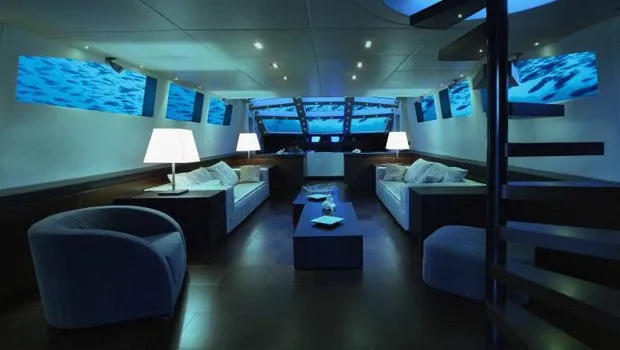
This is the one that makes every other entry on this list feel conventional. Lover’s Deep is not a hotel in any meaningful architectural sense. It is a custom luxury submarine — sleeping two, piloted by a private crew — that submerges in the Caribbean off St. Lucia, parks amid coral reefs and ship wrecks, and lets you wake up surrounded by tropical fish on all sides.
The operator, Oliver’s Travels, markets it through a handful of ultra-luxury concierge services. The package includes helicopter transfers to and from the vessel, a private chef who prepares full catered meals aboard (heavy on caviar, oysters, and champagne), and 24-hour crew support. The submarine moves on request, which means you can drift over a specific reef at dawn if you want. Most guests who have written about the experience describe the silence as genuinely disorienting — no ambient hotel noise, no other guests, no light from the surface. Just the sound of water and whatever is swimming past the window.
The honest caveat: this is an experience for a very specific type of person. Claustrophobia, mild seasickness, or any discomfort with the deep ocean makes this a miserable $235,000. For the right couple — one that finds a moving submarine romantic rather than anxiety-inducing — nothing else on this list comes close to its novelty value.
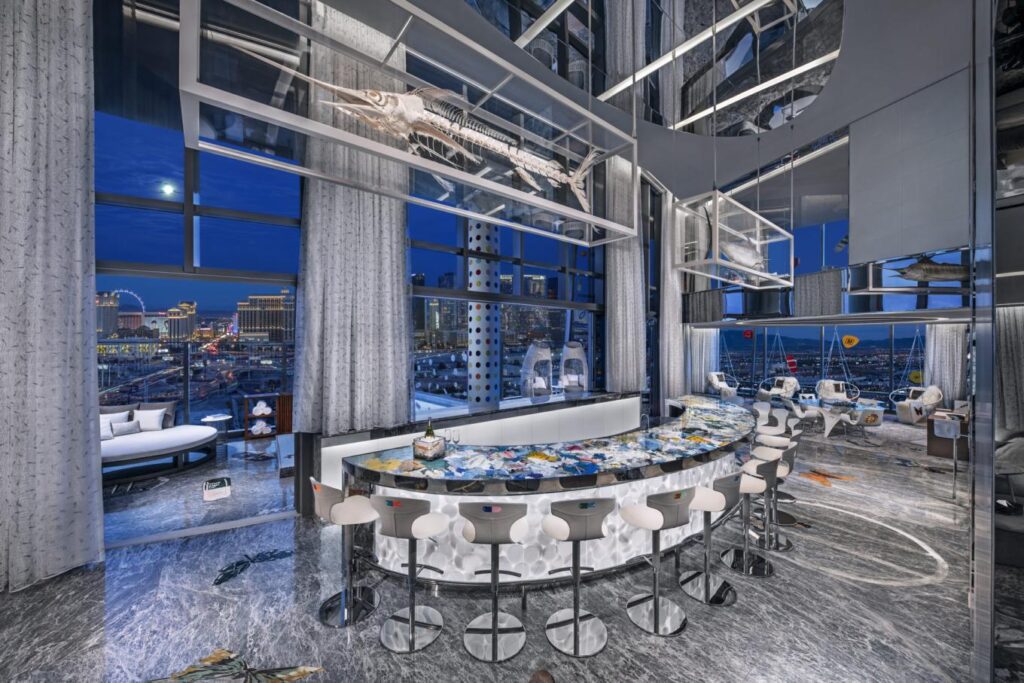
The Empathy Suite is the only hotel room on this list that functions simultaneously as a private art gallery. Damien Hirst — the British artist whose shark-in-formaldehyde sculptures regularly clear $10 million at auction — was given full creative control over the 9,000-square-foot, two-story suite at the Palms. The result is a space where original Hirst works aren’t hanging behind glass. They are built into the walls, the furniture, and the ceiling.
Beyond the art, the practical features are impressive: two master bedrooms, a private pool with direct views over the Las Vegas Strip, a dedicated massage room, a salt therapy room, and 24-hour butler service. The Palms positions this as a destination for high-rollers who want something that can’t be recreated — the art alone makes the space unique in a way that no amount of marble and gold leaf can replicate.
When Atlantis The Royal launched in early 2023 with a Beyoncé performance at the private opening — a concert reportedly costing $24 million that was closed to the public — it was a statement of intent. This is a hotel that spent over $1.4 billion to build and operates on the premise that the world’s wealthiest travelers have seen enough five-star properties to become genuinely bored by them. The Royal Mansion is the answer to that boredom.
The four-bedroom residence sits at the summit of the property. It has its own private terrace, its own infinity pool overlooking both the Arabian Gulf and the Dubai skyline, entertainment spaces that function more like a private home’s living rooms than anything a traditional hotel would recognize, and a permanent around-the-clock staff dedicated exclusively to the suite. The hotel operator, Kerzner International, has positioned it less as accommodation than as a private residence that happens to come with hotel infrastructure below it.
Worth noting: Atlantis The Royal is a full resort. What guests of the Royal Mansion get is access to every amenity across the entire property — restaurants, spa facilities, beach clubs — with full privacy. Most of those other guests are paying in the $1,500–$5,000 range per night. The experiential gap between staying in the Royal Mansion and the next tier down is enormous.
If the Palms Suite is for people who collect art and the Dubai Royal Mansion is for people who want to be seen, the Hotel President Wilson’s Royal Penthouse is for people who cannot afford to be seen at all — and have the security requirements to prove it.
The suite occupies the entire top floor of the hotel: 18,000 square feet across 12 bedrooms, each with its own marble bathroom stocked with Hermès products. The building specs are more fortress than hospitality: bulletproof windows throughout, a private elevator that requires specific clearance, reinforced armored doors, a dedicated safe room, and on-call security staff that do not appear on any hotel directory. Former guests include Mikhail Gorbachev, Hosni Mubarak, Rihanna, Richard Branson, and Bill Gates — a guest list that illustrates why the security infrastructure is not decorative.
Booking cannot be done through the hotel’s standard reservation system. Access requires going through the hotel’s chairman — a detail that functions both as a security filter and as a signal about what kind of property this is. It is one of the last truly discreet major hotel properties left.
The Mark Penthouse is the largest private residential suite in New York City — five bedrooms, five bathrooms, and a private rooftop terrace that looks directly toward Central Park. During Met Gala week in May, it becomes effectively unobtainable; celebrities and fashion houses block-book it months in advance as a base for the entire spectacle. At $75,000 per night, it holds its position by virtue of location (the Upper East Side, minutes from the Metropolitan Museum of Art and Central Park), designer finishes, and the kind of discretion that New York’s hospitality scene does better than almost anywhere else.
The hotel’s broader reputation is built on a relationship with Jean-Georges Vongerichten’s restaurant on the ground floor and genuinely custom service — guests can arrange virtually anything through the concierge, and the hotel’s reputation depends entirely on their not discussing what that includes.
The Muraka is structurally unlike anything else on this list. It is a two-level residence — the upper floor sits above the Indian Ocean in the conventional overwater style, with living spaces and guest bedrooms. The master bedroom is below the waterline, separated from the open ocean by a curved acrylic panel, with coral, fish, and the full underwater ecosystem visible from bed. The building required entirely new marine engineering to construct and has been underwater since 2018 without structural issue.
At $50,000 per night, the price includes more than the accommodation: a private chef, a personal butler, a dedicated guest experience manager, and full use of the resort’s facilities. The underwater bedroom — which allows guests to fall asleep and wake up while visually immersed in the Indian Ocean — is genuinely disorienting in the best possible way. It is the most architecturally interesting room on this entire list.
COMO Laucala was bought by Red Bull founder Dietrich Mateschitz in 2003, developed over a decade into a private island resort, and now operates as one of the most genuinely remote luxury properties on earth. The island — 3,500 acres — supports 25 villas and a permanent staff that substantially outnumbers any possible guest count. The Hilltop Villa, at $45,000 per night, claims the highest point of the island with 360-degree views of the Fijian ocean and surrounding reefs.
What COMO Laucala does better than almost any other property on this list: food. The island runs its own organic farm, its own dairy, its own chocolate production. Guests eating at the restaurant are consuming ingredients harvested the same morning. In an era where “farm to table” has been reduced to a menu footnote, this is the real version.
The Burj Al Arab occupies a peculiar position on this list: it is the most famous luxury hotel on earth, but no longer the most expensive. Built on an artificial island and opened in 1999 — at the time marketed as the world’s only “seven-star hotel,” a designation it created for itself — it spent years at the top of every expensive hotel ranking. Dubai has since built past it.
The Royal Suite is genuinely impressive despite this: 780 square meters across two floors, a personal elevator within the suite, 24-carat gold iPad controls for room functions, a rotating bed, private cinema, and a dedicated butler brigade described as “the world’s largest” by the hotel. Arrival by Rolls-Royce Phantom or helicopter helipad is standard. The suite has been described by numerous guests as the definition of unabashed, maximalist opulence — gold on every conceivable surface, marble floors throughout, views over the Arabian Gulf in every direction.
The global luxury hotel market was valued at approximately $118.5 billion in 2026, growing at 5% annually. The ultra-luxury segment — properties and suites at the top tier — is growing faster than the overall market, driven by the rapid expansion of ultra-high-net-worth individuals globally and a documented shift toward experiential spending over material goods. Approximately 35% of high-net-worth travelers now prefer suite accommodations specifically for privacy.
What You Are Actually Buying at These Price Points
It is worth being direct about this, because most coverage of expensive hotels treats price as spectacle rather than economics. The guests who book these suites regularly — and there are repeat guests for all of them — are not paying for comfort. They are buying specific functional outcomes that cheaper properties cannot provide.
How to Actually Book These Properties
A non-trivial number of the hotels on this list cannot be booked through their website, through hotel booking platforms, or via any standard channel. The booking process is itself a filter. Here is how each category works:
Directly bookable online (Atlantis The Royal, The Mark, Hotel Martinez, COMO Laucala): These properties take inquiries through their websites or can be reached via luxury concierge services. Advance notice of 3–6 months is typical for peak periods; 6–12 months for events like Cannes Film Festival (Martinez) or Met Gala (The Mark).
Requires a luxury travel specialist (Burj Al Arab Royal Suite, Conrad Maldives Muraka): Technically bookable directly but best negotiated through an established luxury travel agency. Virtuoso-affiliated agents often access rates and inclusions that the hotel’s direct channel will not offer. Recommend contacting an agent affiliated with Virtuoso or Amex Fine Hotels & Resorts.
Chairman/personal contact required (Hotel President Wilson, Palms Empathy Suite): The Geneva property explicitly routes bookings through the hotel chairman’s office. Expect a vetting process. Your travel agent needs existing relationships to access this effectively.
Specialist inquiry only (Lover’s Deep): Contact Oliver’s Travels or an ultra-luxury concierge directly. Availability is genuinely limited and the property is not always operational.
The Luxury Hotel Industry in 2026: The Numbers Behind These Prices
These properties don’t exist in a vacuum. The pricing is set by a market — specifically, a market that has been growing at 5–8% annually and is projected to continue doing so through the end of the decade.
Per market research firm Mordor Intelligence, suites accounted for 41.76% of luxury hotel revenue in 2025. The ultra-luxury suite segment — which is what this entire article covers — is outpacing the broader luxury category. The reason, as reported across multiple industry analyses: high-net-worth travelers are pivoting from things (second homes, art) toward experiences, and hotel suites that provide irreplaceable environments capture that spending.
The pace of opening new ultra-luxury properties is also worth noting. Dubai now has two properties on this list (Atlantis The Royal and the Burj Al Arab) and is constructing several more — the Jumeirah Marsa Al Arab, which opened in late 2024 with a five-bedroom Royal Suite of its own, is already attracting attention as a future entrant in this ranking. Geneva, by contrast, has been stable for years. The city’s structural advantage — neutrality, banking, diplomacy — is hard to replicate, which is why the Hotel President Wilson hasn’t needed to change its pricing strategy or product in a decade.
Rates at this tier change. Several properties on this list do not publish fixed pricing, which means the figures here represent the best credibly sourced estimates available as of June 2026. Some properties charge differently based on whether certain staff, amenities, or inclusions are added. Always verify pricing directly with the property or through a specialist luxury travel agent before planning. Never rely on a blog post — including this one — as a final pricing source for a suite that might cost more than a house.
Further Reading on Extreme Luxury
If the pricing here has you curious about what occupies the tier just below — ultra-luxury properties in the $5,000–$20,000 per night range, where many of the same operators run their “accessible” flagship suites — the full comparative landscape is worth exploring. The gap between the top of the market covered here and properties most ultra-wealthy travelers actually stay in regularly is larger than most people expect.
For a broader context on what the world’s most expensive things look like across categories — yachts, private islands, cars, and residences — MostExpensives.com maintains comprehensive rankings across the full spectrum of ultra-luxury goods and experiences. The hotel suites covered here represent some of the most concentrated value-per-night pricing in the luxury world, but they sit within a broader ecosystem of extreme spending worth understanding.
One more thing worth sitting with: the top suite on this list costs roughly the same as the median American household earns in four years. The guests who book it routinely return. Whatever they get from it, a single night is not the point — it’s just the minimum unit of access to a world that operates by entirely different rules than the one most travelers navigate. Whether that’s aspirational or disturbing depends entirely on your frame.
Opulent Suites: Extravagantly Designed Commanding Premium Nightly Rates
Most Expensive Hotels in 2026
These Yachts Cost More Than Private Islands — Here’s Why
Prestige Amenities — Private Pools, Michelin-Starred Dining, and Bespoke Offerings That Define Top-Tier Stays
Lucid Burns $176,000 Per Vehicle Producing Ultra-Luxury EVs. Nobody Buys
Why Most People Fail at Billionaire Travel — And How to Be the Exception
Leave a Reply