

The World’s Most Expensive Vacations:
What Each One Actually Costs
Private islands at $57,000 a night. Around-the-world private jet journeys starting at $159,000 per person. Orbital missions at $55 million a seat. Every price on this page has a verified source — because in this bracket, the numbers are half the story.
| Cheapest entry on this list | $57,000/night — Musha Cay private island (12 guests, all-inclusive, 5-night minimum) |
| Most expensive documented trip | $2.2 million — bespoke multi-country itinerary Luxury Travel Magazine |
| Private jet expedition range | $124,000–$234,000 per person (Four Seasons, 2025–2027) |
| Space tourism low end | $200,000–$450,000 (suborbital, Blue Origin / Virgin Galactic) |
| Space tourism high end | $55–70 million (ISS orbital, Axiom/SpaceX) |
| Superyacht (200m+) | $500,000–$1M+ per week base rate, before APA |
| Who books these | UHNW individuals, celebrities, tech founders; some corporate retreats |
Experience 01
Private Island Buyouts: $57,000 to $150,000 a Night
Renting a private island sounds like a figure of speech. It isn’t. Two of the most documented examples — Musha Cay and Necker Island — publish their rates openly, which makes them useful benchmarks for a category that’s usually shrouded in discretion.
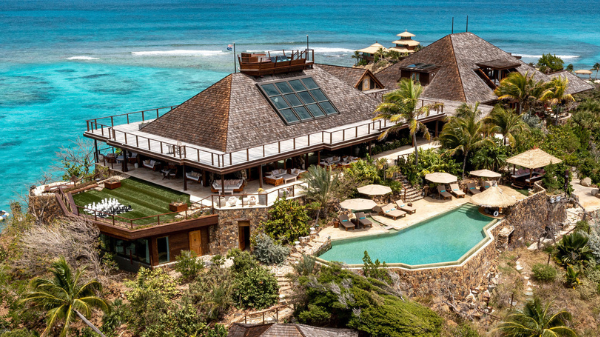
Musha Cay, David Copperfield’s 150-acre estate in the Bahamas’ Exuma chain, starts at $57,000 per night for up to 12 guests, with a five-night minimum. The rate is genuinely all-inclusive — meals, wines, spirits, water toys, chef, staff — the only extras are international calls and special requests. The island accommodates up to 24 guests; at maximum occupancy, the nightly cost pushes higher. The neighboring islands are uninhabited and the surrounding waters are restricted: guests can spend days without seeing another boat. Copperfield has personally designed a three-hour pirate treasure hunt that threads through hidden caves and a petrified lake, which sounds absurd until you consider that the man is a professional illusionist with four decades of stagecraft behind him.
Necker Island, Richard Branson’s 74-acre retreat in the British Virgin Islands, runs $107,500 per night for exclusive island use, accommodating up to 30 guests across the estate. The property was destroyed in Hurricane Irma in 2017 and subsequently rebuilt. Calivigny Island in Grenada — 80 acres, 22 suites across three houses — commands $132,000–$150,000 per night (excluding tax) for up to 50 guests, all-inclusive.
Here’s the structural reality that travel content usually skips: the per-person math on private islands is often less absurd than it looks. A group of 24 at Musha Cay at $57,000/night works out to $2,375 per person per night — comparable to a suite at a Maldivian overwater villa, but with the entire island and the ocean around it to yourselves. The absurdity kicks back in at the five-night minimum: $285,000 before anyone boards a plane.
| Island | Location | Rate (excl. tax) | Guests | Notable | Source |
|---|---|---|---|---|---|
| Musha Cay | Bahamas (Exumas) | From $57,000/night | Up to 24 | 5-night minimum; fully all-inclusive; restricted waters | Musha Cay official |
| Necker Island | BVI | $107,500/night (exclusive) | Up to 30 | Flamingos, iguanas; rebuilt post-Irma 2017 | Luxury Columnist |
| Calivigny Island | Grenada | $132,000–$150,000/night | Up to 50 | 22 suites; fireworks on request; fully staffed | Luxury Columnist |
Experience 02
Private Jet World Expeditions: $124,000 to $234,000 Per Person
Four Seasons’ Private Jet Experience is the most documented product in this category, which makes it the most useful benchmark. The program runs on a custom Airbus A321LRneo with 48 Italian leather seats, each offering 6.5 feet of lie-flat space. An onboard executive chef, physician, and concierge travel with the group throughout the journey.
The 2025–2027 pricing spans a wide range depending on itinerary length and destinations. The shorter regional journeys — 13 to 16 days — price from $124,000 to $159,000 per person based on double occupancy. The full around-the-world itineraries, running 20 to 22 days across eight or nine destinations, come in at $208,000–$234,000 per person. The 2027 “Uncharted Discovery” expedition — 21 days spanning Antarctica, Machu Picchu, Tamarindo, and Cartagena — starts at $234,000 per person.
What’s telling is the demand signal. Four Seasons reports that 100% of surveyed past guests said they would travel with the program again, and 2025 bookings paced ahead of 2024. Some guests have booked six separate itineraries. The 48-seat cap is a structural constraint, not a marketing device — every departure is genuinely intimate.
| Itinerary | Duration | Price/Person | Key Stops | Source |
|---|---|---|---|---|
| African Wonders (2026) | 13 days | $159,000 | Athens, Serengeti, Rwanda, Mauritius, Johannesburg | Four Seasons press |
| Asia Unveiled (2026) | 16 days | $159,000 | Tokyo, Bali, Maldives, Bhutan, Angkor Wat, Bangkok | Four Seasons press |
| Ancient Explorer / Timeless Encounters | 22–24 days | $208,000 | Easter Island, Petra, Great Barrier Reef, Giza | Globetrender |
| Uncharted Discovery (2027) | 21 days | $234,000 | Antarctica, Machu Picchu, Cartagena, Tamarindo | Four Seasons press |
For context: $159,000 buys roughly 530 economy transatlantic flights, or approximately 22 years of the average American’s annual vacation spending. Whether that comparison is useful depends on whether you value scarcity — 48 seats, eight countries, one cohesive experience — or volume.
Four Seasons isn’t alone in this category. X-1 Jets offers a comparable private Airbus Corporate Jet around-the-world experience at $1.5 million, aimed at a fully bespoke group rather than a curated group departure. The higher price reflects custom routing and zero seat-sharing.
The guests who book six consecutive Four Seasons Private Jet journeys aren’t buying travel. They’re buying a reliable social world — the same 48 curious, vetted people crossing the Serengeti and then Bhutan together.
Experience 03
Superyacht Charters: $100,000 to $1M+ Per Week
The superyacht charter market has more transparent pricing than most ultra-luxury categories, because the brokerage industry publishes rate guides. What they rarely clarify — and what changes the economics completely — is that the advertised weekly rate is just the starting number.
For a superyacht over 100 feet (30 meters), weekly base rates start at $100,000 and rise steeply with length. For a mega-yacht over 200 feet, the range runs from $300,000 to $1 million per week — and that’s before the Advanced Provisioning Allowance (APA), which covers fuel, food, beverages, port fees, and crew gratuities. APA typically adds 30–35% on top of the base rate. Add VAT (20% in France, up to 24% in Greece), and a Mediterranean summer on a 150-foot yacht can easily reach $400,000–$600,000 all-in for a single week.
At the extreme end: Flying Fox, a 136-meter mega-yacht with a base weekly rate starting from €4.27 million, can host 36 guests with 54 crew. That’s a crew-to-guest ratio of 1.5:1 — a level of attentive service that would be difficult to replicate in any land-based setting.
| Vessel Size | Base Rate (Weekly) | Est. All-In (with APA+tax) | Typical Crew | Source |
|---|---|---|---|---|
| 80–100 ft (mid luxury) | $80,000–$120,000 | ~$110,000–$165,000 | 6–10 | Blue Life Charters |
| 40–50m (superyacht entry) | €185,143 avg/week | ~€250,000–€280,000 | 12–18 | IYC |
| 60–70m | €555,000 avg/week | ~€750,000–€850,000 | 20–30 | IYC |
| 200ft+ (mega-yacht) | $300K–$1M+/week | $450,000–$1.5M+ | 30–54+ | WI Yachts |
The practical reality of chartering: high-season dates on desirable yachts in the Mediterranean fill six to twelve months in advance. There’s also a secondary market — “distressed weeks” where owners need to fill gaps — where significant discounts occasionally appear, though rarely on the most sought-after vessels.
Experience 04
Space Tourism: $200,000 to $55 Million — and the Gap Is Meaningful
The price spread in space tourism is not a marketing continuum — it reflects a genuine physical divide between two completely different experiences. Understanding which side of that divide you’re buying matters more than the headline number.
Suborbital: The Entry Point
Blue Origin’s New Shepard launches passengers to just above the Kármán line (100km), providing approximately four minutes of weightlessness and a view of Earth’s curvature before returning to the ground. Tickets have been priced in the $200,000–$300,000 range. The total mission time from launch to landing is roughly 11 minutes. Virgin Galactic’s SpaceShipTwo offered $450,000 seats for a 90-minute experience including about four minutes of weightlessness; commercial operations are paused while the Delta-class successor is developed, with flights expected to resume in 2026.
Orbital: A Different Category Entirely
Axiom Space, in partnership with SpaceX, arranges private missions to the International Space Station. A single seat costs $55–70 million, covering a 10–14 day stay on the ISS. Axiom successfully completed its fourth mission (Ax-4) in June 2025, sending private astronauts to the station aboard SpaceX’s Crew Dragon for over two weeks. SpaceX charges approximately $55 million per seat for Crew Dragon orbital missions. The entire Inspiration4 mission in 2021 — four civilians, three-day orbital journey — cost sponsor Jared Isaacman an estimated $200 million.
There’s an honest reason the suborbital-vs-orbital price gap is so extreme: orbital missions require months of astronaut-grade training, complex life support systems, months-in-advance ISS coordination with NASA and international partners, and the technical infrastructure to keep civilians alive in hard vacuum for nearly two weeks. A Blue Origin hop requires roughly a day of preparation. One is a theme park ride with extraordinary views. The other is, by any reasonable definition, an astronaut mission.
Experience 05
Bespoke Expeditions: Where Pricing Disappears Entirely
At the true ceiling of ultra-luxury travel, prices stop being published and start being negotiated. The documented peak is a $2.2 million vacation for a couple, a multi-country private journey designed from scratch. Go2Africa released a family-of-four itinerary exceeding $690,000. These are not off-the-shelf products — they’re commissioned experiences.
What bespoke operators sell at this tier is fundamentally different from what lower price points offer. It’s not better hotels. It’s access that money alone cannot normally purchase: a private viewing of a museum collection after hours, an audience with a head chef at a kitchen no public reservation system can reach, wildlife encounters arranged in coordination with conservation scientists, or diplomatic facilitation in countries where a visa is not simply a form.
There’s a specific category worth naming: Antarctica expeditions at the ultra-luxury tier. Icebreaker ships with spa-level amenities, helicopter glacier landings, and emperor penguin encounters in the breeding season represent a genuine scarcity — there are a limited number of Antarctic summer windows, a limited number of suitable vessels, and the experience itself is both legally constrained and ecologically regulated in ways that create a natural ceiling on supply.
The Economics
Why These Prices Exist — and Why They Keep Rising
Scarcity is the fundamental driver, but scarcity of what, exactly? Not raw luxury — five-star hotels are plentiful. The scarcity driving ultra-luxury travel prices is the scarcity of controlled experience: the ability to be fully present in an environment where nothing unexpected happens unless you choose it, surrounded by no one whose presence you didn’t authorize.
Private islands and bespoke jet journeys don’t sell rooms or seats. They sell the elimination of friction — no queues, no strangers, no public menus, no shared space. For ultra-high-net-worth individuals whose professional lives involve constant visibility and constant decision-making, the value of that elimination is genuinely high and not easily replicated at any lower price point.
There’s also a supply-side constraint that rarely gets discussed: logistics. Moving the infrastructure of luxury hospitality into remote environments — a private island in the southern Bahamas, an Antarctic icebreaker, a mountain gorilla trekking base camp in Rwanda — costs far more per guest than running the same standard of hospitality in an accessible city. Helicopter transfers, security advance teams, customs facilitation in multiple jurisdictions, and the staffing ratios required to maintain seamless service at remote locations all push costs up before the first guest arrives.
The post-pandemic period has intensified this. Total global tourism exports hit a record $1.9 trillion in 2024, and the ultra-luxury segment has grown faster than the broader market. Wealth concentration has increased, younger tech founders are entering the market earlier, and the segment’s demand for “exclusive use” stays — private islands, villas, yachts — has consistently outpaced supply.
You cannot create more Antarctica. You cannot manufacture more uncontacted Pacific atolls. The scarcest experiences will always command the highest prices — and the gap will widen as both wealth and awareness of those places grows.
Looking Forward
Where the Ultra-Luxury Travel Market Is Heading
Two forces are simultaneously expanding and concentrating the ultra-luxury travel market — and they point in different directions.
The first is the democratization pressure from below. Space tourism’s suborbital tier has already dropped from “impossible” to $200,000–$450,000 within a decade. Industry analysts project suborbital prices could fall below $200,000 by 2030 as Blue Origin increases flight frequency and Virgin Galactic’s next-generation Delta-class vehicles enter service. Space Perspective’s stratospheric balloon rides price at $125,000 per seat, offering the overview effect without rockets. This compression is real and will continue — what costs $450,000 today will likely cost $100,000 within a decade.
The second force is the increasing scarcity of the experiences that money genuinely cannot replicate. Glacier access in Antarctica is narrowing as ice coverage changes. Certain wildlife encounters — mountain gorillas in the Virunga Mountains, emperor penguin breeding colonies — are biologically limited to specific seasons and locations. Private island inventory doesn’t expand. Four Seasons’ private jet keeps 48 seats intentionally; it could fly more people, but it doesn’t, because the experience depends on the cohort size. These experiences won’t get cheaper. They’ll get more contested and more expensive as more wealth chases a fixed supply.
The orbital space tourism tier is facing a different dynamic: Axiom Station, currently under construction, is designed to eventually detach from the ISS and operate as a standalone commercial station. When that infrastructure is mature — likely late 2020s — the logistics cost of private orbital stays will begin to fall. Axiom has explicitly positioned this as a path toward accessible orbital tourism, though “accessible” in this context means a price drop from $55 million toward, perhaps, $10–20 million. That’s still a narrow market.
For those who follow what the wealthiest people actually spend money on, the pattern is consistent: the most durable ultra-luxury products are those where supply is physically constrained, not artificially limited. A hotel can add rooms. An island can’t grow. A planet is still just one.
Common Questions
Frequently Asked Questions
What is the most expensive documented vacation in the world?
Can you actually book a private island if you’re not a billionaire?
What does the Four Seasons Private Jet price actually include?
What’s the real cost of a superyacht charter beyond the advertised rate?
How do you actually book these experiences — is it just a phone call?
Final Thought
What “Most Expensive” Actually Means Here
The through-line across every experience on this list is the same: the elimination of uncertainty, combined with genuine physical scarcity. You can buy a better hotel room at almost any price. What you cannot buy — at any price below a certain threshold — is a world with no strangers in it, no waiting, no menus, and no moments you didn’t author.
That’s not a cynical observation. It explains the economics precisely. The prices documented here — from $57,000/night to $55 million a seat — reflect real scarcity, real logistics costs, and a real ceiling on how many people can access certain places and experiences simultaneously. They’re not arbitrary. They’re what happens when supply is permanently constrained and demand keeps growing.
Whether these experiences are worth the price is a question that only makes sense if you have the price. For everyone else, the useful thing is to understand what’s actually being sold — and why these numbers are what they are.
For more on the world’s most extraordinary purchases and experiences, explore MostExpensives.com — or dive into our related guides on the world’s most expensive yachts and the most expensive hotel suites on earth.
The Most Expensive Space Trips: What $200 Million Buys You in Orbit
Most Expensive Parties Ever (2026): Verified Billion-Dollar Celebrations Ranked by Real Cost
Most Expensive Weddings in History
Top 10 Most Expensive Cruise Ships Ever Built
Leave a Reply