
The Most Expensive Handbags in 2026: Records, Crashes & What Nobody Shows You
A $10.1 million world record. A Jane Birkin bag that got zero bids five months later. The resale premium on the most common Birkin is now basically nothing. And the tax math that kills every “investment” argument — fast.
A $10.1 Million Bag That Was Never Meant to Be Worth Anything
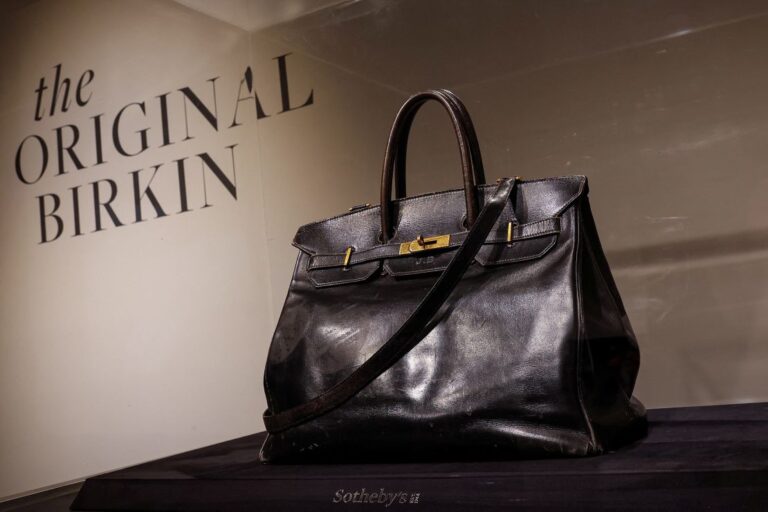
July 10, 2025. Sotheby’s Paris. Nine bidders. Ten minutes. Hammer at €7 million. With the buyer’s premium: €8.6 million — $10.1 million. The most expensive handbag ever sold at auction, and it was scuffed, scratched, and stained with adhesive residue from old charity stickers. There was a nail clipper attached to the strap.
This was the first Birkin bag ever made. Black leather, born in 1985 when Jane Birkin sketched a design on a sick bag mid-flight and Hermès CEO Jean-Louis Dumas happened to be sitting next to her. She carried it daily until 1994. After that it went to MoMA. Then the V&A. Then Sotheby’s. The buyer was Shinsuke Sakimoto, CEO of Japanese luxury resale company Valuence Holdings.
Why $10.1 million for a beat-up leather bag? Honestly, the answer isn’t complicated. In any serious collecting category — art, vintage cars, rock memorabilia — prototypes and “firsts” trade at premiums completely unrelated to materials. Kurt Cobain’s guitar. A pair of Judy Garland’s ruby slippers ($32.5 million, 2024). The literal first Birkin is the origin of a product category worth billions annually. That’s not counterintuitive. That’s the oldest rule in collecting: origin beats craftsmanship. Every time.
The Jane Birkin Bag That Failed to Sell. Completely.
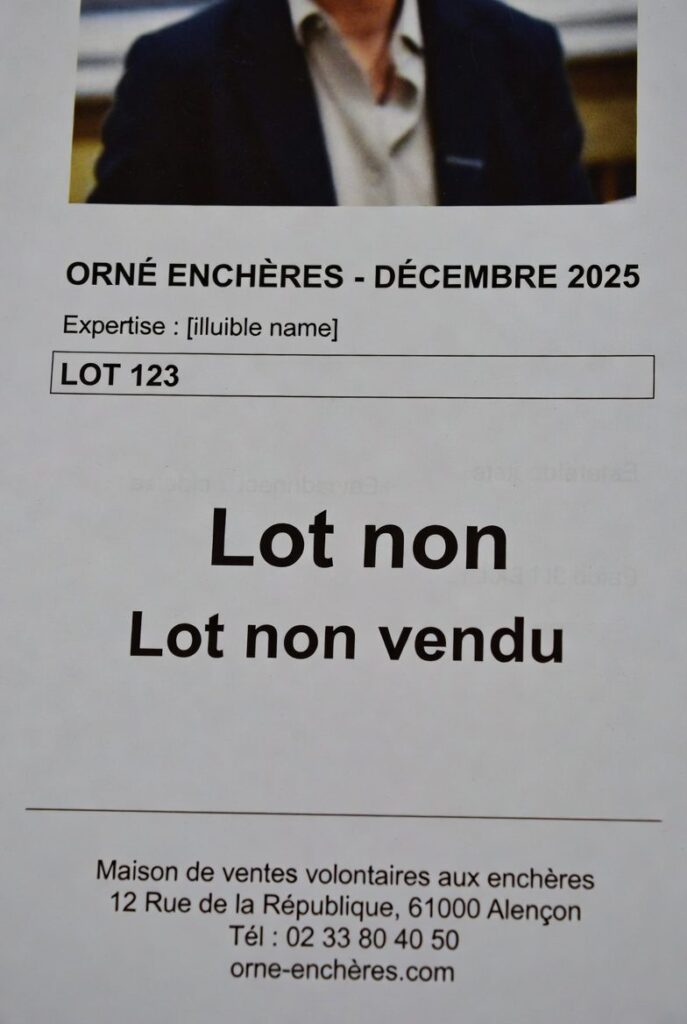
December 15, 2025. Orne Enchères, Paris. A third Jane Birkin bag goes to auction. Estimated value: $115,000–$140,000. Zero bids. Not one. The auctioneer, Patrice Biget, said they’d seek offers privately. Nobody raised a hand or picked up a phone.
The same collector who’d paid $10.1 million for the first Birkin — Sakimoto — had reportedly contacted the auction house the week before. He didn’t show up on sale day.
Five months between these two auctions. Same lineage of ownership. Opposite outcomes. The press wrote extensively about the $10.1 million. Very few covered the zero-bid failure. You know why, probably.
Every Major Sale — Including the One That Didn’t Happen
These are auction results only. Not estimated valuations. Not retail price tags. The unsold bag is included — that’s the point.
| Bag | Result | What Drove the Price | Source |
|---|---|---|---|
| Jane Birkin’s Original Birkin (1985 prototype) | $10.1M | First Birkin ever made. Museum provenance. Unique in the world. | CNN · Jul 2025 |
| Jane Birkin’s Voyageur Birkin (2003–2007) | $2.9M | Personal daily-carry bag. Handwritten inscription. Sold 6× above high estimate. | France 24 · Dec 2025 |
| Mouawad 1001 Nights Diamond Purse | $3.8M* | Guinness World Record holder. 4,500+ diamonds. *Estimated value — not an auction sale. | Guinness Records |
| Hermès Diamond Himalaya Birkin 30 | $450K+ | Niloticus crocodile skin. Diamond-set white gold hardware. Extreme production rarity. | CNN · Sotheby’s 2022 |
| Jane Birkin’s Third Bag (Crawford collection) | UNSOLD — $0 | Zero bids at Orne Enchères. Dec 15, 2025. Estimate was $115K–$140K. Not a single bid. | Luxury Launches · Dec 2025 |
Are Birkins Actually Better Than the Stock Market?
The claim: Birkins returned 14.2% annually from 1980 to 2015, beating the S&P 500’s 11.66%. The source: Baghunter, a commercial handbag resale marketplace.
Let me explain why that number is almost meaningless for your actual decision.
Sotheby’s tells a different story. Their 40-year compound annual growth rate for Birkin bags is approximately 5% — based on actual transaction prices across the full range of bags. That gap between 14.2% and 5% isn’t rounding error. It’s incompatible methodologies measuring fundamentally different things.
“It grosses me out when I see purchases positioned as investments; it hits me the wrong way. I am totally for people buying nice things, but I wouldn’t call it an investment.”
— Carolyn McClanahan, CFP, CNBC Advisor Council · CNBC, March 2025
Handbags are illiquid consumer goods. No regulatory protection. No dividends. No guaranteed buyer. High carrying costs. The resale market contracts when the broader economy weakens — pro-cyclical, just like luxury goods always have been. Framing a Birkin purchase as an “investment” is a marketing strategy, not financial advice. Treat it that way.
The Resale Premium Is Falling. The Data Is Uncomfortable.
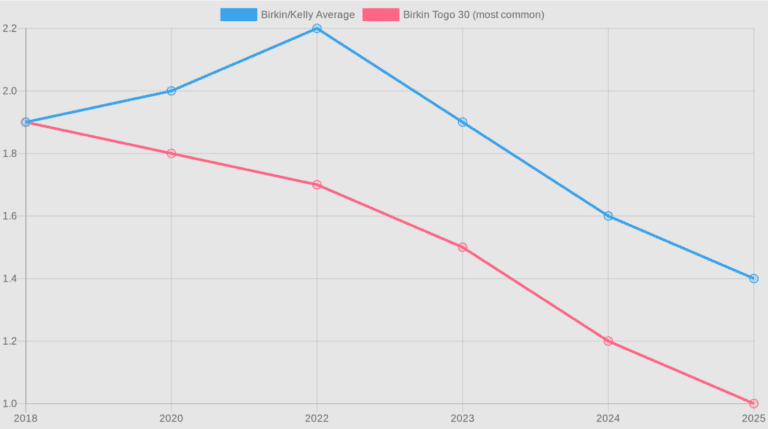
The most common Birkin — the Togo 30 — now resells at exactly what Hermès charges new. Zero profit. And that’s before carrying costs, consignment fees, or taxes. Which means on a net basis, most owners of this model are losing money on the “investment.”
“There has been a sobering up from the post-Covid euphoria. We are atoning and normalizing from that boom.”
— Luca Solca, Luxury Analyst, Bernstein Research · CNBC, December 2025
Bain & Co. reported the luxury market contracted 3% in early 2025 and lost roughly 50 million customers. Berenberg called 2025 the end of the “luxury supercycle.” That context matters. The pandemic inflated resale markets across every asset class. That era is over. What we’re watching now is normalization — which looks a lot like loss for anyone who bought at peak.
The Superfake Problem Is Growing. Fast.
If you’re treating a pre-owned Birkin as a store of value, there’s a risk the industry actively avoids discussing: counterfeits are now sophisticated enough to fool experienced buyers, and they’re flooding the resale market in volume.
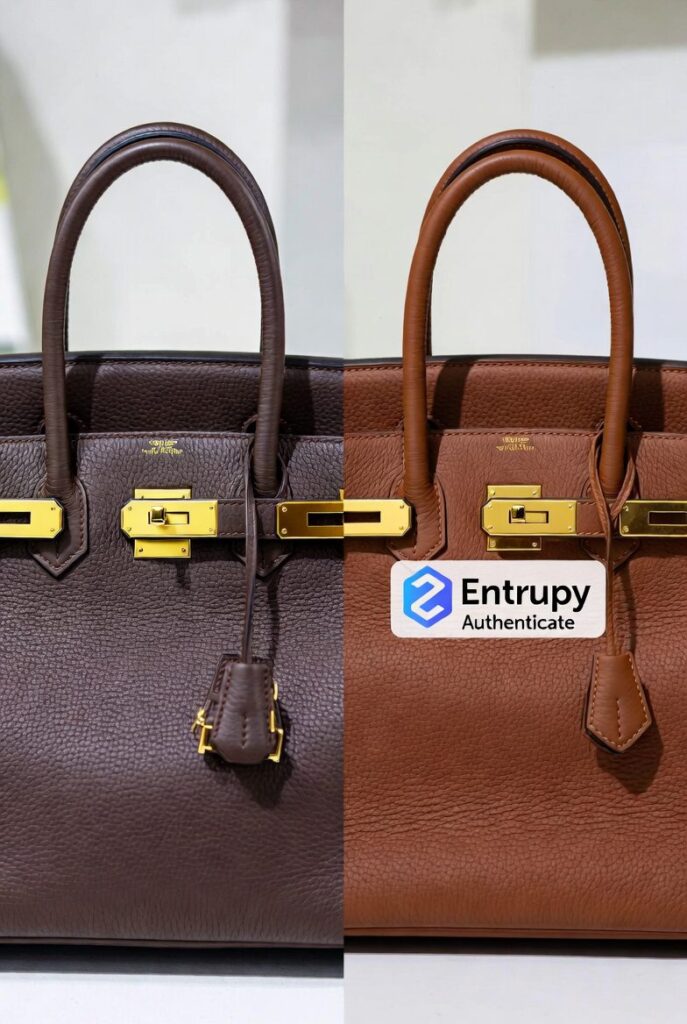
Authentication firm Entrupy scanned handbags worth approximately $1.9 billion in total resale value in 2024. 8.4% were identified as fake or unidentifiable. That’s roughly 1 in 12 items. Not fringe edge cases — 1 in 12.
“There’s never been more counterfeits that are better — the superfakes — like today. Some counterfeit Birkins are $6,000 plus, handmade.”
— Sarah Davis, President & Founder, Fashionphile · ABC News, April 2024
U.S. Customs and Border Protection seized nearly 23 million counterfeit goods last fiscal year, worth over $2 billion in estimated retail value. Luxury goods are the most counterfeited category. A cooling resale market and rising superfake supply create a compounding problem: as premiums fall, the incentive to authenticate thoroughly increases — but so does the cost and uncertainty of that authentication.
What a Birkin Actually Costs to Own
The purchase price is the entry fee. Industry guides estimate carrying costs add 20–30% to the initial purchase over time. For exotic leathers, it’s higher. Here’s what that actually looks like.
A standard Togo 30 retails at approximately $12,700. Add $600–$1,200 in annual carrying costs. Add a 15–40% consignment fee when you sell. Net return after 3–5 years on a standard model, at current 1.0× resale premiums: negative to negligible. Before taxes.
Two more facts that should live in every “investment Birkin” article and almost never do: bags with full original packaging and receipts sell for 10–20% more than identical bags without documentation. Even popular Birkins take 3–6 months to sell at top prices on consignment. This is not a liquid asset. You cannot sell it this afternoon.
Why the IRS Disagrees With Every “Investment” Comparison
This section exists because no “Birkins vs. the S&P 500” analysis I’ve seen includes it. The tax treatment of handbags is genuinely punishing compared to equities.
The 28% Rate
The IRS classifies handbags as “collectibles” — same category as art, wine, and vintage cars. This is statutory, not discretionary. Long-term capital gains on collectibles are capped at 28%, not the 15–20% rate that applies to stocks held over one year. State taxes (up to 13.3% in California) stack on top. Nobody mentions this in the returns comparison.
Short-Term Is Worse
Hold the bag under a year before selling? Gain is taxed as ordinary income — up to 37% federally, plus applicable surcharges. There’s no “trader status” for handbag flipping that grants lower rates.
No Loss Deductions
Sell a Togo 30 at a loss in the current 1.0× market? You cannot deduct it against salary or stock gains. The IRS considers personal-use property ineligible for capital loss deductions. You eat the entire loss.
The Math, Actually Run
3.3% annualized, after tax, before inflation. The S&P 500’s long-run after-tax return in a standard brokerage account is roughly 7–9%. This calculation never appears in the Baghunter study or the Rebag marketing materials.
One more thing: without the original Hermès receipt, the IRS may impute a cost basis of $0 — taxing the entire sale price as gain. If you bought pre-owned without documentation, your risk here increases substantially.
You Can’t Just Walk In and Buy One
This isn’t marketing mystique designed to make the bag feel exclusive. It’s a structural barrier that most “invest in a Birkin” content ignores completely.
Hermès doesn’t sell Birkin bags on a first-come basis. To be offered one, you need an existing purchase history at a specific boutique. The pre-spend requirement before being offered a Birkin is typically 2× or more the cost of the bag itself — meaning you spend $25,000+ at Hermès on scarves, shoes, belts, and ready-to-wear before you’re eligible. Wait times run months to years with no guarantee.
This is the primary mechanism that keeps resale prices elevated. If Hermès removed the quota tomorrow, demand would shift to retail and the resale premium would collapse. The investment thesis for Birkins is structurally dependent on Hermès maintaining artificial scarcity. If that policy ever changes — for any reason — the case disappears with it.
Three Types of Buyers. Three Very Different Realities.
All Sources
Related on MostExpensives.com: Most Expensive Watches · Most Expensive Jewelry · Most Expensive Clothes · Most Expensive Things
Privacy Policy
Most Expensive Handbags 2026: Investment-Grade Luxury Assets & Market Infrastructure Analysis
Most Expensive Designer Brands in the World 2025-2026
Why Your White-Glove Concierge Isn’t Actually Working
Leave a Reply