Opulent Suites:
Extravagantly Designed Rooms
Commanding Premium Nightly Rates
From a Geneva fortress with bulletproof glass to a bedroom submerged 16 feet beneath the Indian Ocean — a candid, deeply researched look at what the world’s most expensive hotel suites actually offer, and whether any of it makes sense.
There’s a certain absurdity to spending what a schoolteacher earns in two years on a single night’s accommodation. And yet, the very top tier of the global hotel market — suites commanding $50,000, $80,000, even $100,000 per night — isn’t merely surviving. It’s quietly thriving, logging some of the strongest occupancy numbers in the industry.
This piece doesn’t sell you on the dream. Instead, it answers a more interesting question: what, exactly, do you get for that money? What separates a genuinely extraordinary space from one that’s simply gilded and overpriced? And who, realistically, is booking these rooms?
The answers are more nuanced than most glossy travel coverage suggests. Some of these suites are architectural masterpieces that genuinely couldn’t exist anywhere else. Others are expensive in a purely numerical sense — lavished with gold leaf and butler staff, but not particularly distinctive. The difference matters if you’re trying to understand what’s actually happening at the bleeding edge of luxury hospitality.
market size, 2025
market growth to 2033
suites in luxury segment, 2025
published nightly rate
The Market Behind the Headlines
The global luxury hotel market was estimated at $110.87 billion in 2025 and is projected to reach $196.70 billion by 2033, according to Grand View Research — a compound annual growth rate of roughly 7.5%. That’s not simply post-pandemic bounce-back. It reflects a structural shift: high-net-worth individuals are spending a larger share of their wealth on experience rather than objects, and the hospitality industry has reorganised itself around that preference.
Within that broader market, suites captured 41.76% of revenue in 2025, according to Mordor Intelligence, while ultra-luxury suites — the ones commanding five-figure nightly rates — represent perhaps 40,000 units globally but generate outsized revenue and an enormous share of press. The fastest-growing segment isn’t traditional suites but villas and private bungalows, expanding at an 11.74% CAGR through 2031, driven by demand for privacy and standalone service teams.
One data point worth holding onto: ultra-high-net-worth individuals anchor top-tier suite demand, but the fastest-growing group booking premium rooms is what analysts call the “rising affluent” — people with serious discretionary income who are willing to save for one genuinely extraordinary stay rather than two or three merely good ones.
The World’s Most Expensive Hotel Suites, Ranked & Assessed
What follows is a ranking based on verified published rates, supported by architectural and service details drawn from primary hotel documentation, independent reviews, and specialist travel reporting. Where rates vary seasonally — as they always do at this level — we cite the published or starting rack rate, and note where that figure has been independently confirmed.
As of April 22, 2025, the Guinness World Records confirmed The Mark’s penthouse as the most expensive published nightly rate for any hotel room or suite on the planet — $114,767 including taxes, with breakfast included. That figure isn’t theoretical: the hotel actively lists it.
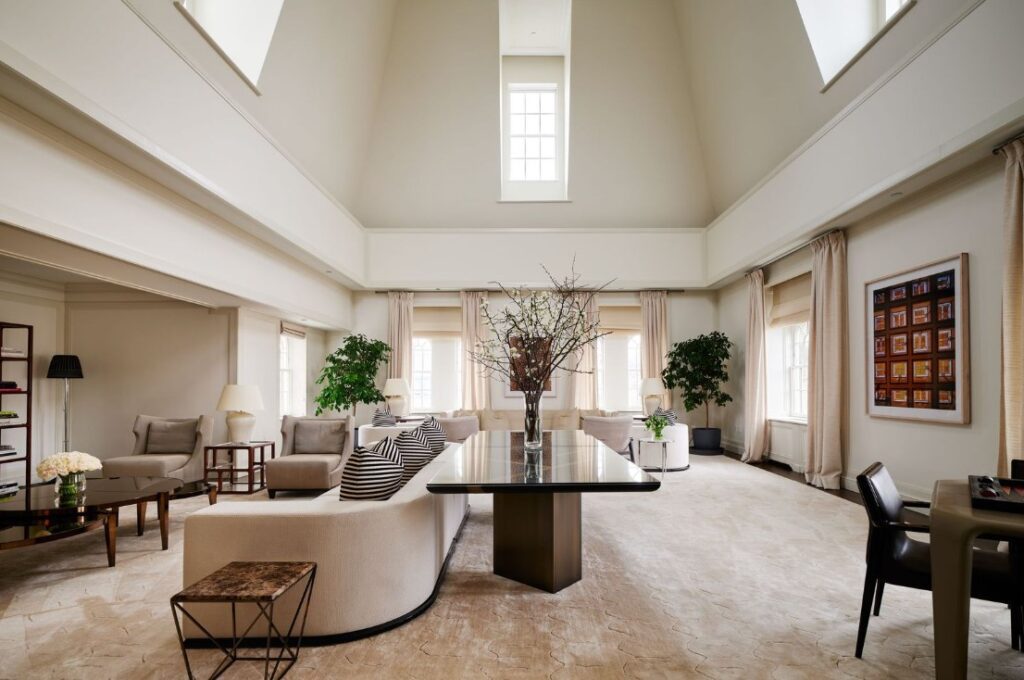
The suite was designed by French interior designer Jacques Grange, who has worked for Karl Lagerfeld and Princess Caroline of Monaco, among others. The main living space doubles as a ballroom with a 26-foot ceiling — high enough to feel genuinely palatial, not just tall. There’s a private gym, a library, a rooftop terrace with views over Central Park, and six full bathrooms for five bedrooms, which tells you something about the expected staff-to-guest ratio.
The Mark sits on 77th and Madison, a few blocks from the Met — the hotel was the unofficial second venue of the MET Gala for years, which made it the de facto off-campus living room for about 400 of the most photographed people on earth one evening each May. That association still matters to the clientele who book this suite.
Atlantis The Royal’s opening weekend in January 2023 was an event in itself: Beyoncé gave a private concert that reportedly cost the hotel $24 million to stage. She stayed in the Royal Mansion. That particular detail tells you the hotel’s target demographic and its marketing strategy in a single sentence.
The Royal Mansion occupies the 18th and 19th floors of Atlantis The Royal — the second Atlantis property on the Palm, which opened to considerable fanfare with its stacked-glass-blocks architecture. The suite features double-height ceilings, a 5,123-square-foot private terrace overlooking the Dubai skyline and Arabian Sea, and a dedicated entertainment room with a 98-inch LED screen and a built-in bar. Bedding is by Hypnos, linens are 800-thread-count, and bathroom amenities are gold-plated — literally.
Elsewhere in the resort: 17 restaurants, a 21-foot aquarium containing 4,000 jellyfish, and Aquaventure waterpark is included with the stay. The suite’s guests check in without ever visiting the lobby — the entire process happens in-suite, which is either efficient or socially avoiding depending on your disposition.
The pillow menu offers seven options, which feels like a detail that will either delight or mildly irritate depending on how you feel about decisions at 11pm.
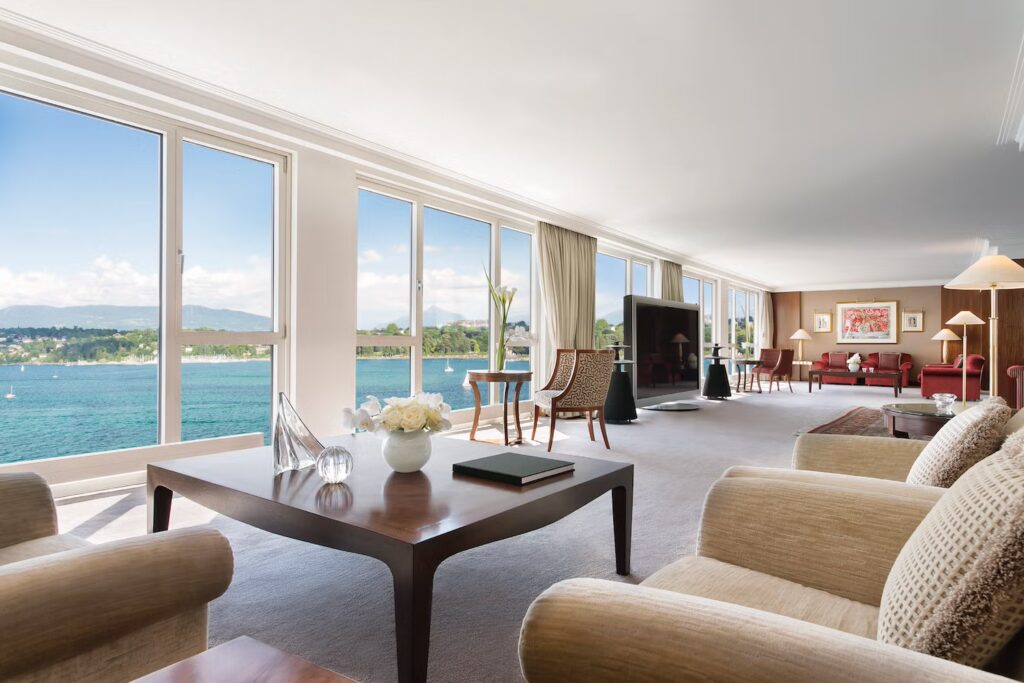
The Royal Penthouse at Hotel President Wilson has been cited as the world’s most expensive hotel suite for so long it’s become a fixture in this type of roundup. The Guinness record has since moved on (The Mark now holds it), but the Geneva suite remains one of the most extraordinary purpose-built spaces in hospitality.
It occupies the entire 8th floor of the hotel — all 1,680 square metres of it. Twelve bedrooms, twelve marble bathrooms stocked with Hermès toiletries, two formal dining rooms (one for 26, one for 16), a private cinema, a billiard table, a Steinway grand piano, a Bang & Olufsen audio system throughout, and a terrace with what is genuinely one of the most dramatic views in European luxury: Lake Geneva directly below and the Alps beyond. The 103-inch television is reportedly one of only three available in a hotel room anywhere in the world.
The windows are bulletproof. The doors are armoured. There’s a human-sized safe and a dedicated security room, because guests at this level — heads of state, royalty, billionaires — arrive with their own security teams and expect the infrastructure to accommodate them. Sir Richard Branson, Rihanna, and Bill Gates are among those verified to have stayed here.
The hotel itself was built in 1962 and named for Woodrow Wilson, whose efforts toward the League of Nations are permanently associated with Geneva’s role as a centre of international diplomacy. The President Wilson sits five minutes from the UN headquarters, which partly explains the security infrastructure.
The Empathy Suite is a genuinely odd thing — and that’s meant as a compliment. Damien Hirst, the British artist whose work includes a diamond-encrusted skull and a shark suspended in formaldehyde, designed the entire two-bedroom space. It functions simultaneously as a hotel suite and a private gallery of original Hirst works, which gives it a particular kind of cultural legitimacy that most ultra-luxury rooms can’t claim.
The suite’s artwork isn’t reproductions. The pieces are originals, incorporated into the architecture and furnishings rather than hung on walls like afterthoughts. The outdoor pool overlooks the Las Vegas Strip; there’s a 13-seat custom bar, two massage rooms, a salt sauna, and VIP check-in that bypasses the casino floor entirely.
Las Vegas hospitality works on different logic than Geneva or New York. The rate here is in some sense subsidised by the expectation of casino spend — the Palms isn’t simply renting out square footage but hosting individuals who will likely drop significant sums on the gaming floor. That context doesn’t diminish what’s on offer in the room, but it explains the economics in a way that applies to no other suite on this list.
The Muraka — the name means “coral” in Dhivehi, the local Maldivian language — is structurally unlike anything else on this list. It’s the world’s first underwater residence: a two-level structure built by a New Zealand firm specialising in aquarium engineering, transported to the South Ari Atoll, and lowered into place in 2018. The master bedroom sits 16 feet below the ocean’s surface inside a 180-degree acrylic dome, surrounded by coral reef and whatever marine life happens to be passing — reef sharks, manta rays, parrotfish, eels.
The $15 million construction cost is widely cited and gives some context to the nightly rates. Above water, the villa operates more conventionally: two guest bedrooms, a living room, kitchen, bar, infinity pool, and private deck facing the sunset. Below, the underwater bedroom includes a spiral staircase or private elevator connecting the levels, an ocean-facing bathroom, and a dedicated viewing tunnel through the reef. Marine biologists are available for private consultations, identifying species drifting past your dome.
A seven-night stay at peak season costs roughly £33,899 per person, though packages vary. The seaplane transfer from Malé runs an additional $700 per guest. Reported guests include members of the Bahraini Royal Family and the Kardashians, who featured their stay on television.
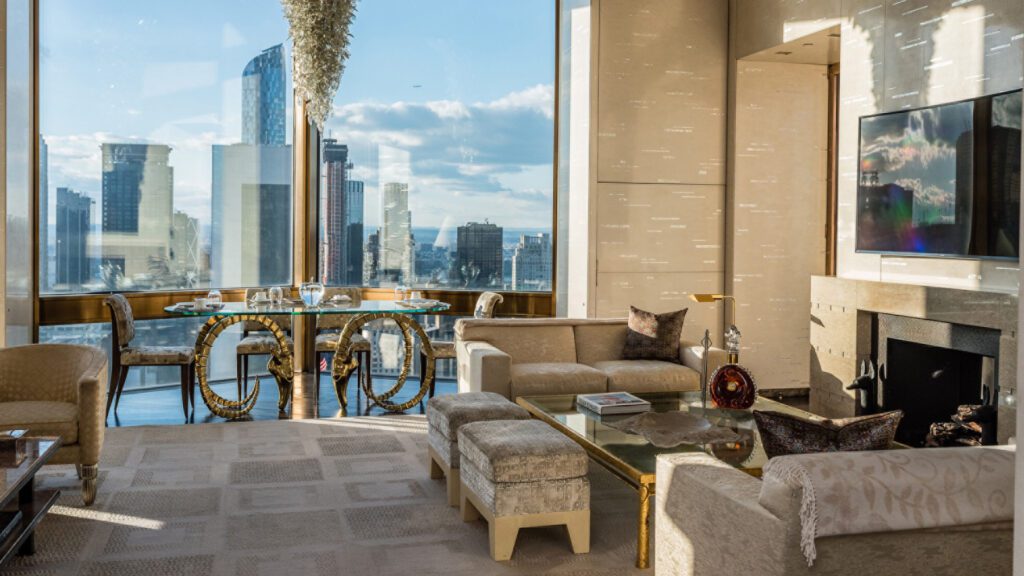
The Ty Warner Penthouse occupies the entire 52nd floor of the Four Seasons New York — a building designed by I.M. Pei, whose contributions to architecture include the Louvre Pyramid and the National Gallery of Art East Building. The interior was finished by Peter Marino. Ty Warner, the Beanie Baby creator who bought the hotel and commissioned the renovation, is by accounts a genuine perfectionist about design.
The result is 4,300 square feet of meticulously composed space: a Bösendorfer baby grand piano, a library, a cascading green bowenite waterfall, a chromotherapy infinity soaking tub facing Central Park, a private spa with views to the East River. The master bedroom has a canopy bed dressed in Thai silk. There’s a private elevator. The chauffeured vehicle is a Rolls-Royce. A dedicated guest relations manager is assigned for the duration of any stay.
What distinguishes this suite from others at comparable rates is that the architectural and design credentials are unimpeachable. I.M. Pei and Peter Marino aren’t simply names attached to a press release — the building itself is one of New York’s great modernist towers, and the penthouse was designed to be its culminating statement.
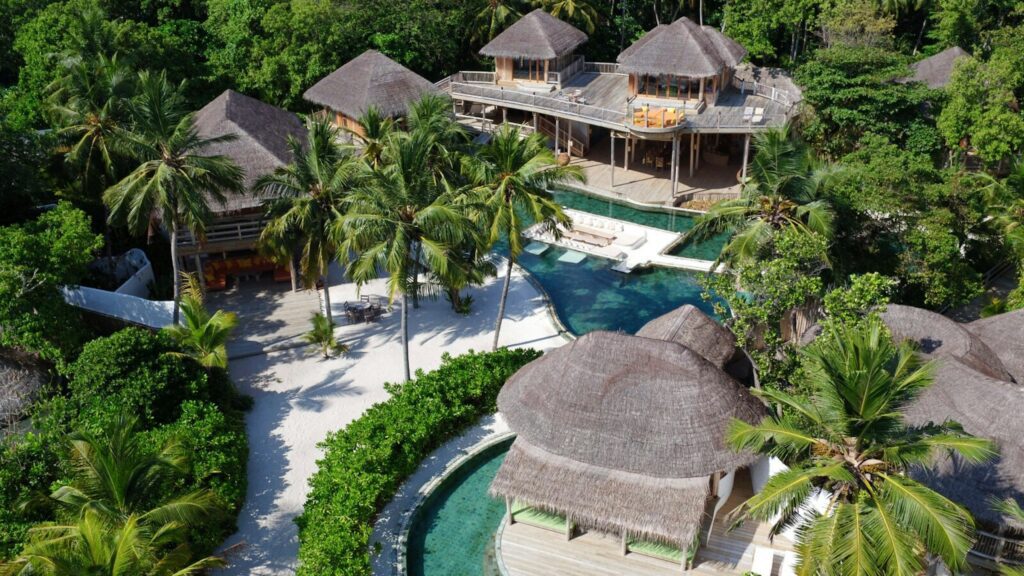
Laucala Island Resort operates on a different logic from urban luxury hotels. The island itself is 3,500 acres of private Fijian paradise. Guests who can’t afford or don’t want the Hilltop Villa can book other villas around the island — but the Hilltop is the apex of the offer, positioned at the island’s highest point with 360-degree views of the Pacific lagoon and the surrounding jungle.
At 11,000 square feet across three separate living areas, each with its own pool, the villa can accommodate six guests in substantial seclusion. The island provides a private chef, personal chauffeur, and dedicated service team. Activities — scuba, horseback riding, an 18-hole golf course, helicopter excursions — are essentially unlimited and largely included.
The island was purchased by Red Bull co-founder Dietrich Mateschitz in 2003 and developed into what it is now. It’s one of the most private luxury destinations on earth. The Hilltop Villa is the best argument for the proposition that isolation itself is a luxury amenity.
The Bvlgari Hotel group — now spanning Rome, Milan, Paris, London, Tokyo, Dubai, Bali, and Beijing — consistently produces arguably the most architecturally coherent ultra-luxury hotels in the world. All properties are designed by ACPV ARCHITECTS (Antonio Citterio Patricia Viel), which brings an unusual degree of design consistency and seriousness to an industry where interior design is often a branding exercise.
The Dubai Bvlgari Villa sits on Jumeira Bay Island and features a private beach, personal cinema, both indoor and outdoor pools, and a dedicated butler team. The material palette is marble, silk, dark woods — the Bvlgari signature — and the approach is controlled Italian elegance rather than Dubai excess, which makes it something of an outlier in its geography.
It’s a favourite among celebrities visiting Dubai specifically because the design aesthetic reads as refined rather than ostentatious. In a city whose luxury hospitality tends toward the theatrical, that restraint is itself a selling point.
At-a-Glance Comparison: World’s Most Expensive Hotel Suites
All rates are verified published or rack rates as of 2024–2025. Seasonal variation can be significant. The Guinness-verified figure for The Mark includes taxes; others are pre-tax.
| # | Suite | Hotel & City | Nightly Rate | Key Distinction |
|---|---|---|---|---|
| 1 | The Penthouse ★ Guinness Record | The Mark, New York | $114,767 incl. tax | Jacques Grange design, 26-ft ceilings, confirmed April 2025 |
| 2 | Royal Mansion | Atlantis The Royal, Dubai | ~$100,000 | 5,123 sq ft terrace, hosted Beyoncé’s opening concert |
| 3 | Empathy Suite | Palms Casino, Las Vegas | ~$100,000 | Designed & furnished by Damien Hirst with original artworks |
| 4 | Royal Penthouse Suite | Hotel President Wilson, Geneva | ~$80,000 | 18,083 sq ft, 12 bedrooms, bulletproof glass, heads of state |
| 5 | Ty Warner Penthouse | Four Seasons, New York | ~$60,000 | Designed by I.M. Pei + Peter Marino, 52nd floor, 4,300 sq ft |
| 6 | The Muraka | Conrad Maldives Rangali Island | $15,000–$50,000 | World’s first underwater residence, 16 ft below sea level |
| 7 | Hilltop Villa | Laucala Island Resort, Fiji | ~$44,000 | 11,000 sq ft, 3 private pools, 3,500-acre private island |
| 8 | Bvlgari Villa | Bvlgari Resort, Dubai | ~$35,000 | ACPV design, private beach + cinema, dedicated butler team |
| 9 | Presidential Duplex Suite | Burj Al Arab, Dubai | ~$30,000–$32,700 | 22-karat gold accents, 667 m², rotating beds |
| 10 | Bvlgari Suite Tokyo | Bvlgari Hotel Tokyo | ~$30,000 | 400+ m², floors 40–45, Italian-Japanese design fusion, Mt. Fuji views |
| 11 | Quintessence Suite | Cheval Blanc Paris | ~$28,000–$30,000 | 650 m², private pool, only hotel on the Seine, views of Notre-Dame |
| 12 | Peninsula Suite | The Peninsula, Hong Kong | ~$15,500/night est. | Concert grand piano, private gym, curated art collection |
“At this level, the infinity pools and Michelin-starred restaurants practically come standard. What’s more interesting is just how differently luxury manifests from place to place.” — Michelin Guide Travel Editorial
Beyond the Gold Leaf: What Separates Genuine Design from Expensive Decoration
There’s a meaningful distinction — often glossed over in travel journalism — between hotel suites that are expensive because they’re architecturally and experientially significant, and those that are expensive because they’ve accumulated costly materials. Both types exist at the top of the market. The difference shows in a few specific ways.
Architectural Authorship
The Ty Warner Penthouse involves I.M. Pei and Peter Marino. The Bvlgari properties are all designed by ACPV ARCHITECTS under a consistent brief that Antonio Citterio maintains personally. The Mark Penthouse was Jacques Grange’s commission. These are real design credentials, not licensing arrangements. When the architect or designer has genuine authority over a space — not just a mood board — it tends to produce rooms with spatial logic and coherence that mere expensive decoration can’t replicate.
Contrast that with suites where the design brief appears to have been “add more gold” — the Burj Al Arab’s Presidential Suite, for instance, is spectacular in the way that a fireworks display is spectacular. It makes an impression, but you’d struggle to identify a considered spatial idea behind the 22-karat cladding.
Structural Uniqueness
The Muraka at Conrad Maldives couldn’t be built anywhere else. Its engineering constraints — 16 feet of water above the bedroom, a 180-degree acrylic dome that must withstand ocean pressure while providing clear views — produce a room that is genuinely irreplaceable. The experience of sleeping while reef sharks circle your bedroom isn’t a hotel amenity. It’s an encounter with a different physical reality.
Similarly, the Hilltop Villa at Laucala Island is inseparable from its geography. The 3,500-acre private island isn’t a backdrop — it’s the product. You can replicate marble bathrooms and butler service. You can’t replicate complete, structural isolation on a Fijian island.
Service Architecture vs. Service Theatre
The best ultra-luxury suites operate on what the industry calls “proactive anticipation” — staff who understand preferences well enough to act on them without being asked. The Royal Penthouse in Geneva assigns a private chef, butler, and personal assistant as a standard package. Conrad Maldives assigns a marine biologist who can identify every species passing the bedroom dome. These aren’t amenities added to a rate sheet — they’re services designed around the specific offer of the property.
Less impressive is what might be called service theatre: elaborate rituals, excessive ceremony, and staff-to-guest ratios impressive on paper but awkward in practice. More staff doesn’t automatically mean better service, and some ultra-luxury properties haven’t fully worked out the difference.
Who Actually Stays in These Suites — and Why
The clientele for five- and six-figure nightly suites breaks down more narrowly than the industry’s marketing might suggest. Roughly speaking, there are three categories of guest.
Ultra-High-Net-Worth Individuals (UHNWIs)
Individuals with investable assets exceeding $30 million. For this group, the booking decision is partly financial (the rate represents a small fraction of daily wealth creation), partly status (the Geneva suite’s association with heads of state and royalty carries social currency), and partly security-driven — the bulletproof infrastructure at Hotel President Wilson isn’t a sales point, it’s a genuine operational requirement for certain guests.
According to Mordor Intelligence’s 2025 analysis, UHNWIs remain the anchoring demand for top-tier suites, but the fastest growth in premium bookings is coming from a broader group of affluent travelers making one exceptional trip rather than regular ultra-luxury travel.
Corporate and Events Bookings
A significant portion of the world’s most expensive suites are booked for specific events: product launches, private dinners for major client relationships, deal closings. The Geneva suite’s boardroom and dual dining rooms make it a genuine corporate venue. The Palms Empathy Suite’s Las Vegas location makes it a natural choice for entertainment industry gatherings. These bookings aren’t leisure — they’re operational expenses with hospitality infrastructure.
Once-in-a-Lifetime Travelers
The genuinely surprising segment. Mordor Intelligence notes that the fastest-growing buyer cohort in the ultra-luxury hotel market isn’t the perpetually wealthy but rising-affluent individuals who save specifically for one extraordinary experience. The Muraka at Conrad Maldives, for instance, attracts guests who have planned and saved for years. This group tends to be highly informed, research-intensive bookers — they know exactly what they’re paying for and have thought hard about whether it’s worth it.
Six Things Worth Knowing Before Booking an Ultra-Luxury Suite
What Six Figures a Night Actually Buys You — Honestly
The world’s most expensive hotel suites don’t exist in a vacuum. They’re the apex of an industry projecting over $196 billion in global market value by 2033, built on genuine, growing demand from a widening base of wealthy travelers. The economics work, which is why these suites continue to be built and booked.
But the honest answer to “what do you actually get?” depends almost entirely on which suite you choose. The Muraka gives you something that genuinely doesn’t exist anywhere else on earth — a night in a glass bedroom surrounded by ocean. The Ty Warner Penthouse gives you a room designed by two of the 20th century’s most serious architects, in a building that itself is an architectural landmark. The Geneva Royal Penthouse gives you 18,000 square feet, 12 bedrooms, and the kind of security infrastructure that allows genuinely prominent public figures to exist without risk.
What the weaker offerings give you is expensive materials, brand name recognition, and the psychological satisfaction of having paid the most. That’s not nothing — the status dimension is real and the materials are often extraordinary. But it’s a different proposition than the best of what’s available at the ultra-luxury tier.
The most useful framework, if you’re genuinely considering any of these: ask whether the experience could be replicated at a lower price point in a different form. If the answer is yes — if it’s a very nice room with very nice things in it — then you’re paying for exclusivity and brand, which may be exactly what you want. If the answer is no — an underwater bedroom, a private island apex, a room designed by I.M. Pei — then the rate reflects something structurally irreplaceable. That distinction matters more than any amenity list.
More from MostExpensives.com
Most Expensive Hotels in the World 2026: Jaw-Dropping Luxury
Most Expensive Hotels in 2026