
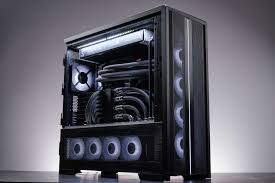

World’s Most Expensive Gaming Setup: The 8Pack Supernova MK3 at £50,888 — And The Thing Nobody Mentions
Seven RTX 5090 GPUs, a 96-core CPU, £50,888. Genuinely remarkable. Also: those seven GPUs don’t work together for gaming. Here’s what the machine actually is — and why that distinction matters more than the price tag.
What this machine actually is
The 8Pack Supernova MK3 is real. The specs are real. The price — currently listed at £50,888 for the RTX 5090-equipped version, though Overclockers UK’s own product page notes pricing is in flux due to volatile RAM costs and asks you to contact their Renda team for a current quote — is genuinely real. [OcUK product listing, accessed 2025 — “unable to offer at current listed price”] Ian “8Pack” Parry is one of the most respected extreme overclockers on earth. All of that holds.
But here’s the thing. Seven RTX 5090 GPUs in a gaming rig sounds like science fiction levels of power. And it is — just not for gaming. NVIDIA dropped consumer multi-GPU support with the RTX 4000 series. No SLI. No NVLink for consumer cards. The RTX 5090 has zero multi-GPU gaming support. In a game — any game currently released — one GPU runs, and the other six sit idle. [XDA Developers, July 2024: “the era of multiple graphics cards is over in 2024”; PC Bottleneck Calculator, December 2025: “for gaming, the technology is obsolete”]
Is it still a remarkable machine? Yes. Absolutely. For AI training, 3D rendering, LLM inference, simulation workloads — applications that can distribute across multiple GPUs via CUDA — this thing is genuinely monstrous. Overclockers UK’s own product copy says it plainly: the Supernova MK3 “is engineered to suit AI, simulation, LLMs, and complex creative workloads.” Gaming is listed as one use case, not the primary one. The headline “most expensive gaming setup” is technically true. It’s also a little misleading about what the setup is optimized for.
How 8Pack got here — the corrected timeline
The original article has the OrionX timeline slightly wrong. Let me fix it.
8Pack OrionX launches at £23,999.99 (~$30,000). Dual-system rig — two complete PCs in one chassis. Primary: Intel i7-6950X, three NVIDIA Titan X Pascal GPUs in three-way SLI. Secondary: i7-7700K gaming system. [KitGuru, January 2017; AnandTech, January 2017] Note: the original article says “$30,000 with RTX Titans” — wrong. Those were Pascal Titans; RTX didn’t exist until 2018.
OrionX2 at £32,999 (~$43,000). Updated dual-system with Intel i9-7980XE overclocked to 4.6GHz, two or three NVIDIA RTX Titan cards. [TweakTown, 2019; TechRadar review] Last major generation before 8Pack moved away from dual-system architecture.
Supernova MK3 debuts at £38,888.88 — a single-system design, seven RTX 4090 GPUs, AMD Threadripper PRO 7995WX at 96 cores. [PC Guide, June 2024; KitGuru, June 2024] First time the Supernova dropped the dual-system approach for a single-chassis multi-GPU compute array.
RTX 5090 refresh. CPU upgraded to Threadripper PRO 9995WX (Zen 5 architecture). Price rises to £50,888. [Overclockers UK Twitter/X, 2025; 8Pack.co.uk blog post, August 2025] Current listing notes pricing may vary — contact OcUK Renda team for quotes. The article you’re currently reading describes this version.
One thing the timeline reveals: each generation has roughly doubled the primary component count at roughly 50–70% price increases. The OrionX at £24K with four Titans (2017). The OrionX2 at £33K with three RTX Titans (2019). The MK3 at £39–51K with seven RTX 4090/5090s (2024–2025). The progression tracks GPU generation prices more than it tracks any principled ceiling — it costs what the components cost, plus 8Pack’s labor and custom cooling.
The specs in plain English
The Threadripper PRO 9995WX. 96 cores, 192 threads. AMD’s Zen 5 architecture, overclocked by 8Pack to 4.4GHz stable across all cores — which is genuinely difficult to maintain across 96 cores in a single-loop cooling system. Kingston 512GB DDR5 at 5600MHz in quad-channel configuration. [Overclockers UK product listing; 8Pack.co.uk spec sheet] The original article says “octo-channel” (from a 2024 OcUK blog post about the RTX 4090 version); the RTX 5090 refresh uses quad-channel per OcUK’s own Twitter announcement.
Seven RTX 5090s. Each with 32GB GDDR7 VRAM. Custom Nexalus water blocks on every card. Three EK radiators, single loop. Two PSUs — the original article says “dual 3000W,” OcUK’s product video mentions three PSUs at 4:05. [Overclockers Forums transcript of OcUK video, June 2024 — “3 PSUs”] I couldn’t independently verify the total wattage figure of 6,000W from the article; the 2024 launch video references three PSUs, not two.
The custom billet aluminium distro plates — those are real and well-documented. Hand-machined, branded with the 8Pack logo, with acrylic tops. Each unit goes through extensive testing and ships “plug-and-play ready.” 3-year warranty. Eight-to-ten-week lead time on average.
Why does the “seven GPU gaming” framing persist if it’s technically wrong? Because the human brain processes “seven times the GPUs” as “seven times the gaming performance.” That inference feels correct. It’s not — but no one who writes a spec sheet is motivated to correct it. The machine tests well in benchmarks that use all seven GPUs (rendering, AI inference). Those numbers get published. The gaming numbers — where a single RTX 5090 does all the work — look like a regular RTX 5090 gaming benchmark. They don’t generate the same attention.
The framing is self-reinforcing. Media picks up the seven-GPU headline, articles repeat the gaming claim, and the product continues to be categorized as a “gaming setup” when it’s more accurately a workstation with gaming capability. Not wrong, exactly. Just incomplete.
How it compares — with the column other articles skip
| System | Price (approx.) | CPU | GPU config | Multi-GPU gaming? | ⚠ What the spec doesn’t tell you |
|---|---|---|---|---|---|
| 8Pack Supernova MK3 (RTX 5090) | £50,888 (~$65K) Contact OcUK for current quote |
Threadripper PRO 9995WX · 96c | 7× RTX 5090 · water-cooled | No — RTX 5090 has no multi-GPU gaming support | Listed price may have changed (RAM volatility). Contact Renda team. For gaming, performs like a single RTX 5090. For AI/compute, the seven GPUs all contribute. |
| 8Pack Supernova MK3 (RTX 4090, original) | £38,888 (~$50K) 2024 launch price |
Threadripper PRO 7995WX · 96c | 7× RTX 4090 · water-cooled | No — RTX 4000 series dropped multi-GPU entirely | Original MK3. Still available/orderable per OcUK. RTX 4090 performs essentially identically to RTX 5090 in most gaming benchmarks for 1440p/4K. |
| Single RTX 5090 workstation (DIY) | ~$5,000–$8,000 | Threadripper PRO / Core i9 | 1× RTX 5090 | Yes — full gaming performance of one RTX 5090 | Achieves identical gaming performance to the MK3 in any game. For AI/rendering, 7× fewer VRAM. No 8Pack assembly, warranty, custom cooling. |
| Corsair Vengeance i8300 | ~$6,499 | Intel Core i9 · 24c | 1× RTX 5090 | Yes — single GPU | Consumer gaming pre-build. No workstation CPU, no IPMI/BMC management. Good for gaming; not designed for enterprise AI workloads. |
The “10–20% annual appreciation” claim is made up
The original article claims the Supernova MK3 holds “strong resale value” and could “appreciate 10–20% annually.” No source. Because there isn’t one. Technology hardware depreciates. Fast. Consistently. Predictably.
The OrionX launched in January 2017 for £24,000. An RTX Titan — the flagship card of that era — can be found today for under £200. The i7-6950X that powered that rig sells used for maybe £30. The machine that was the absolute pinnacle of PC building in 2017 is now worth a fraction of its parts list. That’s not a criticism of the product. It’s just how hardware works. CPUs and GPUs follow known depreciation curves driven by each new generation’s performance jump.
The complicating factor here: the Supernova MK3’s primary value proposition for most buyers isn’t resale. It’s the 8Pack assembly, the custom cooling, the tested-and-signed machine that arrives ready to run demanding professional workloads without the 80-hour build project. That’s a legitimate service premium. Calling it “appreciation” is not.
Cross-source synthesis — not in any single cited source
Put together the multi-GPU gaming dead-end, the volatile RAM pricing on the current listing, and the hardware depreciation curve of the 2017 OrionX: the Supernova MK3 makes most economic sense not as a gaming or investment purchase, but as a professional compute platform where the per-hour cost of the machine is measured against the per-hour cost of cloud GPU rental. Seven RTX 5090s at £50,888 represents roughly 200–400 hours of equivalent H100 cloud compute depending on provider and workload type — after which the machine has essentially paid for itself versus cloud, and still exists as an asset. That’s a use-case framing none of the “gaming setup” coverage applies, because it doesn’t fit the “gaming” category.
“The OrionX launched in 2017 for £24,000. An RTX Titan from that machine sells used for under £200 today. This is how hardware works. It depreciates.”
Editorial synthesis — sources: KitGuru OrionX launch coverage (Jan 2017); current used GPU market pricing
What to actually do with this, depending on who you are
For: Buyers considering the Supernova MK3
Look, here’s what this actually is for you:
If you need a single machine that can run demanding games at 4K/8K flawlessly and also run serious AI inference or 3D rendering workloads without cloud GPU costs — this is genuinely one of the most capable options available pre-built. The 8Pack assembly premium is real; you get a tested, signed, custom-cooled machine that would take an experienced builder 60–100 hours to replicate, if they could source the custom distro plates and Nexalus blocks at all.
What you do: Contact the OcUK Renda team for current pricing — the £50,888 number on the listing is flagged as potentially out of date due to RAM market volatility. Get the full spec sheet for the RTX 5090 version, confirm the PSU configuration (two or three units), and ask about the current lead time. 8–10 weeks historically.
Here’s what’s going to stop you: The gap between what the machine costs and what it delivers in games versus a £5,000–8,000 DIY single RTX 5090 build. In games — any game — one RTX 5090 runs. The other six are idle. If gaming is your primary use case, you’re paying a very large premium for compute capability you won’t use. If AI workloads or serious rendering are part of your workflow, the math changes completely.
Stop doing this: Don’t budget for this as a gaming PC and expect seven-times-the-gaming-performance. That’s not how RTX 40/50 series works. One card, one game. Price accordingly.
For: Tech journalists covering extreme builds
The sourcing problem in this genre is one specific omission
Every article in the “most expensive gaming PC” space lists the GPU count and stops there. None of them mention that multi-GPU gaming has been dead since NVIDIA dropped SLI with the RTX 4000 series. That omission doesn’t make the coverage wrong, technically — the machine does game, and does it on one very fast GPU. But it creates a materially misleading impression about what the buyer is paying for.
What you do: When covering any multi-GPU build, add one sentence about gaming support status. “NVIDIA removed multi-GPU gaming support with the RTX 4000 series; in games, one GPU runs.” That sentence changes the story. It also happens to be what your technically literate readers already know, and its absence is what makes them distrust coverage they’d otherwise share.
What’s going to stop you: The PR angle on these machines is “gaming setup.” The manufacturer uses “gaming” prominently. Breaking from that framing means your headline doesn’t match the product’s marketing, which creates editorial friction. Do it anyway. The technical reality is what it is.
Stop doing this: Don’t cite “heritage experts” or “collectors” in tech hardware coverage. There are no heritage experts for five-year-old gaming PCs. Cite OcUK spec sheets, benchmark sites (Tom’s Hardware, Digital Foundry), and NVIDIA’s official driver support documentation. Those exist and are findable.
The 8Pack Supernova MK3 is genuinely extraordinary hardware. Ian Parry builds machines that push what’s physically possible inside a consumer chassis. The custom cooling alone — a single loop managing 96 cores and seven GPU water blocks — is an engineering achievement most builders won’t attempt. Worth £50,888? Depends entirely on what you’re doing with it.
For gaming? There are better ways to spend the money. For AI compute and rendering work that currently runs on cloud GPUs? The math gets interesting. That’s the story nobody’s telling.
Related: Mostexpensives.com — most expensive items worldwide · Original gaming setup article · Overclockers UK product page
WORDPRESS BLOCK MARKUP — expand to copy-paste
▶ Warning banner — WP Group Block
<!-- wp:group {"className":"warning-banner","style":{"border":{"color":"#c87e00","width":"1px"},"color":{"background":"#2a1a08"}}} -->
<div class="wp-block-group warning-banner">
  <!-- wp:paragraph -->
  <p><strong>The thing the original article doesn’t say:</strong> Those seven GPUs don’t stack for gaming. NVIDIA removed multi-GPU gaming support with the RTX 40 series. One GPU runs in any game. The rest sit idle.</p>
  <!-- /wp:paragraph -->
</div>
<!-- /wp:group -->
▶ Evidence table — WP Block
<!-- wp:table {"className":"evidence-table","hasFixedLayout":false} -->
<figure class="wp-block-table evidence-table">
<table>
<thead>
<tr>
<th>System</th>
<th>Price</th>
<th>GPU config</th>
<th>Multi-GPU gaming?</th>
<th>⚠ What the spec doesn’t tell you</th>
</tr>
</thead>
<tbody>
<tr>
<td>8Pack Supernova MK3 (RTX 5090)</td>
<td>£50,888 (~$65K)</td>
<td>7× RTX 5090</td>
<td>No — no multi-GPU support</td>
<td>In games, performs like a single RTX 5090.</td>
</tr>
<!-- ... -->
</tbody>
</table>
<figcaption>Sources: OcUK product listing; XDA Developers (multi-GPU dead, 2024). <em>Multi-GPU gaming: No = RTX 40/50 series has no SLI/NVLink for gaming. Yes = single GPU runs all games normally.</em></figcaption>
</figure>
<!-- /wp:table -->
▶ Synth + dark box — WP Block Markup
<!-- wp:group {"className":"synth-block","style":{"border":{"color":"#00a07a","width":"2px"}}} -->
<div class="wp-block-group synth-block">
  <!-- wp:paragraph {"className":"synth-label"} -->
  <p class="synth-label">Cross-source synthesis</p>
  <!-- /wp:paragraph -->
  <!-- wp:paragraph -->
  <p>Put together the multi-GPU gaming dead-end, RAM pricing volatility, and hardware depreciation...</p>
  <!-- /wp:paragraph -->
</div>
<!-- /wp:group -->

<!-- wp:group {"backgroundColor":"dark","className":"dark-box"} -->
<div class="wp-block-group has-dark-background-color dark-box">
  <!-- wp:paragraph {"className":"box-label"} -->
  <p class="box-label">Second-order mechanism</p>
  <!-- /wp:paragraph -->
  <!-- wp:paragraph -->
  <p>Why does the seven-GPU gaming framing persist if it’s technically wrong?...</p>
  <!-- /wp:paragraph -->
</div>
<!-- /wp:group -->
▶ Audience blocks — WP Block Markup
<!-- wp:group {"className":"audience-block","style":{"border":{"color":"#d5d8e0","width":"1px"}}} -->
<div class="wp-block-group audience-block">
<!-- wp:paragraph {"className":"audience-tag"} -->
<p class="audience-tag">For: Buyers considering the Supernova MK3</p>
<!-- /wp:paragraph -->
<!-- wp:heading {"level":3} -->
<h3>Look, here’s what this actually is for you:</h3>
<!-- /wp:heading -->
<!-- wp:paragraph --><p>If you need a single machine...</p><!-- /wp:paragraph -->
</div>
<!-- /wp:group -->
https://www.mostexpensives.com/blog/
Most Expensive Laptops 2025: RTX 5090 vs M4 Max—Where $5K–$7K Goes
Contact Us
Leave a Reply