

What Does a Television Cost When Money Stops Being a Constraint?
Most of us spend somewhere between $400 and $2,000 on a television and consider that a significant purchase. But at the very top of the market — the rarefied tier where screens are designed for penthouses, superyachts, and private estates — the rules are completely different. Prices start where the average luxury car ends, and the ceiling keeps moving.
The question worth asking is: what are buyers actually getting for this money? Sometimes the answer is genuinely extraordinary technology — MicroLED panels assembled from millions of inorganic pixels, unfolding through aerospace aluminum mechanisms designed to last 100,000 hours. Other times, it’s precious materials — 28 kilograms of solid rose gold, 72 round-cut diamonds, hand-stitched alligator skin — applied to otherwise conventional display hardware. Both things exist in this market, occasionally in the same product.
This guide covers the full spectrum. We’ve verified every price point against manufacturer sources and recent trade coverage, pulled market data from Grand View Research, Omdia, and Mordor Intelligence, and tried to be direct about what each product actually delivers versus what it costs.
The Luxury TV Market in 2026
The broader global television market was valued at approximately $595 billion in 2025 and is projected to grow at 7.8% CAGR through 2033, according to Grand View Research. Within that vast market, the ultra-premium segment — screens priced above $10,000 — is growing considerably faster, driven by wealth concentration, the expansion of super-luxury real estate, and genuine technological leaps that have made these products meaningfully better than anything available five years ago.
(Grand View Research)
(Grand View Research)
Q4 2024 YoY
(360 Research)
(projected doubling)
(Omdia)
MicroLED — the panel technology underpinning the most ambitious luxury screens — is at an inflection point. According to Omdia, MicroLED panel revenues are expected to double in 2026, reaching $105.4 million, up from $52.4 million in 2025. And Counterpoint Research estimates MicroLED display revenues grew 150% in 2025, though absolute numbers remain relatively modest. The long-term trajectory is striking: analysts project MicroLED panel revenues reaching $6.8 billion by 2032 — a 60%+ CAGR that would represent one of the fastest commercialization arcs in consumer electronics history.
Samsung, LG, and TCL collectively held about 79% of premium-segment TV revenue in 2025, per Mordor Intelligence — but in the extreme luxury tier, smaller specialist brands like C SEED, Bang & Olufsen, and Loewe operate almost entirely outside that competitive frame.
Why Prices Are Moving Up, Not Down
TV prices have deflated consistently for decades. But two forces are disrupting that trend at the high end. First, DRAM prices rose 50% and eMMC memory doubled in 2025, creating genuine upward cost pressure documented by Omdia. Second, MicroLED assembly remains extraordinarily labor-intensive — a 4K TV requires nearly 25 million individual MicroLED chips, each needing precise transfer to the display substrate. Until yields improve dramatically, ultra-large MicroLED screens will stay expensive by definition.
What Makes a $200,000 Screen Different from a $2,000 One
Before the rankings, it’s worth understanding the actual technologies involved. “Expensive TV” covers an enormous range: from OLED panels in ornate frames, to true emissive MicroLED panels assembled from millions of self-illuminating chips. The gap in performance between entry-level premium and the genuine extreme is real — though not always proportional to price.
Each pixel is an individual inorganic LED that self-emits light. No backlight, no organic materials, near-zero burn-in risk. Peak brightness can exceed 4,000 nits. The catch: producing 4K requires ~25 million individual chips. Currently justifies five- and six-figure prices on that basis alone.
Self-emissive organic pixels offering perfect black levels and excellent color accuracy. LG supplies most large-format OLED panels. At 97 inches, these cost $25,000–$63,000+ depending on the brand wrapping them. The organic materials have finite lifespan — typically 30,000–100,000 hours under normal use.
LCD panels backlit by thousands of tiny LEDs in independent dimming zones. Samsung’s flagship 8K Neo QLED achieves excellent HDR performance with far more content compatibility than 8K native content currently allows. Represents the highest-performance accessible luxury tier.
Gold, diamonds, exotic skins, and bespoke metalwork account for the majority of cost in pieces like the Stuart Hughes Prestige HD line. Display technology in these cases is often conventional — the price reflects craft, rarity, and material value rather than viewing performance.
The Most Expensive TVs in the World (2026)
Prices verified against manufacturer sources, authorized dealer listings, and recent trade press. Where price ranges exist, we cite the starting figure for the smallest available size.
Stuart Hughes Prestige HD Supreme Rose Edition
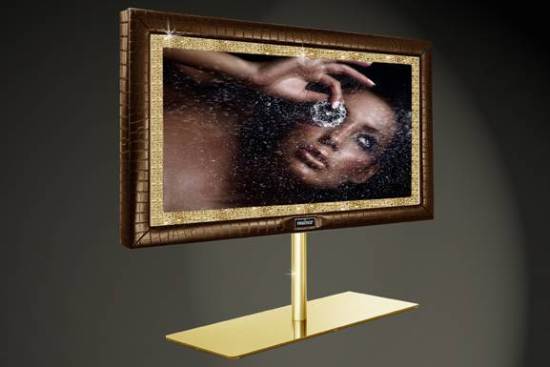
Nothing else in the television world touches this. The Prestige HD Supreme Rose Edition is, to be direct, more jewelry than TV — a 55-inch 4K OLED display encased in 28 kilograms of solid 18-carat rose gold, the external frame set with 72 round-cut 1-carat diamonds interspersed with sunstone and amethyst, the inner bezel hand-stitched in alligator skin. The electronics are supplied by German manufacturer Metz, and the design comes from Liverpool-based luxury customizer Stuart Hughes — the same studio that produced the world’s most expensive game console, a Wii covered in 2,500 grams of solid 22-carat gold.
At approximately $2.5 million (£2 million), the Rose Edition sits in an entirely different category from everything else on this list. It is not, primarily, a display device. It is a collectible — a bespoke luxury object that happens to include a television screen. The viewing performance is good, not extraordinary. The materials are what you are buying.
Source: Stuart Hughes / PrestigeHD. The companion model, the Prestige HD Supreme Edition (yellow gold, 48 diamonds, Aventurine and Topaz), is listed at approximately $1.5 million — still the third most expensive TV on this list on its own merits.
Titan Zeus — 370-inch 4K TV
The Titan Zeus is a fundamentally different kind of extraordinary. Where the Stuart Hughes piece is about opulence at a human scale, the Titan Zeus is about sheer, almost incomprehensible size. At 370 inches corner-to-corner — that is 26 feet wide by 16 feet tall — it is larger than a regulation football goal. It weighs nearly a ton. You need to sit at least 50 feet away for an optimal viewing distance.
UK-based manufacturer Titan Screens built it originally for Microsoft’s Xbox team, who wanted “the most beautiful gaming screen ever.” Only four units were produced. The Zeus supports 4K resolution and 65 million colors, features gesture control, and includes a panel format mode allowing viewers to watch 20 different channels simultaneously. It is designed for both indoor and outdoor use, with enough brightness to remain readable in direct sunlight. At $1.7 million — which includes installation, delivered in a customized Hummer — it’s bought by people who need a screen for events, private cinemas in genuinely enormous spaces, or who simply want to own something unprecedented.
C SEED N1 — Folding MicroLED (165-inch)
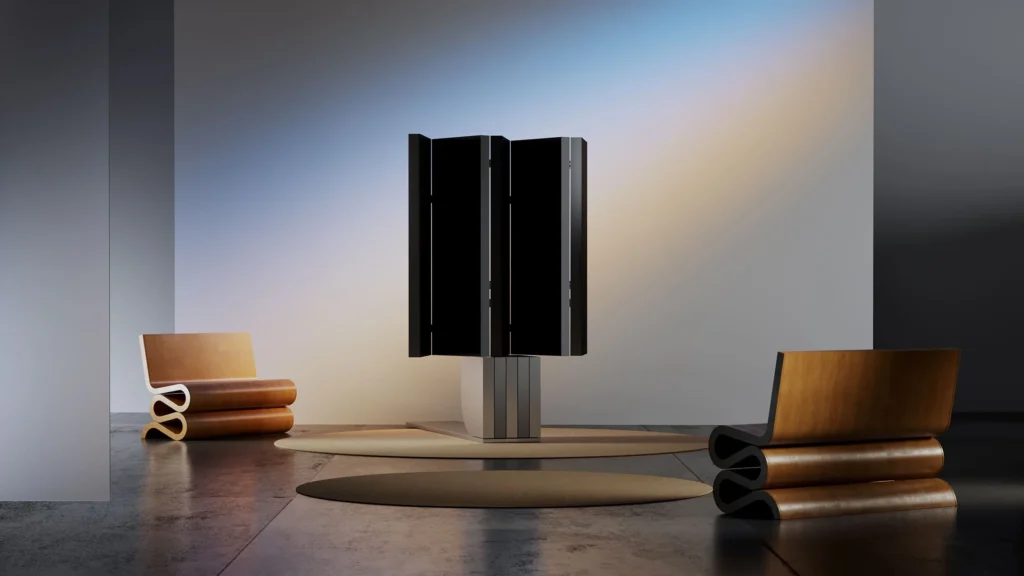
The C SEED N1 is the most technically interesting screen on this list — and arguably the only one that is simultaneously a technological achievement, a design object, and a functioning luxury television. Austrian brand C SEED builds screens for people who treat technology as architecture, and the N1 is the clearest expression of that philosophy.
When not in use, the N1 looks like a brushed aerospace-aluminum monolith — a floor-standing sculpture with the proportions of a minimalist credenza. Press a button and five MicroLED panels unfurl and rise over roughly 45 seconds, assembling themselves into a seamless 165-inch display. The mechanism is machined from aerospace-grade aluminum for an unrivalled stiffness-to-weight ratio, and C SEED’s proprietary Adaptive Gap Calibration system ensures the panel seams are visually imperceptible by intelligently adjusting pixel brightness on either side of each join.
The display itself is 4K MicroLED with 16-bit color processing, HDR10+ support, and a peak brightness of 1,000 cd/m². C SEED’s exclusive “Total Black” surface treatment eliminates glare and deepens contrast. The screen is rated for up to 100,000 hours of operation — nearly three times the typical OLED lifespan. An outdoor version (N1 Outdoor) is available with 4,000-nit brightness and IP65 weatherproofing for terraces and pool decks.
Prices start around $190,000 for the 103-inch version; the 165-inch model shown at CES 2024 was quoted at approximately $300,000. Each is made to order, with a roughly six-month lead time from order to delivery.
Sources: C SEED official product page; Digital Trends; CES 2024 trade coverage (Inverse, Stereoindex)
Samsung The Wall — Residential MicroLED (219-inch)
Samsung’s The Wall is a different animal from the C SEED — it’s a modular commercial MicroLED system that Samsung has gradually made available for residential installation, typically through specialist AV integrators. The pricing varies wildly depending on configuration and size, which is part of why it’s harder to pin down than the others on this list.
To understand the upper range of what The Wall can cost, consider the first documented residential installation in the US: AV integrator Video & Audio Center (Just One Touch) completed a 219-inch Samsung The Wall installation using the Model IW-008A — featuring a 0.84mm pixel pitch, HDR 2000, and true black technology — for a total project cost of approximately $800,000. The 146-inch all-in-one model is typically quoted around $100,000. Larger configurations can run $400,000 or more before installation.
Unlike the C SEED, The Wall is installed permanently — it’s not a freestanding sculpture but a genuine video wall. The image quality at close to zero pixel gap is stunning, and Samsung’s modular system means there is technically no maximum size. The Wall is modular by design, meaning it can be configured into custom aspect ratios, unusual shapes, or extremely large formats for dedicated home cinema rooms.
Source: CE Pro (September 2024 — first US residential installation). Samsung The Wall official page.
Loewe Stellar 97″ DR+ OLED
Loewe is a brand that operates on its own schedule. The German company began rolling out its flagship Stellar in November 2025, and it represents something unusual: a 97-inch OLED television that is engineered and assembled in Europe, at a price that would make most people flinch but that, in the context of this list, feels almost restrained.
The Stellar pairs an LG OLED panel with Loewe’s in-house processing and custom OLED modules. The result is a display with the deep blacks and vibrant color that OLED does best, presented in a brushed aluminum frame with the brand’s distinctive minimalist aesthetic. One exclusive feature worth noting: magic.light, a discreet ambient illumination system below the screen with customizable colors — Loewe’s version of the bias lighting that audiophile home cinema setups often add as an afterthought. Here, it is integrated into the product design from the start.
Source: BGR / Yahoo Tech, March 2026.
Bang & Olufsen Beovision Harmony 97″
Bang & Olufsen has been making luxury televisions since the 1960s, and the Beovision Harmony is their most evolved expression of what that means. The 97-inch model — using an LG OLED panel, which B&O is admirably transparent about — ships with perhaps the most theatrical integrated sound system of any television in existence.
The “wings” — two large speaker panels that fold out from either side of the screen when you power it on, unfolding like a butterfly opening — deliver 450 watts across a three-channel array, each with its own amplifier. The system supports up to 7.1 channel decoding and can wirelessly connect to eight additional Beolab speakers. When the TV is off, the wings close over the screen and the whole object becomes a sculptural furniture piece rather than a blank rectangle on a stand. The remote control is machined from a single piece of extruded aluminum.
Bang & Olufsen’s Bespoke Atelier service offers full customization of finishes, including wood types, aluminum tones, and combinations thereof. The $63,075 starting price is for the 97-inch standard configuration; custom finishes add to that.
Source: DuPont Registry; Bang & Olufsen official
Samsung Neo QLED 8K QN990F (98-inch)
This is the most “mainstream” entry on this list — if any $35,000 television can be called that — and arguably the one with the strongest case for a specific kind of buyer. The Samsung QN990F is the brand’s current 8K flagship, shipping with the NQ8 AI Gen 3 processor, Quantum Mini LED technology, and Samsung Vision AI.
The glare-free screen is a meaningful differentiator for bright living rooms. Dolby Atmos support is built in. The 8K resolution issue — there remains very little native 8K content available commercially — is addressed through Samsung’s AI upscaling, which processes 4K and 1080p source material. Whether that upscaling fully justifies the premium over an equivalently sized 4K set is a genuinely debated question among AV reviewers, and the honest answer is: not always. But for those who want the best Samsung makes in a conventional TV form factor, without committing to the complexity of a C SEED or The Wall installation, the QN990F is where you end up.
Source: BGR, March 2026; Samsung.com
“There is always a client for which money is no object. Don’t be afraid — let the client know what it costs, whether it is $800,000, $400,000 or $300,000. You always have to listen, qualify, and execute.”— AV integrator, Just One Touch / Video & Audio Center, following the first $800,000 Samsung The Wall residential installation (CE Pro, 2024)
Full Comparison Table
All prices are approximate and reflect starting configurations or documented transaction prices. Exchange rates reflect early 2026 figures.
| Model | Price (approx.) | Screen Size | Display Tech | What You’re Really Paying For |
|---|---|---|---|---|
| Stuart Hughes Prestige HD Supreme Rose Edition | $2,500,000 | 55″ | 4K OLED | 28kg rose gold, 72 diamonds, alligator skin |
| Stuart Hughes Prestige HD Supreme Edition | $1,500,000 | 55″ | 4K OLED | 19kg yellow gold, 48 diamonds, gemstones |
| Titan Zeus | $1,700,000 | 370″ | 4K LED | Sheer scale — 26ft × 16ft — and bespoke craft |
| C SEED N1 (165″) | ~$300,000 | 165″ | 4K MicroLED | Folding MicroLED mechanism, aerospace aluminum design |
| C SEED N1 (103″) | From $190,000 | 103″ | 4K MicroLED | Entry-point folding MicroLED sculpture |
| Samsung The Wall (219″ install) | ~$800,000 | Custom | MicroLED modular | Permanent installation, 0.84mm pixel pitch, HDR 2000 |
| Samsung The Wall (146″ All-in-One) | ~$100,000 | 146″ | MicroLED | Accessible MicroLED entry point |
| Loewe Stellar 97″ | $41,066 | 97″ | DR+ OLED | German engineering, magic.light, aluminum minimalism |
| Bang & Olufsen Beovision Harmony 97″ | $63,075 | 97″ | LG OLED | Folding speaker wings, 450W audio, Danish design |
| Samsung Neo QLED 8K QN990F (98″) | $34,999 | 98″ | 8K Quantum Mini LED | Flagship conventional TV — best Samsung makes |
Who Actually Buys These?
The honest answer is: fewer people than you might imagine, and from more varied backgrounds than you might expect. A 2025 Google Trends analysis of “luxury televisions” showed search spikes of 79–90 points between August and November 2025, correlated with product launches and holiday shopping — suggesting genuine consumer curiosity, even among people who will never make the purchase.
The actual buyers tend to fall into recognizable profiles:
Buys the C SEED N1 or Samsung The Wall because the technology is genuinely novel and they want the best of what currently exists. Often engineers, tech executives, or serious AV enthusiasts. The conversation is about MicroLED lifespans and panel seam calibration, not gold karats.
Sees the Bang & Olufsen Harmony or the Loewe Stellar as furniture. The TV must work with the space — in its off state as much as its on state. Buying a screen that vanishes into the room design is worth a $40,000–$60,000 premium over a conventional panel.
The Stuart Hughes buyer. This is not primarily a technology purchase. It is a collectible luxury object in the tradition of Patek Philippe watches or Hermès Birkin bags — the price signals exclusivity and the materials validate it. Viewing performance is secondary.
Buys the Titan Zeus or a large Samsung The Wall installation for a private cinema, resort, or entertainment venue. The scale justifies the cost when you are designing experiences for dozens of people simultaneously.
The luxury TV market is also deeply geographic. The Gulf states — UAE, Saudi Arabia, Qatar — represent a disproportionate share of ultra-high-end purchases, driven by high disposable incomes and a cultural tradition of displaying technological sophistication alongside material wealth. European buyers tend toward the engineering-led options (Loewe, Bang & Olufsen, C SEED), while US buyers are the primary market for Samsung’s large-format Wall installations.
Six Things Worth Knowing Before Spending Six Figures on a Screen
- 1 Installation cost is often not included in the quoted price. The Samsung The Wall requires certified professional installation, which adds meaningfully to the total cost. The C SEED N1, by contrast, is designed to be installed without structural wall modification — one of its practical advantages over the M1 predecessor.
- 2 8K content is still scarce. Samsung’s QN990F is marketed as an 8K television, and the processor upscales lower-resolution content — but native 8K remains largely absent from streaming platforms and broadcast. If this matters to you, the current 8K premium may not be worth it over a top-tier 4K OLED.
- 3 MicroLED lifespan is a genuine differentiator. True MicroLED displays like the C SEED N1 are rated for 100,000+ hours because inorganic LEDs don’t degrade the way organic OLED materials do. For a $200,000 purchase expected to last a decade or more, this is a real factor — not just a spec sheet number.
- 4 Precious-material TVs don’t hold value like precious metals. A Stuart Hughes set contains substantial quantities of gold and diamonds, but its resale value as a television is not linked to gold spot price in any straightforward way. These are luxury goods, not investments, despite how they are sometimes positioned.
- 5 Room design determines the right product entirely. A C SEED N1 requires a freestanding position with space for a 165-inch screen. Samsung The Wall requires a purpose-built viewing room and professional structural assessment. Bang & Olufsen’s Harmony can go almost anywhere but still needs 97 inches of wall clearance. Visit a showroom before ordering.
- 6 Lead times matter at this tier. The C SEED N1 takes approximately six months from order to delivery. The Stuart Hughes pieces are made to order with no standard timeline. Budget for this in any project planning, especially for new construction or renovation projects where the display is part of a designed room.
The Honest Verdict
The world’s most expensive televisions exist along two completely different axes. On one axis, you have screens where the price reflects genuine technological ambition — the C SEED N1’s folding MicroLED mechanism, Samsung’s modular Wall system, the engineering behind Bang & Olufsen’s theatrical audio integration. These things are expensive because they are genuinely hard to build and meaningfully better than alternatives. That’s a defensible value proposition.
On the other axis, you have screens where the price reflects material value and exclusivity — the Stuart Hughes pieces, with their gold and diamonds and alligator skin. These are not trying to be the best televisions. They are luxury objects that contain a television. That’s a different thing, and it’s worth being clear-eyed about the distinction before spending $1.5 million on a 55-inch screen that any $3,000 OLED would outperform technically.
The broader market context is genuinely optimistic for anyone interested in this space. MicroLED — the technology that currently requires a $190,000 minimum commitment — is on a commercialization curve that Omdia projects will grow from $52 million in panel revenue in 2025 to $6.8 billion by 2032. The premium segment that B&O and Loewe operate in is growing at a rate that outpaces the mass market. And as 75-inch-plus screens become increasingly mainstream, the boundary of what counts as “luxury” keeps moving upward. Today’s $35,000 Samsung flagship is a more capable display than anything that existed at any price five years ago.
That trajectory is, in its way, the most interesting thing about this market. The screens that cost $200,000 today will define the standard-tier products of 2035. They always have.
More from Most Expensives
Discover the world’s most extraordinary luxury objects, vehicles, and experiences.
The World’s Most Expensive Smartphones
Most Expensive Laptops 2025: RTX 5090 vs M4 Max—Where $5K–$7K Goes
These Yachts Cost More Than Private Islands — Here’s Why
The Most Expensive Jackets Ever Sold — Ranked by Verified Hammer Price
World’s Most Expensive Diamond Watches: Gems Worth Fortunes