
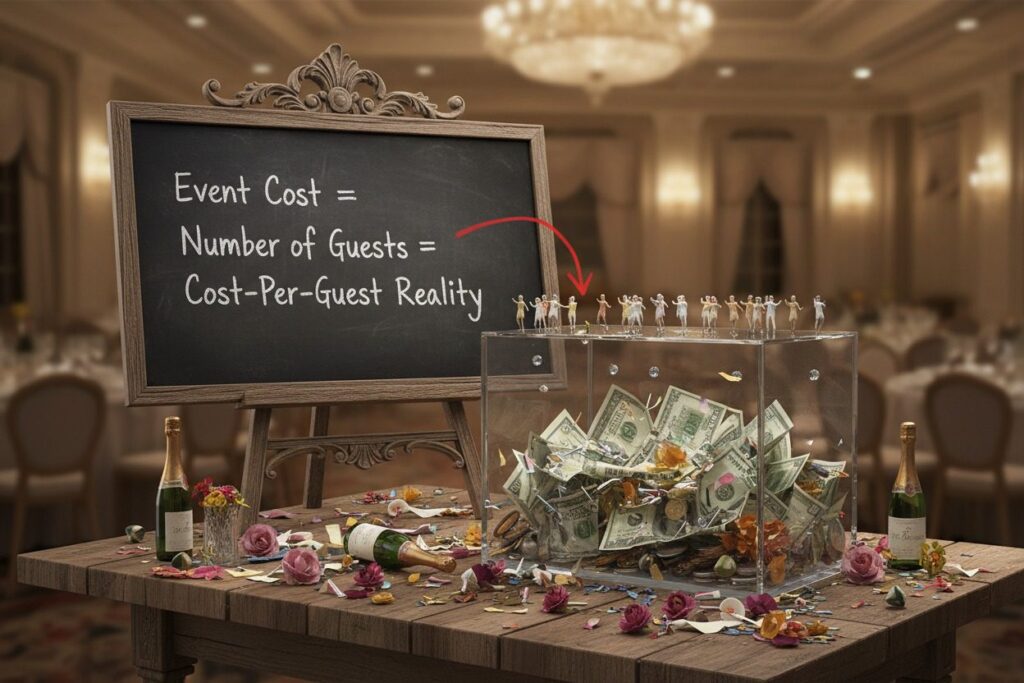


The Gap Between Headlines and Reality
In July 2024, as Anant Ambani and Radhika Merchant exchanged vows in Mumbai, the headlines proclaimed a new record: the “$600 million wedding.” Within weeks, estimates had spread from $132 million all the way to $1 billion. An $868 million spread on the same event. That’s not journalism — that’s speculation with a byline.
This is the problem with party cost coverage. No one uses a consistent methodology. Should airport construction count as “party cost”? What about the police security budget absorbed by the city? These aren’t pedantic questions — they’re the difference between $16 million and $635 million at Persepolis in 1971, or $20 million and $1.1 billion at Venice in 2025.
“The $1 billion party exists in headlines. The $600 million party exists in invoices. The $400 million gap between those numbers is where critical analysis lives — and where most coverage simply gives up.”
What follows is a ranked list built on a framework that’s transparent about what it includes and excludes. Every figure carries a confidence rating. Every “verified” claim has a named source. And when the honest answer is “we don’t actually know,” we say that — clearly, without dressing it up in false precision.
The Three Accounting Traps
These aren’t edge cases. They show up in almost every major event on this list — and they’re why published figures are all over the place.
When Does an Airport Count?
When the Shah of Iran built a new airport for Persepolis, official figures said $16.8 million. Time magazine said $100 million. Our rule: infrastructure built exclusively for the event and never used again counts. Permanent national assets don’t. This is where most of the Persepolis range ($16M–$635M) lives.
The Hidden 75%
Royal weddings routinely report ceremonial costs while omitting security absorbed into police budgets. Prince Harry’s 2018 wedding: widely cited at $45 million. The actual figure when you add $40 million in Metropolitan Police counter-terrorism costs? $54.9 million. We include all security triggered by the event, regardless of which ledger it hits.
CPI Alone Undercounts
A $27 million party in 1996 is not simply $27M plus CPI. Luxury event services — private aviation, bespoke security, celebrity talent — have outpaced general inflation by 40–60% since 1971. Our 2026 adjustment: base CPI multiplier plus a 40% luxury premium for services and 15% for goods. The final figure is higher than most published “inflation-adjusted” numbers — because it should be.
Every Figure on This List Gets One
The Verified Hierarchy
Sorted by best-estimate 2026-adjusted total. Where figures are disputed, we use the most defensible conservative estimate and note the range.
~$15–25M actually verified
This is the most-cited “most expensive wedding ever” on the internet. And it’s worth saying upfront: no official confirmation exists. The $1 billion figure comes entirely from Russian media speculation — TASS, RBC — based on visible elements at the wedding, not any documented invoice or financial disclosure.
What can actually be verified? Jennifer Lopez, Sting, and Enrique Iglesias performed. At industry standard rates for private events ($1–2M per artist), that’s roughly $6 million in talent. The venue transformation at Safisa banquet hall, the nine-tier cake, the floral walls — industry estimates put that at maybe $5 million. Fleet of Bentleys: $500K. The Elie Saab gown was later confirmed at $25,925 — not the “$1 million” widely reported. Total visible costs: $15–25 million.
So where does $1 billion come from? Best guess: the figure conflates the wedding itself with Mikhail Gutseriev’s concurrent business asset transfers to his son Said — the groom — and likely includes “political facilitation payments” typical of large Russian business transactions. $1B makes a better headline than $25M. Nobody fact-checked it. The number stuck.
We include this because it’s the dominant search result for “most expensive wedding.” But if your standard is verification, Gutseriev belongs closer to #5, not #1.
from $100M nominal (Time, 1971)
The Shah of Iran, Mohammad Reza Pahlavi, spent 1971 celebrating 2,500 years of the Persian monarchy. He invited 65 heads of state. Emperor Haile Selassie arrived with 72 personal attendants and a diamond-collared dog. The Shah’s own tent had a solid gold bathroom suite.
The figure debate alone is fascinating. Iranian government: $16.8 million (excluded infrastructure). Time magazine in 1971: $100 million (included logistics). Post-revolutionary claims: $200 million-plus, though those numbers were politically motivated inflation. Our $635M represents the Time figure brought to 2026 using a luxury-adjusted CPI multiplier — it’s the most honest upper-bound available.
Maxim’s of Paris shut down for two weeks. Eighteen tons of food and twelve tons of wine flew in from France. The “tent city” was actually 50 acres of climate-controlled luxury suites with an 18-hole golf course embedded in the desert. Sixteen hair salons. Four beauty parlors with Parisian stylists. Three hundred wigs. This is what it looks like when a government decides to throw a party.
The historical consequence is stunning. Within eight years, the Shah was deposed. Ayatollah Khomeini explicitly cited Persepolis as evidence of imperial decadence in his revolutionary rhetoric. The party didn’t just spend money. It spent political legitimacy. Worst ROI in this entire list.
range: $400M–$800M
The most expensive private party we can actually document with something resembling evidence. The $600 million figure — conservative estimate, not headline — comes from vendor leaks, aviation tracking of over 100 private jets, and confirmed performer fees. It’s not precise. But it’s the most defensible number in the range.
The Indian media estimate of $1 billion gets cited constantly and it’s wrong. That figure incorrectly folds in Jamnagar airport upgrades and road construction that serves the Ambani refinery operations — permanent capital investments that had nothing to do with the wedding. Strip those out and you land at $600M, maybe $700M on a generous interpretation.
What $600 million actually bought: Rihanna at the pre-wedding celebration in March ($9 million). A Mediterranean cruise with Katy Perry and the Backstreet Boys ($150 million estimated). Justin Bieber performing at the main wedding ($10 million). One million flowers. Sixty animal sculptures. Complete transformation of Jio World Centre. Luxury watches worth $200,000 each gifted to VIP guests. Security involving facial recognition, 3 Falcon-2000 jets on retainer, and 100+ private aircraft logistics. Cost per guest: $500,000 — for 1,200 people.
66% was security
750 million people watched on television. 3,500 guests in person. And $110 million — two-thirds of the entire budget — went to security. That’s the royal wedding math that nobody talks about: the ceremony is almost incidental to the protection apparatus around it.
The 1981 figures, adjusted with luxury premium to 2026, land at about $166 million total. That makes it the most expensive royal wedding in real terms — though Prince Harry’s 2018 wedding was actually more expensive per head, because security costs have exploded post-9/11 and 7/7 while guest counts dropped. Diana’s dress, the flowers, the cake — all relatively modest in the context of what it cost to keep 3,500 people safe in central London while 750 million watched globally.
from $55M certified nominal
This is the only event on this entire list where an independent body — Guinness World Records — audited the cost. The $55 million figure is certified. Everything else on this list involves some degree of estimation. The Mittal wedding is the gold standard for event cost documentation.
What $55 million (about $94 million today) actually bought: the Palace of Versailles — the first time it was ever rented for a private event. Twelve private jets flying 1,000 guests from India. The Hotel le Grand Intercontinental reserved entirely. A $1.5 million wine bill. Kylie Minogue performing privately. Invitations delivered in silver-plated booklets costing $2,000 each. Eiffel Tower fireworks. And it all worked out to $55,000 per guest — remarkable efficiency at this scale.
For context: the Bezos Venice wedding ($50 million) delivered comparable luxury at 200 guests, meaning Bezos paid $250,000 per person — 4.5x less efficient than Mittal. Scale matters enormously when you’re this far up the wealth ladder.
from $27M nominal (Reuters, 1996)
The Sultan of Brunei hired Michael Jackson for his 50th birthday. That alone — $15–17 million for three private concerts at a custom-built 60,000-seat amphitheater (Jerudong Park) — is one of the largest entertainment fees ever paid for a single event. The total: $27 million in 1996 dollars, documented by Reuters and later by the South China Morning Post.
This is also, mathematically, one of the most efficient mega-parties ever hosted. Sixty thousand people attended the Jackson concerts. Divide $27 million by 60,000 and you get $450 per attendee — cheaper than many major music festivals. The private dinner for 3,000 at Istana Nurul Iman (the Sultan’s 1,778-room palace) cost roughly $17,667 per head — comparable to a top-tier modern luxury wedding.
The party lasted 14 days. Prince Charles played polo there. The Sultan reportedly had a helicopter deliver a boot mid-match when the Prince lost one. That detail tells you everything about the hospitality standards involved.
Forbes: $20–25M · Veneto govt: $46–56M
The initial rumors said $600 million. Bezos denied it. A Forbes investigation then established the actual range at $20–25 million based on itemized vendor rates — Aman Venice buyout ($900K), 30 water taxis ($270K), Quattro Passi catering ($1.1M), security ($2–3M), Murano glass gifts ($100K). The $46–56 million figure from Veneto’s regional government includes economic impact modeling, not just event costs.
Italy’s Ministry of Tourism claimed a $1.1 billion “economic impact” from the wedding. That number is advertising equivalency valuation — the estimated media coverage value, not money spent. It is not a party cost. It’s a PR metric dressed up as an economic figure. Don’t cite it as the wedding cost. Unfortunately, many outlets did exactly that.
The Venice protest angle is worth noting: Bezos chose one of the world’s most anti-overtourism cities for a 200-person billionaire wedding. Protests materialized. Security was significant. The tension between private celebration and public space in a UNESCO World Heritage site is genuinely interesting — and it drove some of the security costs that pushed the number above $20 million.
Highest verified CPG in history
This one’s different from everything else on this list. The price was publicly advertised — not estimated, not leaked, not speculated. Two million dollars for two people. One million per person. That makes it the highest verified cost-per-guest of any event in recorded history.
What did it actually include? An 8-hour experience starting with a 45-minute helicopter tour of Singapore, a chauffeured Rolls-Royce, a private luxury yacht cruise, and then dinner at CÉ LA VI on the 57th floor of Marina Bay Sands: 10,000 fresh roses, an 18-course Modern Asian degustation menu, 44- and 55-year-old vintage wines, diamond-encrusted chopsticks engraved with the diners’ names, a custom furniture piece, fireworks at midnight, and Louis XIII cognac.
And the kicker: a 2.08-carat Fancy Vivid Blue diamond ring — the Jane Seymour — valued at $2 million and included in the price. Meaning you’re effectively paying $0 for the experience and $2M for the ring. Or $1M for each. The accounting is wonderfully absurd.
Cost Per Guest — Where the Real Story Lives
Total cost obscures everything. When you normalize for attendance, the hierarchy flips dramatically — and the “most expensive” events often turn out to be the least efficient by a factor of 4x or more.
| Event | Total Cost (2026 adj.) | Guests | Cost Per Guest | Efficiency | Confidence |
|---|---|---|---|---|---|
| World of Diamonds Dinner | $2M | 2 | $1,000,000 | — | ★★★★★ |
| Gutseriev Wedding (alleged) | $1.31B | 600 | $2,183,000 | low | ★★☆☆☆ |
| Persepolis 1971 | $635M | 500 | $1,270,000 | low | ★★★☆☆ |
| Ambani Wedding 2024 | $615M | 1,200 | $512,500 | medium | ★★★★☆ |
| Bezos-Sánchez 2025 | $50M | 200 | $250,000 | low | ★★★☆☆ |
| Prince Harry Wedding 2018 | $54.9M | 600 | $91,500 | medium | ★★★★☆ |
| Mittal-Bhatia 2004 | $94M | 1,000 | $94,000 | high | ★★★★★ |
| Charles & Diana 1981 | $166M | 3,500 | $47,429 | high | ★★★★☆ |
| Sultan of Brunei 1996 | $53M | 60,000 | $883 | exceptional | ★★★★☆ |
CPG for Sultan of Brunei includes 60,000 concert attendees. The private dinner (3,000 guests) would be ~$17,667/head — a very different figure.
Why Royal Weddings Are Different
Security consumes 66–75% of royal wedding budgets. Understanding that changes how you interpret the cost comparison with private billionaire events entirely.
Charles & Diana
1981 · London ~$166MWilliam & Kate
2011 · London ~$48MHarry & Meghan
2018 · Windsor ~$54.9MMyth vs. Reality
Three Scenarios for Extreme Celebration
The $2 Billion Wedding
Likely by 2028–2030 if wealth concentration continues at current rates (top 0.001% net worths growing ~12% annually) and competitive escalation continues between Indian and Gulf billionaires. Would require 5,000+ guests, $100M+ talent budget, permanent venue construction, and pre-event infrastructure that actually belongs to the event. Barrier: ESG scrutiny and tax authority attention at this scale.
Regulatory Compression
Most likely baseline. Luxury event taxes (15–20%) in the EU, India, and UK; carbon tariffs on private aviation; stricter enforcement of gift tax rules on event favors. Result: maximum event costs plateau at $800M–$1.2B nominal, with anything above $200M requiring public justification or facing penalty taxation. The mega-wedding doesn’t disappear — it gets taxed.
Social License Collapse
Venice was a preview: protests disrupted the Bezos wedding logistics. If climate crisis acceleration combines with “flight shaming” targeting ultra-wealthy events, vendor boycotts and security risks could make $500M+ events genuinely difficult to execute. Shift toward stealth wealth: 50–100 guests, local sourcing, virtual attendance for peripheral guests. Maximum costs drop 40–60% by 2030.
The most expensive parties in history are economic indicators as much as celebrations. Persepolis ($635M) marked peak oil-state confidence — before the Iranian Revolution. The Mittal wedding ($94M) signaled India’s arrival as a luxury market. The Ambani celebration ($600M) demonstrates wealth concentration now exceeding 1970s petrostates in absolute dollars, if not proportional terms.
The Gutseriev case remains the cautionary one. Without verification, media speculation creates “records” that become self-referential truth. Our $600M Ambani figure may itself be inflated — future documentation could adjust it downward. The $400M of uncertainty in that range is where critical analysis lives, and where most coverage simply stops asking questions.
— Analysis: The National (2024), Reuters (2024), Forbes (2025), Guinness World Records (2004), Waddingtons (2023)FAQ
What is the most expensive party ever held?
How much did the Ambani wedding actually cost?
Was the Gutseriev wedding really $1 billion?
What is the most expensive dinner party ever?
Why are royal weddings so expensive — isn’t it mostly the dress and flowers?
What does “cost per guest” tell you?
References
Most Expensive Dresses: Best Guide 2026
Top 10 Most Expensive Cruise Ships Ever Built
Inside a $500 Million Superyacht: What Pure Luxury Actually Looks Like
World’s Most Expensive Gold Smartphones in 2025: The Pinnacle of Luxury
The World’s Most Expensive Vacations: What Each One Actually Costs
These Yachts Cost More Than Private Islands — Here’s Why
Most Expensive Castles: Best Guide 2026
Lucid Burns $176,000 Per Vehicle Producing Ultra-Luxury EVs. Nobody Buys
Leave a Reply