MostExpensives.com · Luxury & Rarity
The World’s Most
Expensive Diamonds
Priceless Treasures
From a $71.2 million pink stone the size of a strawberry to ancient blue gems once worn by French kings — the real story behind the prices, the geology, and the obsession.
The most expensive diamonds in the world do not cost what they cost because they are pretty. They cost what they cost because they are essentially impossible to replicate, because the geological conditions that created them stopped existing hundreds of millions of years ago, and because the humans who found them, cut them, and sold them at auction attached stories to them that have a value entirely separate from the carbon itself.
That distinction matters. You cannot understand a $71 million price tag on a pink diamond by staring at its color chart. You understand it when you realize the mine that produced most of the world’s fancy pink diamonds — Rio Tinto’s Argyle operation in Western Australia — closed permanently in November 2020, meaning the supply of new material ended entirely. What exists now is all that will ever exist. That is not a sales pitch. That is geology.
This guide covers every category of record-setting diamond: the ones that broke auction records, the ones whose value can never be calculated because a government owns them, and the geological principles that separate a $2,000 stone from a $2 million one. We have also included the market context as of mid-2026, because the fancy-color diamond investment landscape has shifted meaningfully since 2020.
Why a Diamond Costs What It Costs: The 4Cs Are the Beginning, Not the Explanation
The Gemological Institute of America introduced its 4C framework — Cut, Color, Clarity, Carat — in 1953. It remains the standard grading language. But for the stones at the top of this list, the 4Cs are table stakes. What separates a $500,000 stone from a $50 million stone is something the GIA grades but cannot fully quantify: the simultaneous achievement of excellence across all four dimensions at an extraordinary scale, in a color that is essentially mythological in its rarity.
Cut
For colorless diamonds, cut determines roughly 40% of perceived value — it controls the fire and brilliance. For fancy-color stones, cut is subservient to color: cutters sacrifice yield and symmetry to maximize color saturation. The Oppenheimer Blue’s emerald cut, for example, was chosen specifically to deepen the blue.
Color
In colorless diamonds, less color means more value (D through Z). In fancy colors, the equation inverts: more saturated, purer color means exponentially more value. “Fancy Vivid” is the GIA’s highest color grade — only a fraction of colored diamonds earn it. Both the Pink Star and the Oppenheimer Blue carry it.
Clarity
Internally Flawless (IF) is the highest clarity grade a stone can receive. Both the Pink Star and the Williamson Pink Star are internally flawless — nature produced not a single visible inclusion in stones of 59.6 and 11.15 carats respectively. The probability of this, at those sizes, approaches zero.
Carat
Price does not scale linearly with carat weight; it scales exponentially. A 10-carat stone does not cost 10 times a 1-carat stone of identical quality. It can cost 50–100 times more because large rough crystals of gem quality are vanishingly rare. At 59.6 carats, the Pink Star is a geological anomaly.
There is a fifth factor the 4Cs do not capture: Type classification. The GIA classifies diamonds as Type Ia, Ib, IIa, or IIb based on their nitrogen content. Type IIa diamonds contain virtually no nitrogen impurities — they represent approximately 1–2% of all gem diamonds and include most of the world’s largest and most famous colorless stones. The Pink Star, the Oppenheimer Blue, and the Graff Pink are all Type IIa or IIb. This classification alone acts as a quality signal that pushes bids into territory that would otherwise seem irrational.
The 10 Most Expensive Diamonds Ever Sold at Auction
These are confirmed auction results. No estimates, no approximations. The buyer’s premium is included in each sale price where applicable.
The Diamonds, Up Close
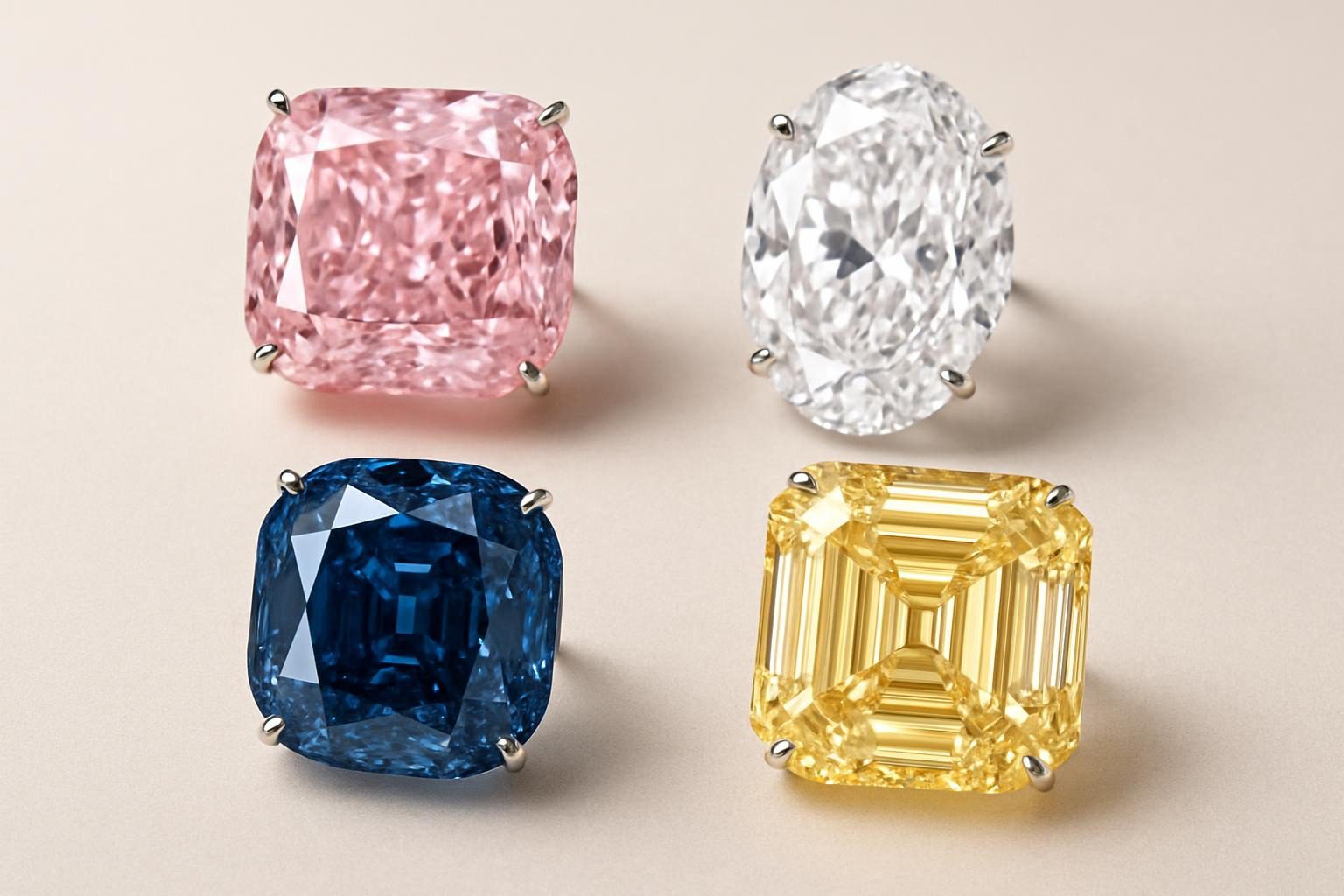
De Beers found the 132.5-carat rough in Africa in 1999. Two years of cutting and polishing produced this 59.6-carat oval — the largest Fancy Vivid Pink the GIA has ever graded. Chow Tai Fook purchased it and renamed it CTF Pink Star in memory of their founder’s father. Still the highest price ever paid for any diamond or gemstone at auction. The pink diamonds supplying 80–90% of the world’s supply came from one mine. That mine closed in 2020.
Mined at Tanzania’s Williamson mine — historic for its exceptional pink output — the rough weighed 32.32 carats. At $5.17 million per carat, this broke the per-carat record for a pink diamond at the time of sale. The GIA described it as “amongst the rarest of all gemstones.” A stone roughly the size of a hazelnut, priced like a yacht.
Named for Sir Philip Oppenheimer of the De Beers dynasty, this is the largest Fancy Vivid Blue emerald-cut diamond ever to appear at auction. After a 20-minute telephone bidding war, an anonymous buyer acquired it. Christie’s specialist François Curiel described it plainly as “one of the rarest gems in the world” — not marketing language; a technical observation about the frequency of Fancy Vivid Blue stones at this size. This stone is returning to Christie’s Geneva in November 2025.
Discovered in 2021 at the legendary Cullinan Mine in South Africa — the same mine that yielded the Cullinan I — this stone set a record price per carat for any blue diamond at $3.8 million per carat. Its provenance (a mine responsible for more historic diamonds than any other on Earth) and its IIb typing were the decisive factors. The Oppenheimer family’s connection to Cullinan adds a quiet layer of historical irony given the diamond ranked one position above it.
Originally owned by the Oppenheimer family and later purchased by Harry Winston, who renamed it the Pink Legacy. The $2.6 million per-carat price was a record at the time for this size and color classification. The rectangular cut is unusual for a vivid pink — most are cut to maximize color, which typically favors ovals and cushions. The decision to maintain a modified rectangular shape while preserving Fancy Vivid color is a cutting achievement that itself contributed to the price.
Discovered in South Africa in January 2014, this 12-carat stone set the record for highest price per carat at auction for any diamond at the time: $4 million per carat. Hong Kong billionaire Joseph Lau purchased it and named it after his seven-year-old daughter. The same buyer also purchased the Sweet Josephine pink diamond for his daughter at the same auction season. When a buyer names two diamonds after his seven-year-old at the same auction event, you understand the psychology driving prices at this level.
Previously owned by Harry Winston and sold to a private collector in the 1950s, this 24.78-carat stone resurfaced at Sotheby’s Geneva in 2010. Laurence Graff — the jeweler known as “the King of Diamonds” — purchased it, re-cut it to improve its brilliance, and renamed it. Graff later purchased the 1.56-carat Argyle Phoenix red diamond in 2024 for a record per-carat price for a red diamond. The man does not buy diamonds quietly.
Orange diamonds are rarer than pink or blue — there is no established mine known to produce them reliably. This 14.82-carat stone, whose origins are undisclosed, set the world record for price per carat for any colored diamond at the time of its 2013 sale. It remains the largest Fancy Vivid Orange diamond ever offered at auction. The buyer was anonymous. No other orange diamond of similar quality has surfaced since.
The largest pear-shaped pink diamond ever sold at public auction, purchased by an anonymous Asian buyer. The pear cut is technically demanding for fancy-color stones; the graduated thickness from the rounded base to the point creates color distribution challenges that cutters spend months solving. A stone that achieves Fancy Vivid in pear form is telling you something about the intensity of its original color.
The Mellon Blue was the first diamond to break the $3 million per-carat barrier for a blue stone — described by Christie’s specialist Fawcett as a defining market moment. It returns to auction at Christie’s Geneva in November 2025, making it one of the most watched blue diamond sales of this auction season. What it achieves at resale will be a direct indicator of where the blue diamond market sits post-pandemic, post-economic volatility.
All Top Auction Results at a Glance
| # | Diamond | Color | Carats | Sale Price | $/ct | Year | Auction House |
|---|---|---|---|---|---|---|---|
| 1 | CTF Pink Star | Fancy Vivid Pink | 59.60 | $71.2M | $1.19M | 2017 | Sotheby’s HK |
| 2 | Williamson Pink Star | Fancy Vivid Pink | 11.15 | $57.7M | $5.17M | 2022 | Sotheby’s HK |
| 3 | Oppenheimer Blue | Fancy Vivid Blue | 14.62 | $57.5M | $3.93M | 2016 | Christie’s Geneva |
| 4 | De Beers Cullinan Blue | Fancy Vivid Blue | 15.10 | $57.4M | $3.80M | 2022 | Sotheby’s HK |
| 5 | Pink Legacy | Fancy Vivid Pink | 18.96 | $50.4M | $2.60M | 2018 | Christie’s Geneva |
| 6 | Blue Moon of Josephine | Fancy Vivid Blue | 12.03 | $48.4M | $4.02M | 2015 | Sotheby’s Geneva |
| 7 | Graff Pink | Fancy Intense Pink | 24.78 | $46.2M | $1.86M | 2010 | Sotheby’s Geneva |
| 8 | The Orange | Fancy Vivid Orange | 14.82 | $35.5M | $2.40M | 2013 | Christie’s Geneva |
| 9 | Unique Pink | Fancy Vivid Pink | 15.38 | $31.6M | $2.05M | 2016 | Sotheby’s Geneva |
| 10 | Mellon Blue | Fancy Vivid Blue | 9.51 | $32.6M | $3.43M | 2020 | Sotheby’s NY |
All prices include buyer’s premium. Sources: Sotheby’s, Christie’s, Guinness World Records, Natural Diamond Council.
The top 10 most expensive diamonds ever sold are almost exclusively pink or blue. That is not a coincidence. It is a consequence of geology, mine closures, and the rarest intersection of all four quality dimensions at once.
The Diamonds Nobody Can Buy: Historic Stones Beyond Price
The most discussed diamonds in the world are not the ones that sold for $71 million. They are the ones that cannot be sold at all — state property, crown jewels, national institutions. Their value is not zero because no price exists; their value is incalculable because their meaning exceeds their material composition.
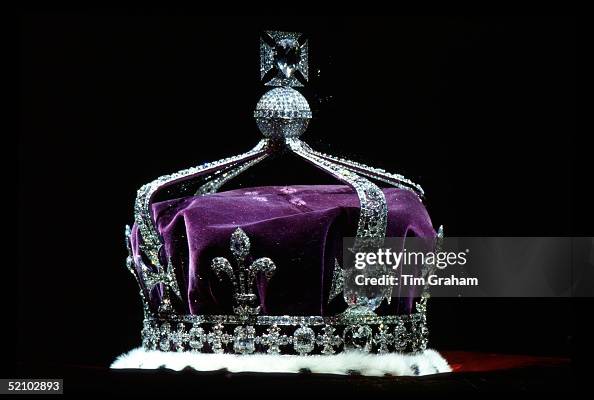
The Koh-i-Noor — “Mountain of Light”
Known since at least 1304 in the possession of the Rajahs of Malwa, the Koh-i-Noor has passed through the hands of Mughal emperors, Persian shahs, Sikh maharajas, and the British Crown. The 5th Mughal Emperor Shah Jahan placed it in the Peacock Throne as the eye of the peacock. It now rests in the Tower of London as part of the British Crown Jewels, set in the crown made for Queen Elizabeth the Queen Mother. India, Pakistan, Afghanistan, and Iran have all made formal requests for its return. The British government has declined each one. Current estimated value: no credible market figure exists. The stone itself weighs 105.6 carats after being recut from its original 186 carats by Prince Albert’s lapidaries in 1852 — a cut that reduced its weight by 43% but increased its brilliance.
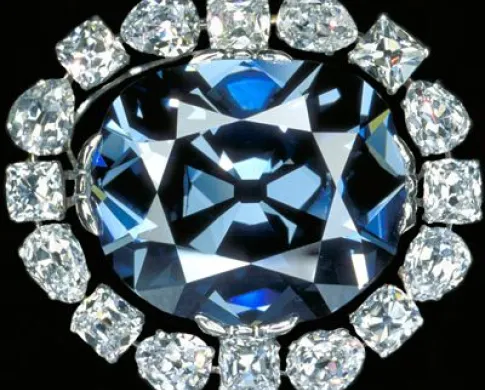
The Hope Diamond — 45.52 Carats of Blue and Mythology
The story begins in 17th-century India, almost certainly at the Kollur mine in Golconda — the same region that produced the Koh-i-Noor. French merchant Jean-Baptiste Tavernier sold the original 112-carat blue rough to Louis XIV in 1668, who had it cut to a 69-carat gem called the French Blue. It disappeared during the French Revolution’s chaos of 1792 and resurfaced in London decades later, recut again to its current 45.52-carat form. The “Hope” name comes from banking heir Henry Philip Hope, who owned it in the 1830s. Harry Winston purchased it in 1949 and donated it to the Smithsonian in 1958, where it has remained ever since — the most visited gemstone in the world. Current appraisal estimates range from $200–$350 million, though that number is essentially a thought experiment.
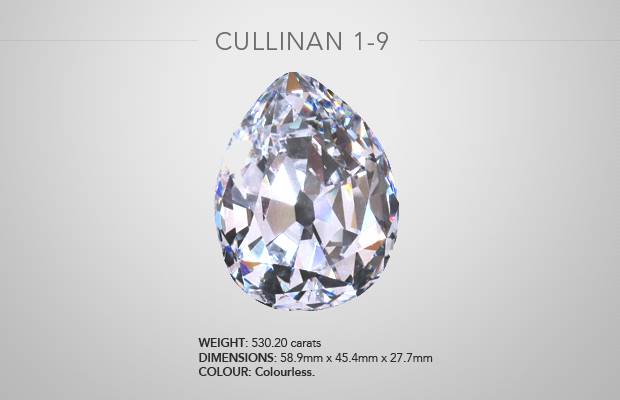
The Cullinan — One Stone Became a Crown
Found at the Premier Mine in South Africa in 1905, the Cullinan rough weighed 3,106 carats — larger than anything geologists thought possible for gem-quality diamond material. It was cut into 105 separate stones. Cullinan I (the Great Star of Africa, 530.4 carats) is mounted in the Sovereign’s Sceptre. Cullinan II (317.4 carats) sits in the Imperial State Crown. If the original rough had remained intact and come to market today, conservative estimates place its value in excess of $2 billion. As distributed across royal jewels and private ownership, the combined value is estimated at approximately $400 million — though that number is essentially meaningless, since these stones will never enter the market.
The Regent Diamond — 140.64 Carats in the Louvre
Mined in India in 1698 and purchased by Philippe II, Duke of Orléans in 1717 for the French Crown, the Regent Diamond is a 140.64-carat cushion-brilliant cut now on display at the Louvre. Napoleon Bonaparte had it mounted on his sword hilt. It survived the French Revolution. Its 2025 estimated value is $60 million — making it one of the few historical diamonds with a credible modern valuation, though it has not traded in over 300 years.
Fancy-Color Diamonds as Investment Assets: The 2025–2026 Picture
The fancy-color diamond market in 2025 demonstrated something unusual for luxury assets: stability during a period of broad economic volatility. While equity markets and even other hard assets saw double-digit swings, the FCRF’s data showed overall fancy-color prices declining by approximately 1% annually — a figure that, in context, represents remarkable resilience.
The longer-term data is more compelling. Pink diamonds have delivered approximately 394% returns since 2005, against the S&P 500’s roughly 230% in the same period. Only 1 in 10,000 diamonds mined carries a fancy color. GIA-certified stones command 20–30% higher prices even in downturned markets. Blue diamonds at auction continue to achieve $2–4 million per carat at the top end.
Lab-grown diamonds now hold approximately 45% of the bridal market and their prices continue falling. But lab-grown colored diamonds have not materially impacted the natural fancy-color market — the rarity premium is precisely the point. A collector paying $10 million for a pink diamond is not buying a colored stone. They are buying geological scarcity that took billions of years to create and that ended when the Argyle mine closed.
A Timeline of Record-Breaking Diamond Sales
The Questions Most Articles Don’t Answer
What the Price Is Actually Buying
The easy answer is rarity. The fuller answer is compressed time. When you pay $71 million for a 59.6-carat pink diamond, you are paying for the following: a carbon atom subjected to temperatures above 1,000°C and pressures above 50,000 atmospheres, roughly 500 kilometers beneath the Earth’s surface, between 1 and 3 billion years ago. A kimberlite eruption violent enough to transport it to a depth humans could mine. Two years of cutting by craftsmen who had one chance to get it right. A market where the primary supply source closed permanently in 2020. And a room full of bidders who understood, faster than most people’s mortgages process, that nothing else like it would ever exist.
That is not irrational. That is the most literal possible application of supply and demand to a physical object.
The discomforting implication: as the post-Argyle era extends further and the existing inventory of exceptional natural pink diamonds passes between private collections with decreasing frequency at auction, the price gap between what these stones sold for between 2015 and 2022 and what they will sell for in 2030 and beyond is probably not going to close. There is no new supply. There is only inheritance.
Auction result data: Sotheby’s · Christie’s · Phillips.
Color and grading standards: Gemological Institute of America (GIA).
Market price indices: Fancy Color Research Foundation (FCRF).
World record confirmation: Guinness World Records.
Natural diamond context: Natural Diamond Council.
Hope Diamond: Smithsonian Institution.
Most Expensive Rings in the World 2026: The $71.2M CTF Pink Star Still Reigns – Ranked by Verified Auction Records
World’s Most Expensive Diamond Watches: Gems Worth Fortunes
The Most Expensive Rings in the World: The Real Pricing Framework Behind Record-Breaking Stones
The 15 Most Expensive Necklaces in the World: Verified Records & 2025 Market Reality
The 25 Most Expensive Earrings in the World: Auction Records, Market Dynamics, and Valuation Challenges
Leave a Reply